


The meeting was an exclusive opportunity to gain first-hand knowledge about the guidelines of modern lighting design and lighting for cities: Roger Narboni stands at the origins of the formation of lighting design as such, it was he who began to use the definition of "lighting designer" and developed the methodology of this field.
His studio Concepto began operating in 1988. Narboni is one of the founders of the French Association of Lighting Designers and Technicians, and has been a member of the French Union of Lighting since 1992.

Roger Narboni, expert in light urbanism, founder of the French studio Concepto. Photo: Maksym Drobinenko
Over the years, Roger Narboni has created a unique collection of projects that have transformed urban spaces and landscapes around the world: from cities and monuments in China, Brazil, the Middle East, North Africa to the lighting of Jerusalem, Athens, Paris. He is the author of 150 lighting master plans for cities and the creator of the concepts of Nocturnal urbanism and Dark infrastructure. The expert emphasizes the importance of darkness and the dark time of day as a natural part of the life of all beings, on the development of lighting solutions for cities and environments that would support ecological, caring night scenarios.

Mykola Kabluka, lighting designer, founder and art director of Expolight and Kabluka Light & Digital Sculptures. Photo: Maksym Drobinenko
Mykola Kabluka — lighting designer, founder and art director of Expolight and Kabluka Light & Digital Sculptures, is a frontman of an innovative approach to lighting for architecture, infrastructure facilities, spaces, light installations and performances in Ukraine and abroad.
With 25 years of experience working with light, for more than 10 years he has represented Ukraine in such international associations of lighting designers as IALD (International Association of Lighting Designers) and IES (Illuminating Engineering Society).
In projects, experts from Expolight and Kabluka Light & Digital Sculptures collaborate with leading foreign architectural and design practices: Zaha Hadid, UNStudio, driendl*architects, AVRO|KO, city and country governments, key architectural and design bureaus of Ukraine - YOD Studio, balbek bureau, YODEZEEN, Archimatika, MAKHNO Studio, Yakusha Design and others.
Last year, Expolight received 6 awards and 13 distinctions from the international LIT Lighting Design Awards.
Roger Narboni's visit to Ukraine and his participation in the development of the lighting master plan for the Dnipro River were made possible thanks to the private initiative of Mykola Kabluka.

Olena Shulyak, Chairwoman of the Verkhovna Rada Committee on Organization of State Power, Local Self-Government, Regional Development and Urban Planning, Chairwoman of the Servant of the People Party. Photo: Maksym Drobinenko
Olena Shulyak: "Light for all of us is the personification of hope, resilience, this was especially felt during the recent blackouts that the country experienced"
The meeting was opened by the editor-in-chief of PRAGMATIKA.MEDIA Konstantin Kovshevatsky, the guest of the event was also Olena Shulyak, Chairman of the Verkhovna Rada Committee on the Organization of State Power, Local Self-Government, Regional Development and Urban Planning, Chairman of the Servant of the People party, who addressed the audience with a welcoming speech.

Editor-in-chief of PRAGMATIKA.MEDIA Kostyantyn Kovshevatsky. Photo: Maksym Drobinenko
Olena Shulyak says: "Light for all of us is the embodiment of hope, resilience, especially during the recent blackouts the country has experienced. She noted the selfless work of energy workers and specialists who worked to restore the networks."
"I am not only the head of the specialized committee, but first of all, a Kyiv resident and I really want our city to be fantastic, to develop now and after the war ends, during the recovery period. I want the best world practices, with the experience they have gained in different countries of the world, to unite with our best specialists and restore Ukrainian cities and communities. To make them better, energy-efficient, and energy-independent."
The evening consisted of three parts: in the first and second parts, Mykola Kabluka and Roger Narboni gave a retrospective of the most important and characteristic projects of their creative path. Then they presented the results of a week-long workshop. City Light Masterplan regarding the concept of city lighting, which took place in Dnipro.
Speech by Mykola Kabluka
Mykola Kabluka: “Lighting Master Plan — "an important study that allows you to feel the city. In Eastern Europe there is still no city lighting master plan, but this is common practice for the rest of the world."
Mykola Kabluka noted that the collaboration with lighting designer Roger Narboni was supposed to begin in the spring of 2022 on a comprehensive project for Mariupol, but the full-scale war and the disaster it brought destroyed these plans. He thanked Narboni for his support and for the fact that, despite the concerns about the security situation, he visited Ukraine for a long visit and took part in the team work in Dnipro.
The Ukrainian lighting designer emphasized that lighting master plans are a common practice in developed European countries and the New World during the transformation of spaces and the development of urban development strategies.
“Lighting master planning is part of architectural and lighting design. It’s not just about lighting, but about what creates the city environment. Why do some cities, like Paris, look and feel complex? At first you don’t pay attention to it, but it’s all about the hierarchy of light, about adhering to the design code for all elements of the city’s lighting environment: the lighting of roads, pedestrian zones, parks, architectural structures, dominants, and monuments,” says Mykola Kabluka.
He added: lighting design is crucial for modern conceptual works and projects involving complex forms, one of the first to understand this was Sir Norman Foster, who began involving lighting specialists in his architectural projects back in the 1970s.

Mykola Kabluka told the audience about the role of light in modern architectural and spatial projects and the tasks that lighting designers work with. Photo: Maksym Drobinenko
Light affects not only the physical world of living beings, but also participates in the formation of impressions and complex experiences.
Mykola Kabluka explained to the audience the principles of architectural lighting design and the tasks assigned to modern lighting. This is about both the functions for spaces and the emotional experience of their users. He also spoke about the influence of the physical characteristics of light on all living things and its role in forming impressions, complex experiences, catharsis, which was noted and used by masters of the past and present, for example, architects Tadao Ando and Daniel Libeskind, and Ukrainian painter Arkhip Kuindzhi. He mentioned the memorial object - the unique wooden synagogue "Place for Reflection" in Babyn Yar, designed by architect Manuel Hertz, for which Expolight developed the concept and implemented the lighting.

Lighting for the memorial synagogue "Place for Reflection" in Babyn Yar is one of the most emotional projects implemented by Expolight. Photo: expolight.net
Delving into the topic of lighting master plans, Mykola Kabluka spoke about his collaboration with Roger Narboni in research for one of the districts of Bangkok. He explained what data is analyzed and on the basis of which lighting designers form decisions. This includes the activity of people in different city locations at different times of the day, demographics, car and pedestrian traffic, roads, green and blue zones, landmarks and tourist routes; lighting of streets, infrastructure, parks that already exists; cultural and even religious features — for example, what colors are typical or what urban traditions exist. Data from the Light Pollution Map — a satellite map that demonstrates light pollution, glare from artificial light in cities — is also used. All these elements help to create an overall picture and visions for change.
The lighting designer introduced the audience to a number of projects completed by Expolight and Kabluka Light & Digital Sculptures at different times.
For the sake of presentation logic, they were grouped into three categories: public spaces, facades і light art installations.
Mykola Kabluka spoke about the intended meanings, concept, and implementation of lighting for the Freedom and Peace Square in Mariupol (currently under temporary occupation, lighting scenarios cannot be implemented), Franz Joseph Square in Chernivtsi, Mystects Boulevard and Uspenskaya Square in Dnipro, the territory of the Emily Resort recreation complex in Lviv, the space in UNIT.City/UNIT.Home, to which almost all the principles of working on the lighting master plan were applied, but on a smaller scale; locations in the Al Noor Island Park in Dubai and the area near Lake Al Qudra in Dubai - this is the project currently in progress.

Mykola Kabluka introduced the audience to a number of projects completed by Expolight and Kabluka Light & Digital Sculptures at different times, their philosophy and implementation details. Photo: Yuriy Ferendovych
A Ukrainian lighting expert calls the work on lighting building facades important; they can become key landmarks.
He invited the audience to watch presentations about the media sculpture "Cube" in the Chicago Central House complex in Kyiv, the lighting of the Cascade Plaza complex in Dnipro, and the lighting of the facade of St. Nicholas Church in Kyiv - the landmark was recently damaged by an air attack and was quickly restored thanks to Toronto-Kyiv and other sponsoring companies, including the lighting.
Mykola Kabluka spoke about the TBC Forum project in Tbilisi, where Expolight works together with the famous Dutch office UNStudio, as well as about the lighting of the facades of the B06 campus and the A07 residential building in UNIT.City/UNIT.Home, the mesh facade of the SAGA City Space building, the Signature Residence complex, and solutions for the Taryan Towers high-rise towers (the listed objects are located in Kyiv).

Comprehensive lighting for Freedom and Peace Square in Mariupol from Expolight until 2022. Photo: expolight.net
"With the help of appropriate lighting, building facades can become key landmarks," — Mykola Kabluka
The founder of Expolight and Kabluka Light & Digital Sculptures noted: for facade projects, the team often develops individual optics, custom luminaires that solve problems specifically for a specific object. For this, they have their own large laboratory where they perform mock-ups and tests.

Lines, dimensions and light of the Heroes' Cross memorial in Vyshgorod. Photo: expolight.net
Mykola Kabluka says that light art installations are becoming a standard element for new residential complexes or for the city in general, their potential is being revealed.
The author calls the memorial project "Heroes' Cross" in Vyshgorod, filled with bright sadness and sacred gratitude to the heroes, one of the strongest in his experience.
Mykola Kabluka also told the meeting guests about the memorial installation near the Romanivskyi Bridge in Irpin, destroyed during the offensive on Kyiv. This project is the first in the "Routes of Memory" initiative about locations related to the resistance of Ukrainians to Russian armed aggression.
Mykola Kabluka: "Dnipro Light Flowers is a symbol that conveys the meanings of the city. "Flowers" tell us that this is no longer a factory city, but a center of high technology, aesthetics and art."
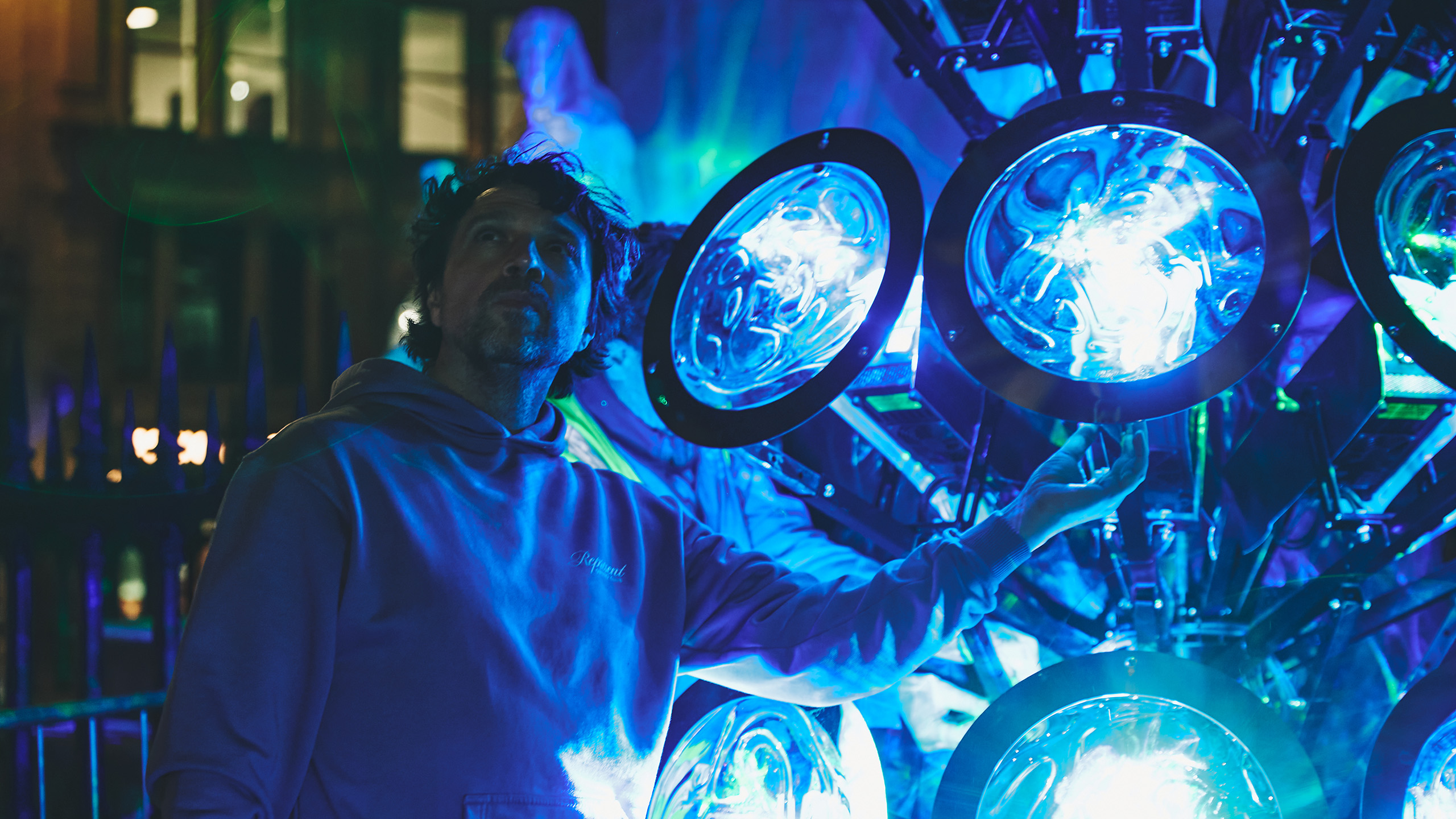
Recent Expolight works that are not related to memorialization, but that evoke a strong reaction from the audience, are the audiovisual installation “Soul” and the Dnipro Light Flowers project. “Soul”, being a temporary project, later found its place in Zurich. “Flowers of the Dnipro” is currently the world’s largest post-industrial light installation and is intended to become a visual calling card of the city. The light on the former factory pipes symbolizes the emergence of new life and development of the Dnipro.

The former factory pipes of "Flowers of the Dnieper" are connected by a complex control complex into a single synchronous laser-light system. Photo: expolight.net
Speech by Roger Narboni
Roger Narboni In a lecture for a Ukrainian audience, he told how his journey to conquer the light began and what projects led him to the principles that guide him today.
Drawing on two backgrounds—an artist and an electronics engineer—Narboni decided to be neither, or perhaps to become both in synergy. In the 1980s, there were virtually no specialists in France who would work “specifically” with light in the context of architecture and urbanism. Today, the French Association of Lighting Designers is celebrating its thirtieth anniversary.
However, Mr. Roger says that currently there are about 120 lighting design specialists in his country, and, for example, more than 40 architects and 4000 landscapers. The potential for the development of the profession and participation in various projects, even within France, is significant for the lighting design and lighting engineering industry.

The achievements of Roger Narboni and the Concepto studio include 300 projects in different parts of the world, 150 lighting master plans for cities and territories, and 30 studies of dark infrastructure. Photo: Maksym Drobinenko
Roger Narboni drew attention to the specifics of lighting projects: all of them — both those related to functional lighting and art projects — are fluid, because light is renewed. Buildings are built "for ages," trees can also grow for centuries, but lighting design projects can cease to exist during the lifetime of their author.
He says: “The lifespan of lighting design is getting shorter. It used to be around 35 years, now it’s no more than 10–15 years. But I like the idea that our projects are ephemeral in a way, and if they last 15–20 years, I’m happy with that.”
Narboni noted: one of his debut projects was the lighting of the Notre Dame Cathedral in Paris, the first national lighting design competition in France in 1989. The complex work from idea to implementation took 19 years. In 2019, the monument suffered from a major fire. The floodlights, the lighting system - all the work was destroyed. Now a new competition is being launched to illuminate Notre Dame.
Roger Narboni: "Lighting design projects are ephemeral and may cease to exist during the lifetime of their author. But there is nothing wrong with that."
From standard tasks, such as lighting for office buildings and public spaces, which were very important for Concepto studio at the beginning of its activities, over the years the team has moved on to very different projects - for example, lighting waste recycling plants or thermal power plants to build a positive image for these important, but not very attractive, structures.

Narboni says that the profession of lighting designer is evolving in an interesting way - from functional and aesthetic tasks to the implementation of virtual scenarios, the protection of biodiversity, and the care of the health of city residents. Photo: Maksym Drobinenko
“Architectural light creates a different image of an object at night. It can be completely opposite to what the building is like during the day. We, lighting designers, can modify the perception of a building, transform the image, focus on certain elements or “erase” others with light. Therefore, when working on lighting concepts, we need to discuss them with the author-architect, if this communication is possible: what kind of image will be created. But the good thing is: if no one is satisfied, we can easily “turn it off”. This is also a kind of ephemeral attitude, an approach that helps to launch projects, describe new things, test them, see the reaction of the audience and everyone involved in the project, — explained Roger Narboni. — Lighting designers today work in many, many industries, with different scales of objects — from huge to small. I like to work from the beginning of a project with a multidisciplinary team: architects, urban planners, landscape designers and lighting designers. It is really important to start from the very beginning to integrate lighting design into an architectural or landscape project. This way we can move with the team and become stronger, integrating all lighting solutions into the architecture and the “second skin” of the project.”
Roger Narboni: "The profession is evolving in an interesting way, and the spectrum of application of the lighting designer's expertise is expanding: from working with monuments, landscapes, parks to designing lighting for transport networks. Lighting is becoming increasingly important for all urban initiatives, urban policies."
In 2023, Roger Narboni decided to say goodbye to his company Concepto and now works as an independent expert in urban lighting. He speaks of this as a great freedom that allows him to travel and participate in projects in different parts of the world at a more moderate pace.
In addition to the already mentioned 300 projects implemented in different countries and 150 lighting master plans for cities, Narboni is the author of 30 studies on the so-called “dark infrastructure”. They study the potential and importance of darkness in selected locations and urban spaces, and he also devoted part of his speech in Kyiv to this.

Night lighting of the 21-kilometer Huangpu River embankment (Shanghai, China), a project implemented as part of the revitalization of a highly industrialized area. Photo: www.concepto.fr
The lighting designer commented on selected projects of various scales that reflect the Lighting master plan, Nocturnal urbanism, and Dark infrastructure methodologies he developed.
The meeting guests learned how the master plan for lighting the French city of Toulouse was created, lighting strategies for Nantes and Chartres; the master plan for the "Crown of Paris" - the districts and suburbs that surround the city, and the vision of new Parisian lighting "Geography of the Night"; master plans for the cities of Valenciennes (an industrial suburb of Lille, France), Guangzhou (China), São Paulo (Brazil), and parts of the old city of Jerusalem with the Jaffa Gate.
Sometimes Concepto lighting designers have taken unexpected approaches: for example, responding to a request from the local authorities of the French city of Rennes, they created virtual lighting for historical monuments, visible only through a mobile app. The project won an award and was used by the city for 5 years.
Roger Narboni and his team have implemented many projects in China. For a tourist promenade in Chengdu, a kilometer-long media facade featuring giant pandas, a symbol of the region, was designed to increase the attractiveness of the location for visitors at night.

Jade and gold light for the river landscape and historical monuments in Dujiangyan, China. photo: www.concepto.fr
“We also had the opportunity to work in one of the largest cities in the world, Chongqing. The city has a population of 34 million, which is almost half of the population of France (the population of the entire administrative territory of Chongqing is about 30 million. — Ed. note). This is an amazing city at the intersection of important rivers in China, and it was an interesting study that took us 2 years to complete,” Roger Narboni commented on the video presentation.
Focusing on landscape lighting projects, the urban lighting expert commented on the night lighting strategy for the 21-kilometer Huangpu River Embankment (Shanghai, China), a project to illuminate a section of the Grand Canal in Hangzhou, inscribed on the UNESCO World Heritage List as one of the oldest hydraulic structures.
Roger Narboni explained the solution for the area in the Chinese city of Dujiangyan (Sichuan) - a unique irrigation system of dividing a river into branches, created in 256 BC. In 2008, a devastating earthquake occurred there, and the city authorities were faced with the tasks of restoring river landscapes and developing tourism, among others.
The Concepto agency developed a lighting plan for a 5-kilometer stretch to illuminate the banks, the historic covered bridge, and later the temples and pagodas around the city center.

Concepto and Studio 5.5 designed street lighting for the Olympic Village in Paris, the fixtures were made from recycled scaffolding supports, old lampposts and wood. Photo: www.dezeen.com
Some of the projects Roger Narboni has been involved in are repetitive, such as the strategy for Valenciennes: “This means that we are updating the existing lighting master plan, which was developed 15-20 years ago. The requirement is to rethink the existing lighting, replace it with LED and, where possible, reduce energy consumption as much as possible. The city has an industrial tradition, and we also enhanced the architectural heritage of this period with light. One of the topics for discussion was to create night-time art routes with projections of paintings and sculptures from the local museum.”

Sustainability, reduced energy consumption in the context of a circular economy, emphasis on care and well-being are common trends in modern lighting projects. Photo: Yuriy Ferendovych
Sustainability, reducing energy consumption in the context of a circular economy, and focusing on user care and biodiversity are common trends in modern lighting projects.
Last summer, Concepto produced all the lighting for the Olympic Village in Paris. The luminaires were made from existing lamp posts or leftover pipes and scaffolding, reducing the carbon footprint by 50%.
Sometimes it is important to review established scenarios: for example, in developing a strategy for new lighting in Paris, Concepto specialists suggested shifting the focus from historical buildings and monuments to the architectural lighting of public buildings that people use. really used in the dark - schools, cultural and sports centers.
Reducing energy consumption, focusing on user care and biodiversity is a common trend for modern lighting projects.
The rights of cities and all living beings to darkness at night attract the attention of Roger Narboni. He is the author of the methodology night urbanism.
“Simply put, night urbanism is urban planning at night. It takes into account both aspects: both lighting and darkness in the city. Back in 1987, I was interested in how urban lighting could provide us with information about the identity of a city, its topography, geography, architecture, materials. I analyzed many night cities at that time and tried to understand how lighting could help me better understand their images. And I came to the conclusion that it is very difficult: you have a lot of information coming from thousands of shining points, but you don’t really understand what the city is,” the lighting designer explained.
He suggested that those present play a game: look at night panoramas of cities, guessing the landscape, building style, and occupation of the residents, and then look at them during the day and compare these assumptions with reality.

Cities and landscapes have specific features that can be revealed more fully through the balance of light and dark infrastructure (in the graphic is the Septentrional project for seven cities along the rivers in the Yangtze Valley (China). Image: www.concepto.fr
Narboni drew the audience's attention to the problem of light pollution, which is increasing with the increase in the time frame for urban lighting and the development of artificial light sources:
"Light pollution can threaten natural features. There is a problem with what we call intrusive lighting, that is, lighting from public spaces that gets into your apartment or room. A very big challenge is preserving biodiversity."
He noted that France has had strict regulations in place since the end of 2018 to combat light pollution and preserve biodiversity.
Roger Narboni: "By rejecting darkness, we lose the starry sky, the connection with the universe, and I think this poses a danger to humanity, to future generations. What can be done? In projects, in particular for urban spaces, we have tried to rediscover darkness."
Studying the behavior of city dwellers, Roger Narboni concluded that people do not like light as much as it might seem:
“It’s hard to convince politicians because they always talk about safety and lighting. But we can conduct experiments and, based on them, develop projects. For example, we implemented lighting for a 2-kilometer alley around the Acropolis in Athens. Many studies have been conducted, the conclusion of which is that most people prefer to be in a shaded place rather than under floodlights.”
He concludes: “It is important to systematically initiate research and propose strategies to help policymakers make decisions and understand the importance of night time"... The issue of energy conservation is very relevant, but there are others, such as the culture of urban lighting, connections between the city center and the suburbs, etc."

Roger Narboni's lecture and presentation of the results of a joint workshop with Expolight experts and Dnipro architects gathered the audience at UNIT.City. Photo: Maksym Drobinenko
Concluding his speech, Narboni gave several examples that illustrate the importance of understanding the dark infrastructure of cities for the future, given the overall growth of urbanization.
"In many places we can rediscover darkness and offer it to people. You can be on city streets at night and enjoy it," he says.
According to the lighting expert, in the near and distant future, the lighting design industry will develop in the context of caring, supporting the health of users, and ensuring their well-being.
Presentation of the Lighting Master Plan developments for the Dnipro
In the final part of the meeting, Roger Narboni and Mykola Kabluka spoke about the results of a week-long workshop on developing a lighting master plan and controlling the dark environment for the city of Dnipro, in which interdisciplinary teams of Ukrainian specialists participated.

Roger Narboni and Mykola Kabluka worked with four interdisciplinary teams to study the situation in the Dnieper, its infrastructure, landscapes, and the potential of spaces. Photo: Maksym Drobinenko
The chief architect of Dnipro participated in the research initiated by Expolight Dmytro Volyk, urban space architect Ksenia Donetska, leading Dnipro architects — Olga Podushkina, Vice-President of the National Academy of Sciences of Ukraine, Founder of FPA-architect, Mikhail Alipov, Head of the Dnipro NSAU, Sergey Filimonov і Natalia Kashirina, founders of FILIMONOV & KASHIRINA architects, Oleksiy Obraztsov, founder of the architectural bureau ArchObraz, Oleksiy Valentirov, chief architect and CEO of VALENTIROV&PARTNERS, teachers and students of the Pridneprovsk State Academy of Civil Engineering and Architecture, experts of Expolight and Kabluka Light & Digital Sculptures.
The specialists worked in 4 mixed teams, each of which had to present its vision for working with urban spaces, based on previous research.
Studies began to survey the situation: inspecting long-existing and newly created public spaces, pedestrian zones, the transport framework, the embankment, green areas, parks, the Dnieper River, the condition and type of lighting fixtures used. The teams worked most in the city center.

The workshop included research on light pollution and a Nocturnal analysis specific to lighting design. Photo: Maksym Drobinenko
Mykola Kabluka said: not only for Dnipro, but also for other cities in Ukraine, a situation is typical when urban lighting systems are partially modernized, but residents perceive these changes poorly. The light becomes cold, "spiky" and changes the impression of familiar spaces and architectural surroundings.
This is what happens when the choice of lights is determined only by their engineering characteristics, energy efficiency, and cost, but not by aesthetics and the impact on users.
That is why there should be lighting master plans, clear guidelines that will be taken into account when planning the allocation of funds or procurement. They will determine what exactly the city needs.
During the workshop, there were several interim presentations by the teams, in which they summarized the information collected, receiving feedback from Roger Narboni and Mykola Kabluka.
System analysis allowed us to understand the morphology, the main features of the Dnieper. Roger Narboni says that the city has a very special topology - the location of natural and man-made green areas, many hills on one bank and flat areas on the other.
Under his leadership, studies on light pollution and Nocturnal analysis specific to lighting design were carried out.

The meeting was an exclusive opportunity to gain first-hand knowledge about the guidelines of modern lighting design and lighting for cities. Photo: Maksym Drobinenko
As a result of the work, each of the 4 teams presented its vision of the lighting strategy in the city.
Team 1, consisting of: Dmytro Volyk, Ksenia Donetska, Iryna Turhan, Artem Sudenko, Darya Tarasova, Natalia Tereshchenko, Yulia Nikolaeva, Anna Mikheeva. Strategy title: “Time and Scenarios”.
Team 2, consisting of: Serhiy Filimonov, Nataliya Kashirina, Oleksandr Denisenko, Serhiy Polyushkin, Volodymyr Moroz, Anastasia Tkachenko, Oleg Semenov, Anastasia Martynenko, Kateryna Tyshchenko. Strategy title: “The Dnieper is in trouble: light and darkness.”
Team 3, consisting of: Oleksiy Obraztsov, Olga Podushkina, Anastasia Akhaimova, Kateryna Kharchenko, Oleksandr Chernyavsky, Maria Strashko, Artem Matyutin, Hanna Klymenko, Ivan Severin. Strategy name: "Nature of the Night".
Team 4, consisting of: Oleksiy Valentirov, Yana Zakharova-Kunitska, Hanna Slavinska, Nataliya Zakharchuk, Vadym Solomykov, Serhiy Lapinsky, Artem Sadovy, Stanislav Korneev, Oleksandra Gorelova. Strategy title: “Reflection. Reflection. Responsive Space.”
"Every city deserves a panorama that you want to admire, enjoy, and photograph," — Mykola Kabluka

Lighting master plans and clear lighting guidelines can optimize procurement, community decision-making, and change the image of Ukrainian cities for the better. Photo: Maksym Drobinenko
Excerpts from the research of each team were presented to the audience by Roger Narboni and Mykola Kabluka.
Some suggestions from experts: creating a clear silhouette of the right bank of the Dnieper with its architectural dominants, the line of the embankment and the bridge; harmonizing the color temperature of the city panorama; dynamic light for islands of activity, parks, boulevards that exist or are planned, and at the same time using "low" unsupported light in green areas to preserve biodiversity; developing thematic routes with light markings and "dark" paths; accentuating the entry points into the Dnieper water area of "ghost rivers" - water arteries of the city that are currently hidden underground or abandoned, and integrating them into the fabric of the city; a "less is more" approach in choosing lighting and the possibility of its easy adaptation depending on the time of day, seasons or events.
"Every city deserves a panorama that you want to admire, enjoy, and photograph," Mykola Kabluka concluded his speech with this slogan of the 4th team.
The Dnipro truly deserves qualitative changes to its image, including its light "face," with respect for people and spaces. Some of them are happening right now.


