Konstantin Kovshevatsky: Let's first understand - what does Kyiv consist of? We see an array of bad and very bad typical architecture, the fate of postmodern eclecticism, a rapidly decreasing amount of heritage and a layer of modern high-quality architecture. Let's try to estimate it as a percentage?
Sergey Korol: I have no idea in what percentage they coexist, I can only guess. Quality architecture in the residential sector in our country began to appear only a few years ago. But the prerequisites for this existed earlier. I myself spoke about this ten years ago, when we saw the beginning of a movement towards new architecture. Not because some architectural trend suddenly took shape - the market pushed us to the appearance of high-quality architecture. In fact, all drivers, including in the field of architecture, depend on the market. Everything we will talk about today is dictated primarily by the market. It is he who demands interesting projects — and they appear. The projects are competitive, they generate greater value, and arouse greater interest in the buyer. True, some cases make me think about the lack of logic on the part of the Ukrainian buyer, who is ready to invest in projects with a high cost per square meter, located in uninteresting and, from my point of view, unpromising locations.
K.K.: Perhaps they are attractive to the buyer, because it is there that quality infrastructure is provided?
S.K.: Sometimes designers do not have to envisage developed infrastructure at all, because it already exists - for example, in the historical center.
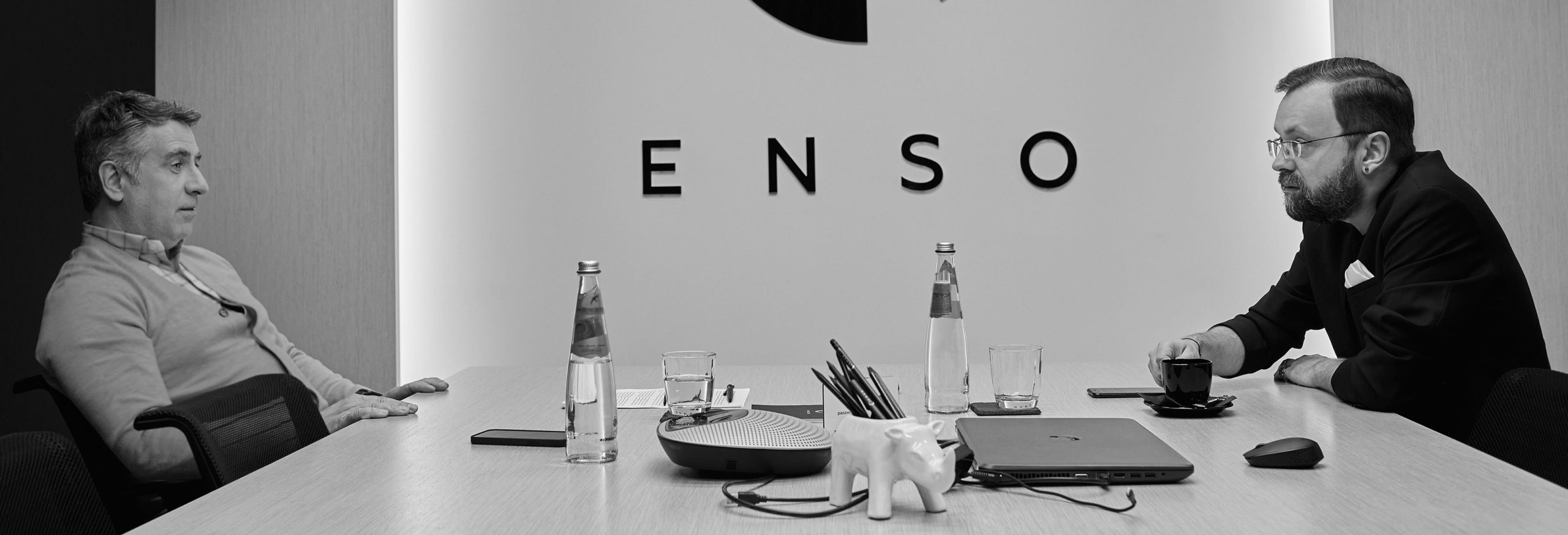
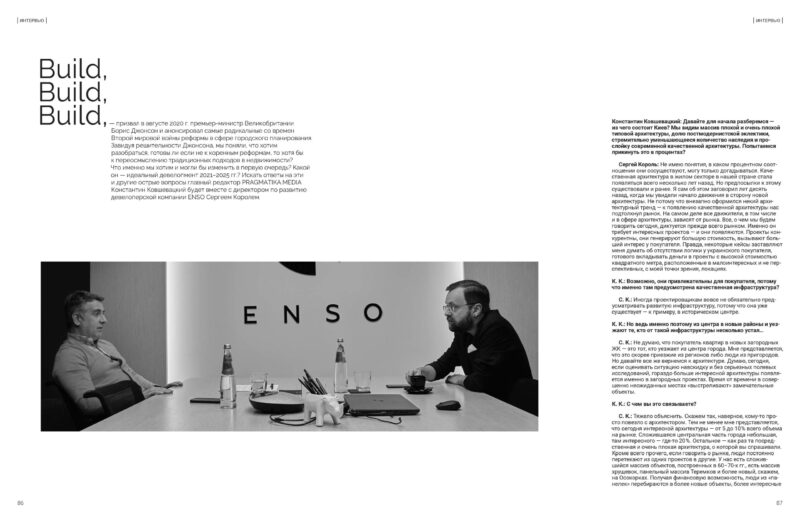
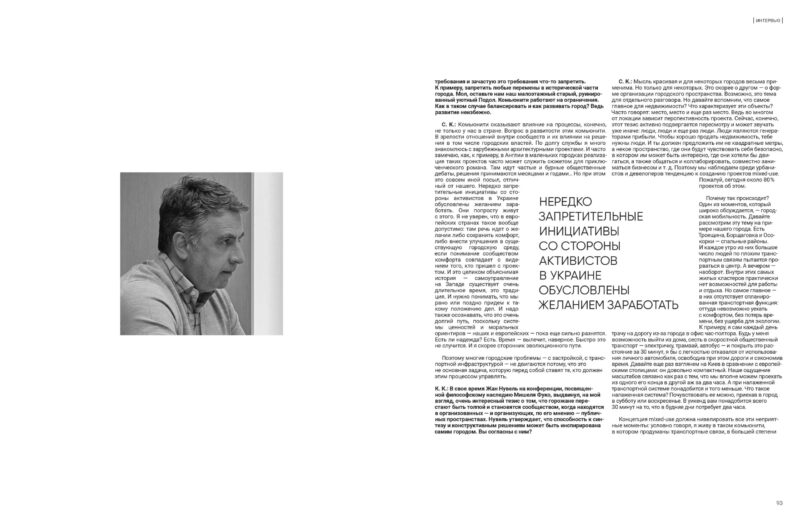
Sergey Korol, development director of the ENSO development company, and Konstantin Kovshevatsky, editor-in-chief of PRAGMATIKA.MEDIA
K.K.: But that is precisely why those who are somewhat tired of such an infrastructure leave the center for new districts...
S.K.: I don't think that the buyer of apartments in new suburban residential complexes is someone who leaves the city center. It seems to me that these are more likely to come from the regions or people from the suburbs. But let's get back to architecture. I think that today, if the situation is assessed casually and without serious field research, much more interesting architecture appears precisely in suburban projects. From time to time, remarkable objects are "shot" in completely unexpected places.
K.K.: What do you associate this with?
S.K.: It's hard to explain. Let's put it this way, someone was probably just lucky with an architect. However, it seems to me that today interesting architecture is 5 to 10% of the total volume on the market. The existing central part of the city is small, there is about 20% of what is interesting. The rest is just the mediocre and very bad architecture you asked about. Among other things, when talking about the market, people constantly flow from one project to another. We have an established array of objects built in the 60s and 70s, there is an array of Khrushchev buildings, a panel array of Teremkov, and a newer one, say, in Osokorky. Having received a financial opportunity, people from "panels" move to newer objects, more interesting housing complexes. Conventionally speaking, the charter lives in Troeshchyna, people are ready to move to another district with a more developed infrastructure, better transport connections and good architecture, if financial opportunities arise, of course.

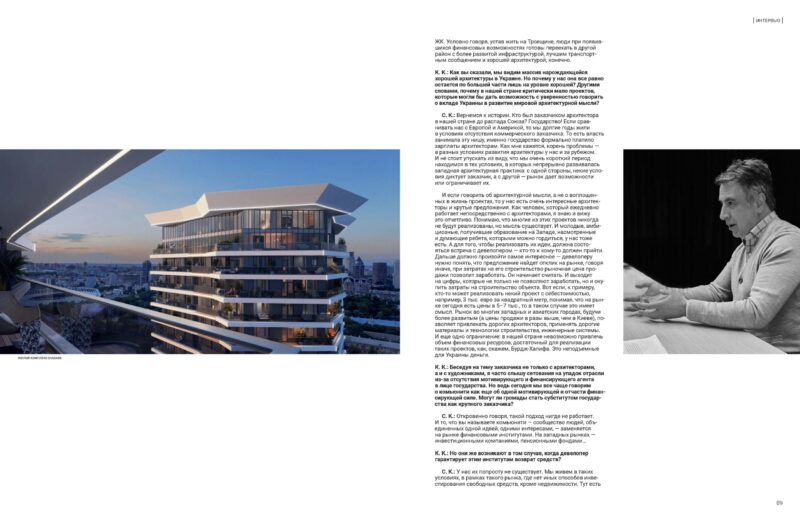
Residential complex DIADANS
K.K.: As you said, we see an array of emerging good architecture in Ukraine. But why does it still remain for the most part only at the level of good? In other words, why are there critically few projects in our country that could give an opportunity to speak with confidence about Ukraine's contribution to the development of world architectural thought?
S.K.: Let's go back to history. Who was the customer of the architect in our country before the collapse of the Union? State! If you compare us with Europe and America, we lived for many years in the absence of a commercial customer. That is, the government occupied this niche, it was the state that formally paid the salaries of the architects. As it seems to me, the root of the problem lies in the different conditions of development of architecture in our country and abroad. And we should not lose sight of the fact that for a very short period we are in the conditions in which Western architectural practice has continuously developed: on the one hand, certain conditions are dictated by the customer, and on the other hand, the market gives opportunities or limits them.
And if we are talking about architectural thought, and not about projects embodied in life, then we have very interesting architects and cool proposals. As someone who works directly with architects on a daily basis, I know and see this clearly. I understand that many of these projects will never be implemented, but the idea exists. And we also have young, ambitious, Western-educated, observant and thoughtful guys who you can be proud of. And in order to implement their ideas, a meeting with the developer must take place - someone must come to someone. Next, the most interesting thing should happen - the developer needs to understand that the proposal will find a response in the market, in other words, at the cost of its construction, the market price of the sale will allow to make money. He starts counting. And it comes to figures that not only do not allow you to make money, but also pay off the costs of building the facility. If, for example, someone can implement a project with a cost price of, for example, 3 thousand euros per square meter, understanding that the market today has prices of 5–7 thousand, then in that case it makes sense. The market in many Western and Asian cities, being more developed (and selling prices are many times higher than in Kyiv), allows you to attract expensive architects, use expensive materials and construction technologies, and engineering systems. And one more limitation: in our country it is impossible to attract the amount of financial resources sufficient to implement such projects as, say, the Burj Khalifa. This is unaffordable money for Ukraine.
K.K.: Talking about the customer not only with architects, but also with artists, I often hear complaints about the decline of the industry due to the lack of a motivating and financing agent in the form of the state. But today we increasingly talk about the community as another motivating and partly financing force. Can communities become a substitute for the state as a major customer?
S.K.: Frankly speaking, this approach does not work anywhere. And what you call a community — a community of people united by the same idea, the same interests — is being replaced on the market by financial institutions. In Western markets — by investment companies, pension funds...
Sergey Korol, development director of the ENSO development company
KK: But do they arise when the developer guarantees these institutes a refund?
S.K.: We simply don't have them. We live in such conditions, within the framework of such a market, where there are no other ways of investing free funds, except in real estate. Is there a stock market here? Is there an exchange? It is obvious that people are forced to carry money not even to banks - someone tries to trust them, of course. But this is a difficult question. And in the absence of other opportunities for investment, the average Ukrainian brings money to the real estate market.
You are saying that someone must provide a scheme by which good architecture will develop. My answer: you don't need to come up with a scheme. In fact, the development of architecture depends on several factors: market conditions, favorable or not; the customer, whose level of development, taste, strategy and self-understanding play an important role in this issue. For example, you can build projects of the same type, sell them successfully, and feel relatively good. And until recently, there were many such developers on the market. Suddenly, a moment came when some of them started to have projects of a completely different kind. Why did it happen? Either something appeared on the market to which the consumer began to give preference, or in the bowels of these developers appeared, let's say, fresh brains. I think that many people have these processes happening in parallel.
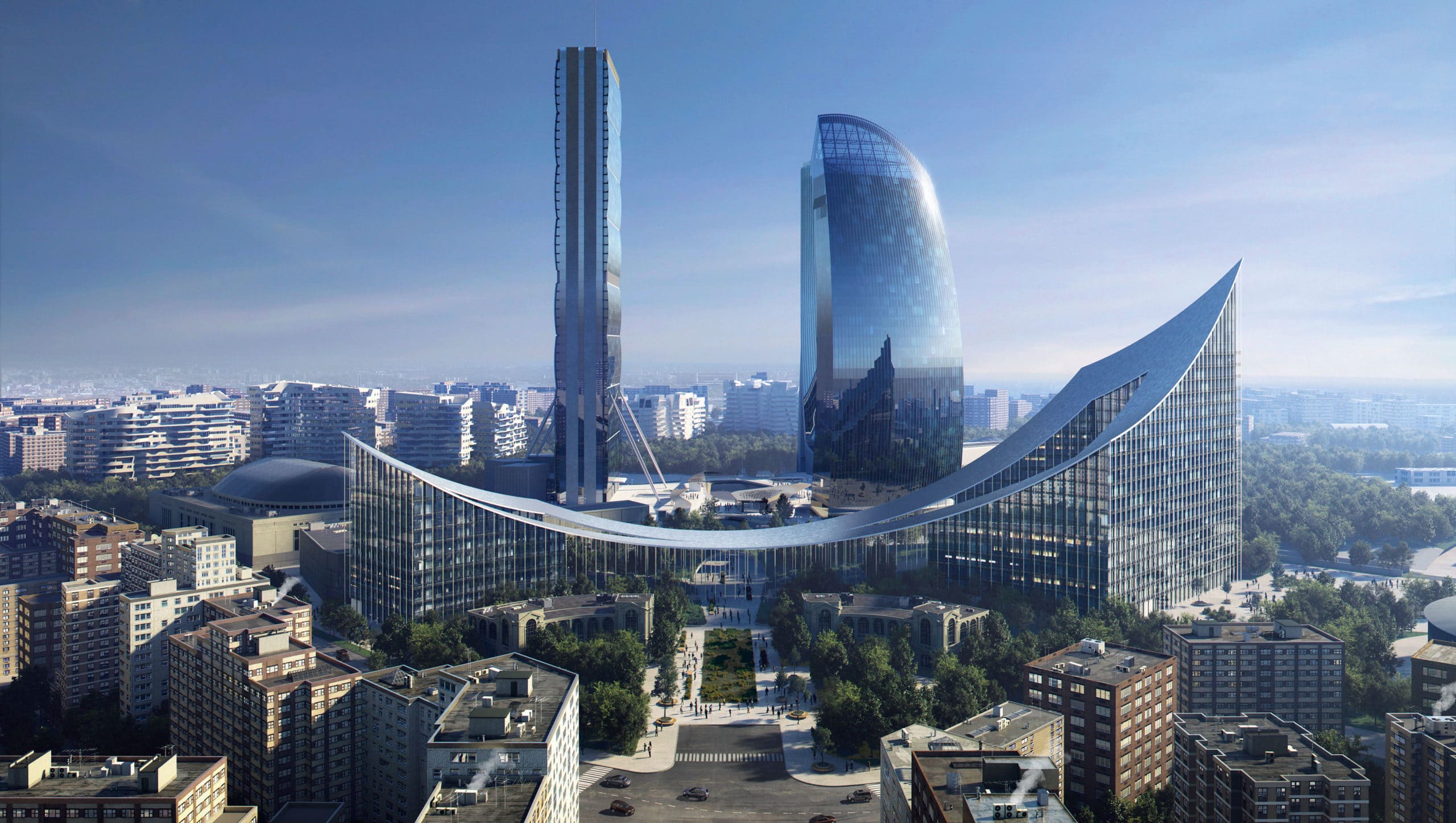
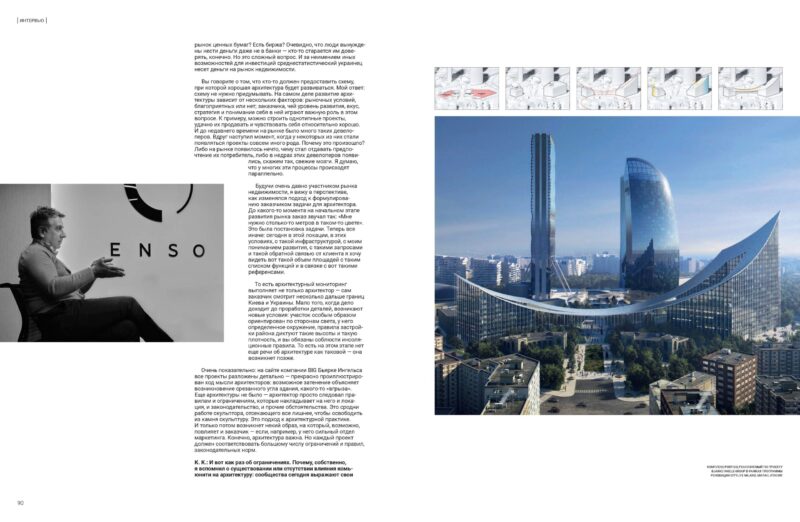
The Portico complex, implemented according to the Bjarke Ingels Group project as part of the renovation program CITYLIFE MILANO, Milan, Italy

The Portico complex, implemented by the Bjarke Ingels Group project
Having been a participant in the real estate market for a very long time, I can see in the future how the approach to the customer's formulation of the task for the architect has changed. Until a certain moment at the initial stage of market development, the order sounded like this: "I need so many meters in such and such a color." This was a task statement. Now everything is different: today in this location, in these conditions, with such an infrastructure, with my understanding of development, with such requests and such feedback from the client, I want to see such a volume of areas with such a list of functions and in conjunction with such references.
That is, architectural monitoring is performed not only by the architect - the customer himself looks a little further from the borders of Kyiv and Ukraine. Not only that, when it comes to working out the details, new conditions arise: the plot is oriented in a particular way to the cardinal points, it has a certain environment, the rules of the development of the area dictate such heights and such density, and you are obliged to observe the insolation rules. That is, at this stage there is no question of architecture as such - it will arise later.
It is very telling: on the site of BIG Bjarke Ingels, all the projects are laid out in detail - the architect's thought process is perfectly illustrated: possible shading explains the appearance of a cut corner of the building, a kind of "bite". There was no architecture yet - the architect simply followed the rules and restrictions imposed on him by location, legislation, and other circumstances. This is similar to the work of a sculptor, who cuts away everything superfluous in order to free the sculpture from the stone. This is an approach to architectural practice. And only then will a certain image appear, which may be influenced by the customer as well - if, for example, he has a strong marketing department. Of course, architecture is important. But every project must comply with a large number of restrictions and rules, legislative norms.
Sergey Korol, development director of the ENSO development company
K.K.: And just about the restrictions. Why, in fact, I remembered the existence or absence of community influence on architecture: communities today express their demands and often these demands prohibit something. For example, any changes in the historical part of the city will be prohibited. Like, leave us our low-rise old, ruined, cozy Podol. Communities work on limitations. In that case, how to balance and how to develop the city? After all, development is inevitable.
S.K.: Communities influence the processes, of course, not only in our country. The question is the development of these communities. In the maturity of relations within communities and their influence on decisions, including those of city authorities. During my service, I get to know a lot of foreign architectural projects. And I often notice how, for example, in England in small towns, the implementation of such projects can often serve as a plot for an adventure novel. There are frequent and heated public debates, decisions are made for months and years... But at the same time, this is a completely different message, different from ours. Often, prohibitive initiatives on the part of activists in Ukraine are motivated by the desire to make money. They simply live on it. I am not sure that in European countries this is generally acceptable: there it is a desire either to preserve comfort or to make improvements to the existing urban environment, if the community's understanding of comfort coincides with the vision of the person who came up with the project. And this is a completely self-explanatory story - self-government has existed in the West for a very long time, it is a tradition. And it is necessary to understand that sooner or later we will come to such a state of affairs. And it is also necessary to realize that this is a very long way, since the systems of values and moral guidelines - ours and European - are still very different. Is there hope? There is Time will probably heal. It won't happen quickly. And I am rather a supporter of the evolutionary path.
Therefore, many urban problems - with construction, with transport infrastructure - do not move because this is not the main task that those who have to manage this process set before themselves.
Often, prohibitive initiatives on the part of activists in Ukraine are motivated by the desire to make money
K.K.: At one time, Jean Nouvel, at a conference dedicated to the philosophical legacy of Michel Foucault, put forward, in my opinion, a very interesting thesis that citizens cease to be a crowd and become a community when they are in organized — and organizing, according to him in the opinion of public spaces. Nouvel asserts that the ability to synthesis and constructive solutions can be inspired by the city itself. Do you agree with him?
S.K.: The idea is beautiful and very applicable for some cities. But only for some. It is more about something else — about the form of organization of urban space. Perhaps this is a topic for a separate conversation. But let's remember what is most important for real estate? What characterizes these objects? They often say: place, place and place again. After all, the perspective of the project largely depends on the location. Now, of course, this thesis is being actively revised and may sound differently: people, people, and people again. People are profit generators. To sell real estate well, you need people. And you must offer them not square meters, but some space where they will feel safe, in which they may be interested, where they would like to move, as well as communicate and collaborate, do business together, etc. Therefore, we observe among urban planners and developers there is a tendency to create mixed-use projects. Perhaps, today about 80% of projects are about it.
Why does this happen? One of the points that is widely discussed is urban mobility. Let's consider this topic using the example of our city. There are Troeshchyna, Borshchagovka and Osokorky — sleeping areas. And every morning, a large number of them try to break through to the center due to poor transport connections. And in the evening - vice versa. Within these most residential clusters, there are practically no opportunities for work and recreation. But the most important thing is that they lack a planned transport function: it is impossible to leave there comfortably, without wasting time, without harming the environment. For example, I myself spend an hour and a half on the way from the city to the office every day. If I had the opportunity to leave the house, get on high-speed public transport - a train, tram, bus - and cover this distance in 30 minutes, I would easily refuse to use a personal car, free up the roads and save time. Let's take another look at Kyiv in comparison with European capitals: it is quite compact. Our sense of scale is connected precisely with the fact that we can drive from one end of it to the other in as little as two hours. And with an established transport system, even less will be needed. What is an established system? You can feel it if you come to the city on Saturday or Sunday. On the weekend, you will need only 30 minutes for what would take two hours on weekdays.

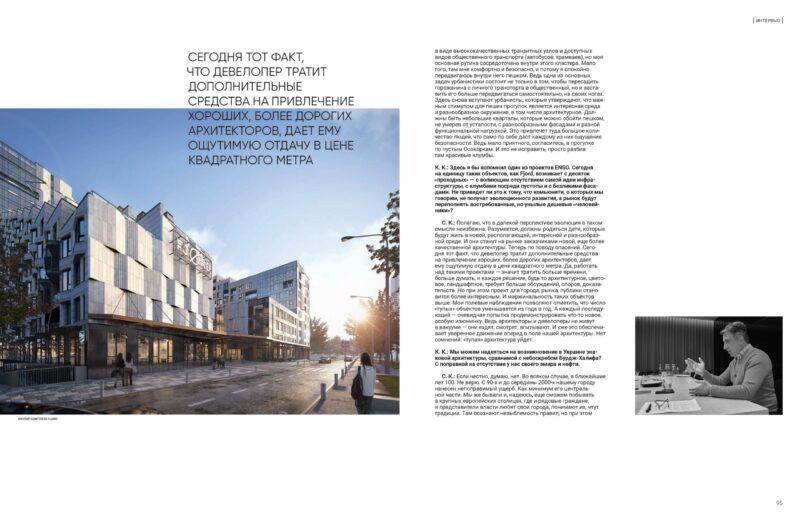
Residential complex FJORD
The concept of mixed-use should level out all these unpleasant moments: relatively speaking, I live in such a community in which transport connections are thought out, to a greater extent in the form of high-quality transit nodes and accessible types of public transport (buses, trams), but my main routine is concentrated within this cluster. Not only that, I feel comfortable and safe there, and therefore I calmly move inside it on foot. After all, one of the main tasks of urban planning is not only to transfer a citizen from personal transport to public transport, but also to make him move more independently, on his own feet. This is where urbanists come in again, who argue that an important incentive for walking is an interesting environment and a diverse environment, including an architectural one. There should be small quarters that can be walked around without dying of fatigue, with various facades and different functional loads. This will attract a large number of people there, which in itself will give each of them a sense of security. After all, you will agree, there is little pleasure in a walk through empty Osokorki. And it won't fix it, I just broke beautiful flower beds there.
K.K.: Here I would like to recall one of the ENSO projects. Today, for one unit of such objects as Fjord, there are a dozen "walk-through" ones - with a glaring absence of the very idea of infrastructure, with flowerbeds in the middle of the void and with faceless facades. Won't this lead to the fact that the communities we are talking about will not receive evolutionary development, and the market will be flooded with sought-after but depressingly cheap "humans"?
S.K.: I believe that in the long term, evolution in this sense is inevitable. Of course, children must be born who will live in a new, comfortable, interesting and diverse environment. And they will become customers of new, even better architecture on the market. Now I'm worried about it. Today, the fact that the developer spends additional funds to attract good, more expensive architects, gives him a tangible return in the price of a square meter. Yes, working on such projects means spending more time, thinking more, and every decision, be it architectural, color, or landscape, requires more discussions, disputes, and proofs. But at the same time, the project becomes more interesting for the city, the market, and the public. And the marginality of such objects is higher. My field observations allow me to note that the number of "dull" objects decreases from year to year. And each subsequent one is an obvious attempt to demonstrate something new, a special highlight. After all, architects and developers do not live in a vacuum - they travel, look, absorb. And this already ensures confident movement forward in the field of our architecture. There is no doubt: "stupid" architecture will go away.
Today, the fact that the developer spends additional funds to attract good, more expensive architects, gives him a tangible return in the price of a square meter
Sergey Korol, development director of the ENSO development company
K.K.: Can we hope for the emergence of iconic architecture in Ukraine, comparable to the Burj Khalifa skyscraper? With the correction for the absence of our emir and oil.
S.K.: To be honest, I think not. In any case, in the nearest year it will be 100. I don't believe it. From the 90s to the mid-2000s, irreparable damage was inflicted on our garden. At least the central part of the ego. We have been and, I hope, will still be able to visit large European capitals, where both ordinary citizens and representatives of the authorities love their cities, understand them, and respect their traditions. There they realize the unshakability of the rules, but at the same time they find an opportunity for some compromises, which obviously fit into the overall picture and give the city something important. Not to someone personally — to the garden! In Kyiv, we have lost many historical buildings and we feel absolute disrespect for the history of the city, the country, the people, including the history of architecture. Here, in the historical environment, "monsters" appear all the time, and they managed to reproduce in huge numbers. And this is a question of correct legislative regulation, implemented with understanding and love for the city.
KK: Sounds good. But if we talk about regulation from the point of view of market laws, then such an approach will seem somewhat more cerebral than we can afford in a city like Kyiv. After all, sentiments about the preservation of old architecture are foreign to the market.
S.K.: Here we are again closely approaching regulation: the declaration of love for the city on the part of officials should be implemented in clear rules. Conventionally speaking, if in that period (1990-2000) there was strict regulation in terms of zoning, density and height, then the developer would be obliged to comply with these rules. Yes, of course, in certain locations there is a desire to realize 100 square meters of space, but only 000 is possible. For the customer, this is obviously worse than 20, but better than nothing. Let's fantasize further. Volumes of new construction are decreasing, demand is growing, as are market prices. We are starting to move in this sense in the direction of London and Paris. Such an influence on the market must inevitably lead to its growth, which entails an increase in tax revenues, and migration to cities due to their attractiveness also increases.
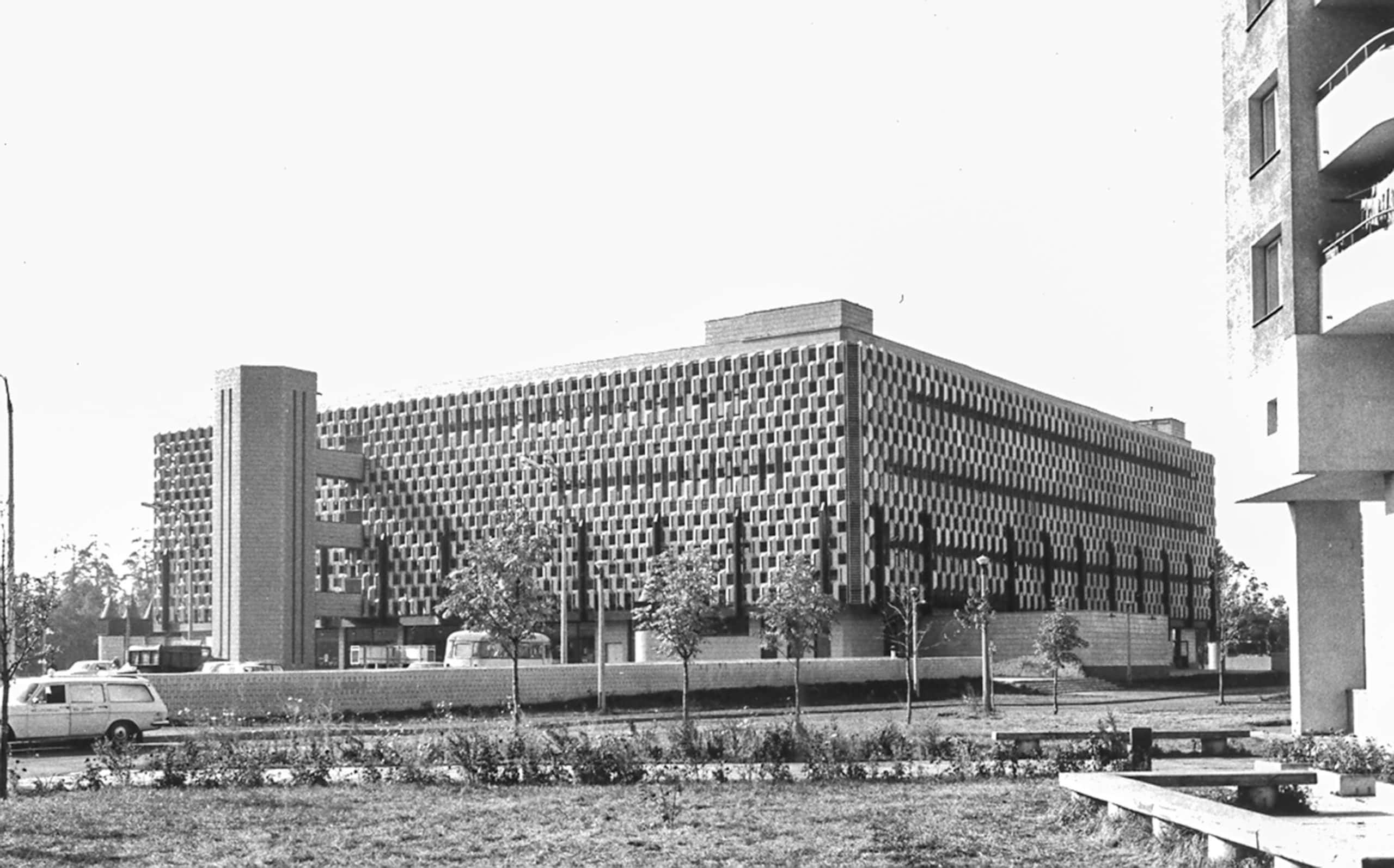
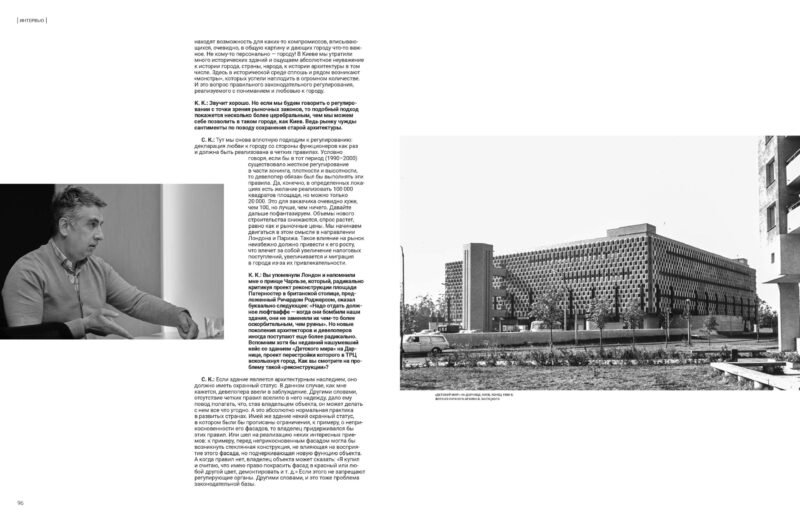
"Children's World" on Darnytsa, Kyiv, late 1980s. Photo from the personal archive of V. Zalutskyi
K.K.: You mentioned London and reminded me of Prince Charles, who, radically criticizing the reconstruction project of Paternoster Square in the British capital proposed by Richard Rogers, literally said the following: "You have to give credit to the Luftwaffe - when they bombed our buildings, they did not replace something more offensive than ruins." But new generations of architects and developers sometimes act even more radically. Let's recall at least the recent sensational case with the "Children's World" building in Darnytsia, the reconstruction project of which in the shopping center shook the city. How do you look at the problem of such "reconstruction"?
S.K.: If the building is an architectural heritage, it must have a protected status. In this case, it seems to me, the developer was misled. In other words, the lack of clear rules instilled hope in him, gave him reason to believe that, having become the owner of the object, he can do whatever he wants with it. And this is absolutely normal practice in developed countries. If the building had a certain protection status, which would have prescribed restrictions, for example, about the inviolability of its facades, then the owner would have adhered to these rules. Or he went for the implementation of some interesting techniques: for example, a glass structure could appear in front of an inviolable facade, which does not affect the perception of this facade, but emphasizes the new function of the object. And when there are no rules, the owner of the object can say: "I bought and believe that I have the right to paint the facade red or any other color, dismantle it, etc." If this is not prohibited by the regulatory authorities. In other words, this is also a problem of the legislative base.
If we are talking about architectural thought, and not about projects embodied in life, then we have very interesting architects and cool proposals
Sergey Korol, development director of the ENSO development company
KK: Aristotle interpreted aesthetics as a part of ethics. What role do ethics play in your own development projects?
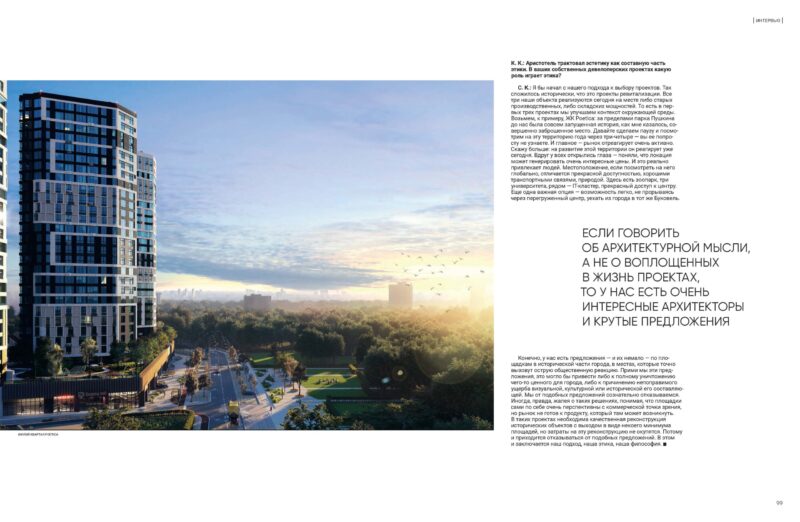
S.K.: I would start with our approach to the selection of projects. Historically, these are revitalization projects. All three of our objects are being implemented today on the site of either old production or warehouse facilities. That is, in the first three projects, we improve the context of the environment. Take, for example, the Poetica residential complex: outside the Pushkin Park, we had a completely run-down history, as it seemed to me, a completely abandoned place. Let's pause and look at this territory in three or four years - you simply won't recognize it. And most importantly, the market will react very actively. I will say more: he is reacting to the development of this territory already today. Suddenly everyone's eyes opened - they realized that the location can generate very interesting prices. And it really attracts people. The location, if you look at it globally, is distinguished by excellent accessibility, good transport connections, and nature. There is a zoo, three universities, an IT cluster nearby, excellent access to the center. Another important option is the ability to easily leave the city in the same Bukovel without breaking through the congested center.
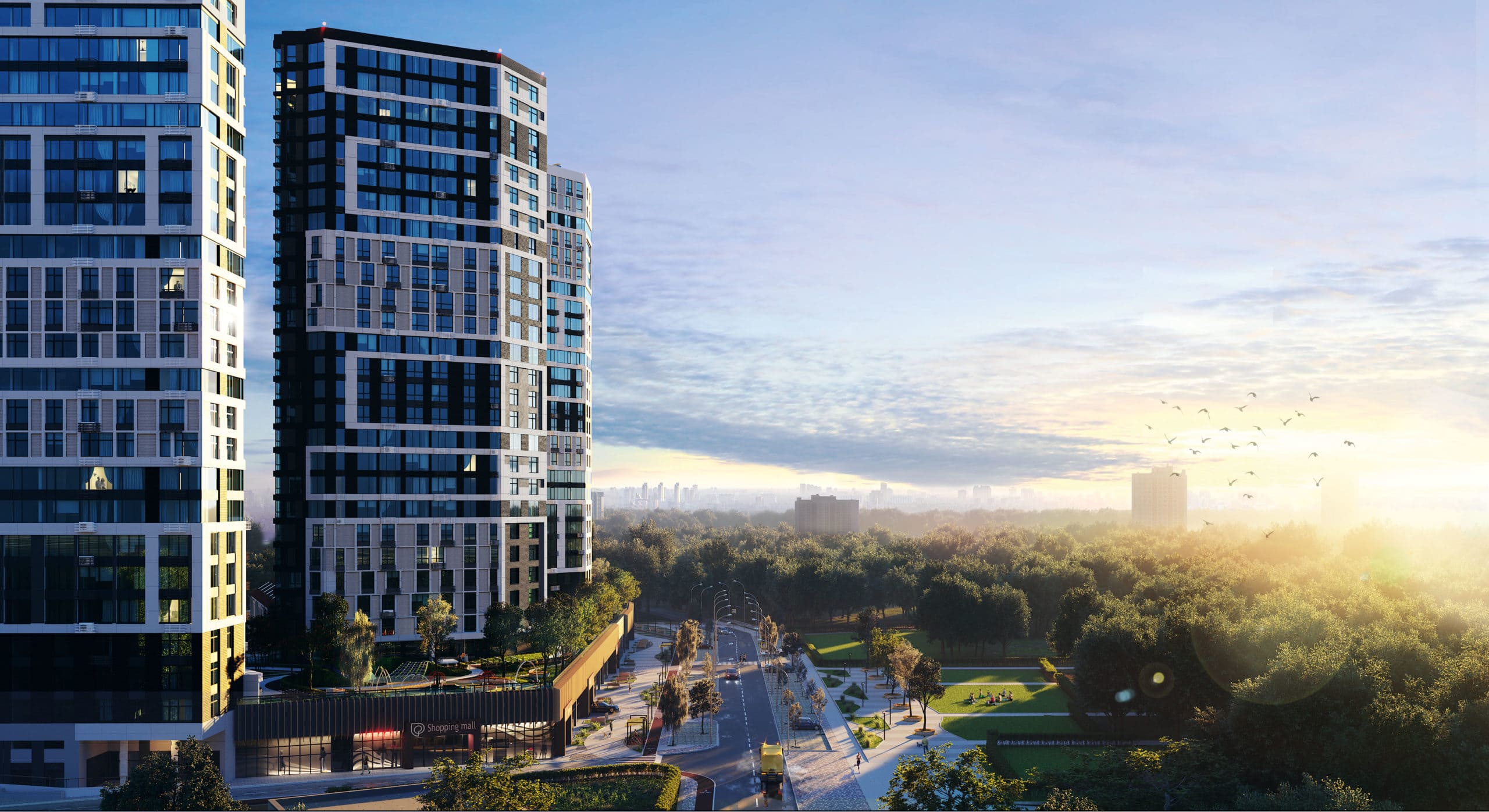
POETICA residential quarter
Of course, we have proposals - and there are many of them - for sites in the historical part of the city, in places that will definitely cause a strong public reaction. If we accept these proposals, it could lead either to the complete destruction of something valuable for the city, or to causing irreparable damage to its visual, cultural or historical components. We deliberately refuse such offers. Sometimes, however, regretting such decisions, realizing that the sites themselves are very promising from a commercial point of view, but the market is not ready for the product that may arise there. In such projects, a high-quality reconstruction of historical objects is necessary with an output in the form of a certain minimum of square footage, but the costs of this reconstruction will not pay off. That is why we have to refuse such proposals. This is our approach, our ethics, our philosophy.
Interviewed by Konstantin Kovshevatsky
Photo: Maksym Drobynenko
/The material is published on the pages #30 of volume PRAGMATIKA.MEDIA/