


Igor Nikonov
Founded by KAN company
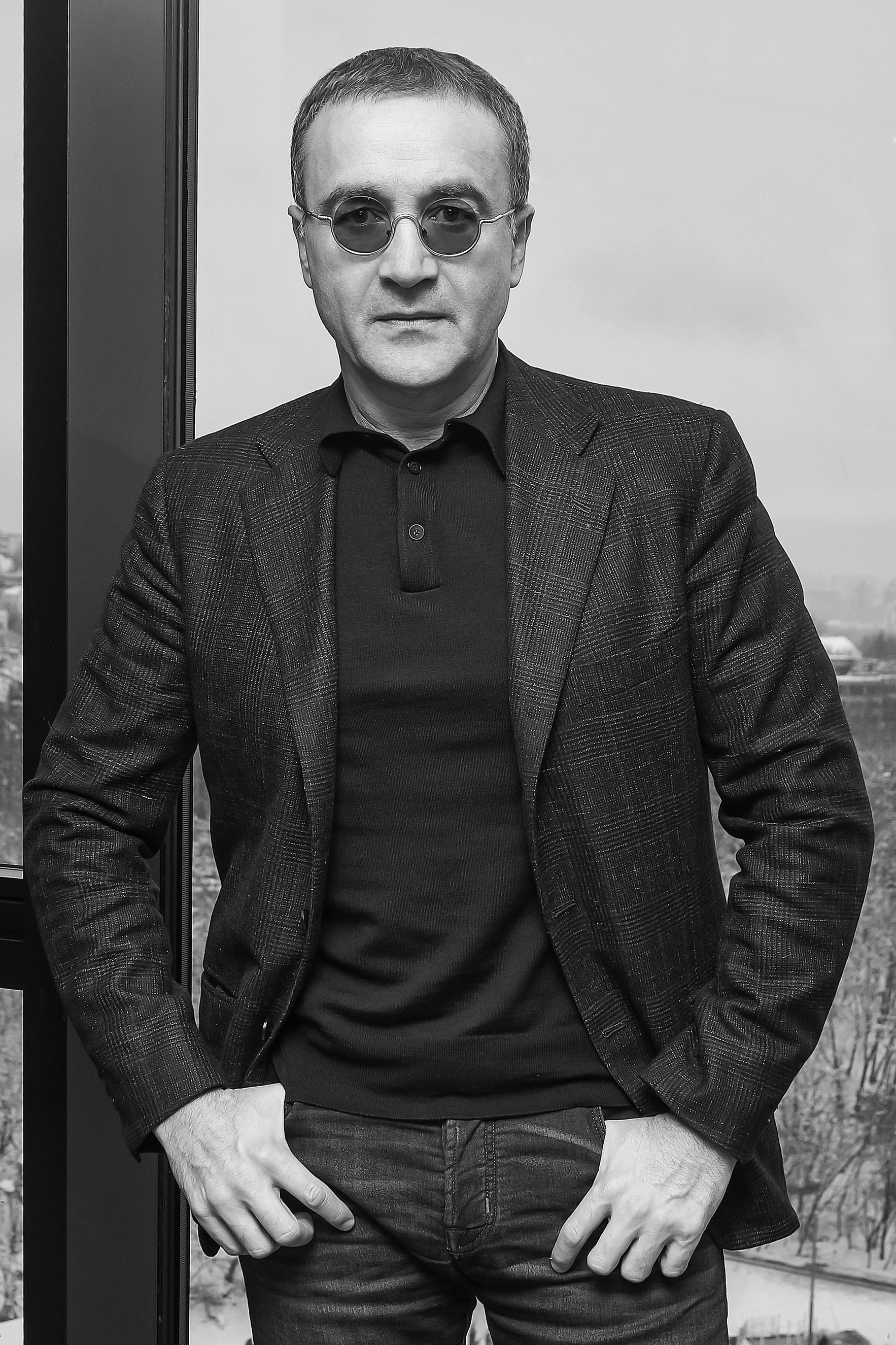
Igor Nikonov, founder of the KAN company
Konstantin Kovshevatsky: The topic of the issue for which we are preparing the material is designated as "Plans and dreams". Tell me, has the project of your dreams already been realized?
Igor Nikonov: No, of course! A person will fade away when he realizes the project of his dreams. As soon as one dream is fulfilled, another must appear. A dream is something to which you must constantly strive.
K.K.: What else do you aspire to?
I.N.: What else am I striving for? The market adjusts my aspirations, of course. What I would really like to build is, let's say, very difficult from an engineering point of view. This is not being implemented now, as the market is not ready. But we, for example, continue to work on the hospital project - it is a super complex structure. I hope that at the beginning of 2019 we will finish the project and start forming a financial plan. There are a number of other interesting objects. But I can't reveal all the cards yet.
There is a trend of shifts in the direction of increased supply on the market - there is an opportunity for a wider choice than ever before
KK: Let's talk about the market. What do you think will be the ego dynamics in 2019?
Everything depends on the political situation. For example, if full-fledged martial law were introduced, then, I think, he would have stopped altogether.
K.K.: Martial law was introduced.
I.N.: No. They entered the ego partially. And it is obvious that this is some compromise option. Understand me correctly, but in conditions of full-scale martial law, investors, foreign banks stop issuing loans. And most importantly, people stop spending money, expecting that they will be needed for completely different purposes. These are, strictly speaking, the "beacons" of the crisis that can affect the market. That is, if this does not happen, I do not see any prerequisites for the deterioration of the market situation.
I can say with all confidence that there is a trend of shifts in the direction of increased supply on the market - there is an opportunity for a wider choice than ever, because many developers have begun to build higher quality housing.

Several companies demonstrate a very deep understanding of the importance of the environment, they invest in infrastructure. This is very important. I think that such a trend will prevail in the market. Hence, it is easy to assume that prices will definitely not decrease. I believe that they will increase even more because the cost of construction is increasing. In 2018, the price per square meter increased by $70–80 only due to the cost of work. A lot of specialists left the country, and the people who came instead of them want the salary that their colleagues who left for Poland receive. Materials are also rising in price - the growth trend is obvious.
K.K.: Do you see any of the market sectors that could be called a "window of opportunity" and that did not exist in the 18th year?
I.N.: No, I don't see such a sector. There are no prerequisites for this. In order for new windows to open, economic growth is needed. And I don't find any growth points: they don't sell land, everyone talks about anything, except the economy. Although, I think it is much more important than everything else.
The developer must understand that he is definitely not deceiving anyone and that the project is of high quality
K.K.: What can be considered a successful project in your field?
I.N.: A successful project is a combination of many factors. First, he must be economically successful. That is, it should include such a business model that guarantees not only the return of funds to the investor, but also earnings. But I am not ready to take on all successful projects. For example, I do not agree to build very, very cheap housing, "hang noodles on people's ears", saying that it is good, and sell it at the price of the middle segment. At the same time, some of my colleagues consider this a successful project. Such approaches never interested me at all. We still create good housing and sell it, maybe at a slightly higher price or at the same price as others, and I understand why this happens. I believe that the developer should not be ashamed of what he is doing. He must understand that he is definitely not deceiving anyone and that the project is of high quality. The price and terms are all forgotten, and the quality remains with the project for 50 or even 70 years. And I don't think that anyone needs the negativity that can be heard in this period of time. I definitely don't.
Igor Nikonov
KK: What role does good architecture play in a successful project? Can it be measured and what is it for you?
I.N.: In our experience, we realized one thing - only the collective, joint work of the architect and the development company can make the project successful. No architect is able to independently create a successful project, and a developer cannot do this without a good architect. Therefore, there is success where this tandem works. People should not be lazy and provide variability. In other words, the developer must have a choice. Next, he must set the task very clearly, because it is necessary to determine the target audience and apartment layout, present the transport model, and deal with the infrastructure. This is all joint work. And according to our experience, an architect, even the most stellar one, if you leave him alone with the project, nothing will succeed. The goal is precisely joint work, and work with great respect for each other and with an understanding of who is responsible for what.
K.K.: Still, good architecture, in your opinion...
I.N.: This corresponds to the principles of spatial planning decisions. Figuratively speaking, architecture should not be identical to the environment, it should be inscribed in it. That's why, for many years, I have been advising that 3D modeling and fitting the object into the real environment, views from real points, should still be included in the permit documentation. This would greatly simplify the chief architect of the city's understanding of whether the object has the right to exist or not.
The market adjusts my aspirations
The second criterion of good architecture is, of course, ergonomics, that is, how comfortable this project is for people. And I would also highlight the "landmark" factor. I believe that every architect and developer should strive to ensure that his building can be identified. Like any artist, an architect and developer should have their own handwriting. The totality of all these factors is probably a quality architecture. This is subjective, of course. We all well remember the story of the Eiffel Tower, for example. However, the impulse of some aggressively-minded people opposing this or that project, in most cases, gives envy. In addition, everything innovative is not immediately perceived. Let's remember the 90s and 2000s, when we were required to build new buildings for the 50th century. I believe that architecture should correspond to the era. And I really want them to say in XNUMX years that our buildings reflect the beginning of the XNUMXst century with all its attributes.
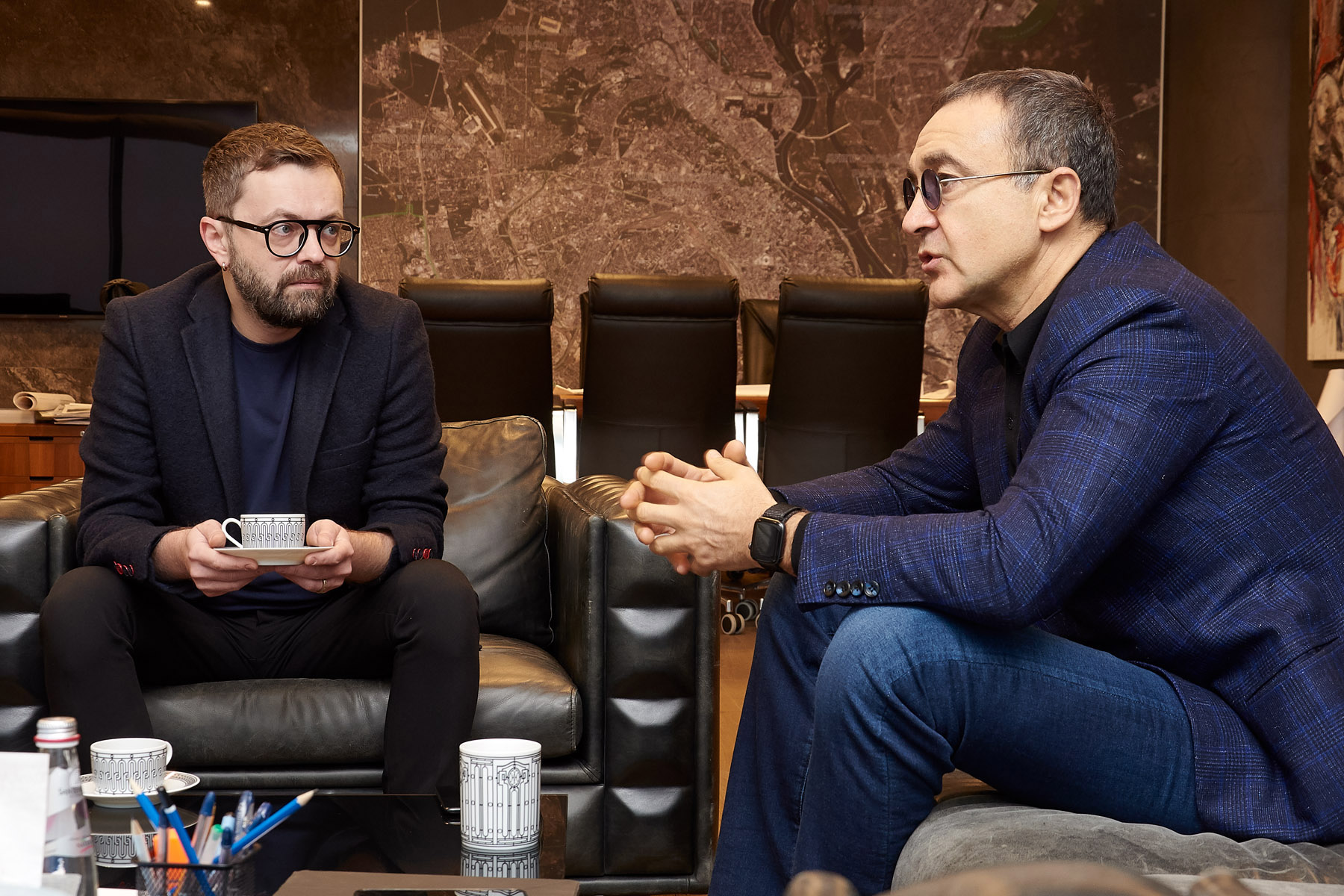
Konstantin Kovshevatsky and Igor Nikonov
K.K.: What is important to you when choosing a design partner, what do you focus on?
I.N.: The first is, of course, ego competence. The second is maximalism. I have already mentioned the need for project variability. Oh, by the way, you won't expect many, especially Western architects. You get three options - that's it. Those with whom we work have a completely different approach. Although, I will say frankly, there are more and more problems with this in Ukraine. True, we ourselves already have such a powerful technical management that to some extent we are able to duplicate what the designers do, if the latter are not able to do it.
A good developer monitors the totality of all factors: price, quality and deadlines
KK: Are they important to you? BIM technologies when creating projects?
I.N.: Rather, they are important for architects. I consider 3D design mandatory. Even 4D. The idea is that all engineering was taken into account and placed with absolutely clear coordinates in the completed and constructed three-dimensional model. You know what networking is and what a nightmare it turned into before on paper. It turned out that whoever laid the network first is the main one. Imagine: some guy designed the sewer system, then the others begin to adapt to it.
Igor Nikonov
Today, thanks to 3D-modelling, you already calculate volumes correctly and correctly, and ordering materials is easier. And the most important thing is that you see all the ceiling marks, all the minimum points and all the problems. I myself often have to intervene in the final engineering solutions - engineers and designers "walk" on the ceilings very freely, but my task is to leave as much space as possible. It's an eternal war, but we usually win. I dare to say that designers and engineers are the enemies of space, capable of placing some kind of beam or pylon necessarily in the middle of the hall. Of course, modern technologies make life easier for us in this regard.
Architecture should not be identical to the environment, it should be inscribed in it
K.K.: To what extent do you personally intervene in the projects?
I.N.: I am definitely not a "cobbler without boots". And I don't think that a developer business can be run by just a manager. Here it is necessary to make a huge number of decisions - not only political and architectural, but also technical and technological. Therefore, sometimes I cannot stop at all and immerse myself very deeply in the project. After all, the appearance of the building, convenience, energy efficiency, and its cost can change from the adoption of certain decisions.
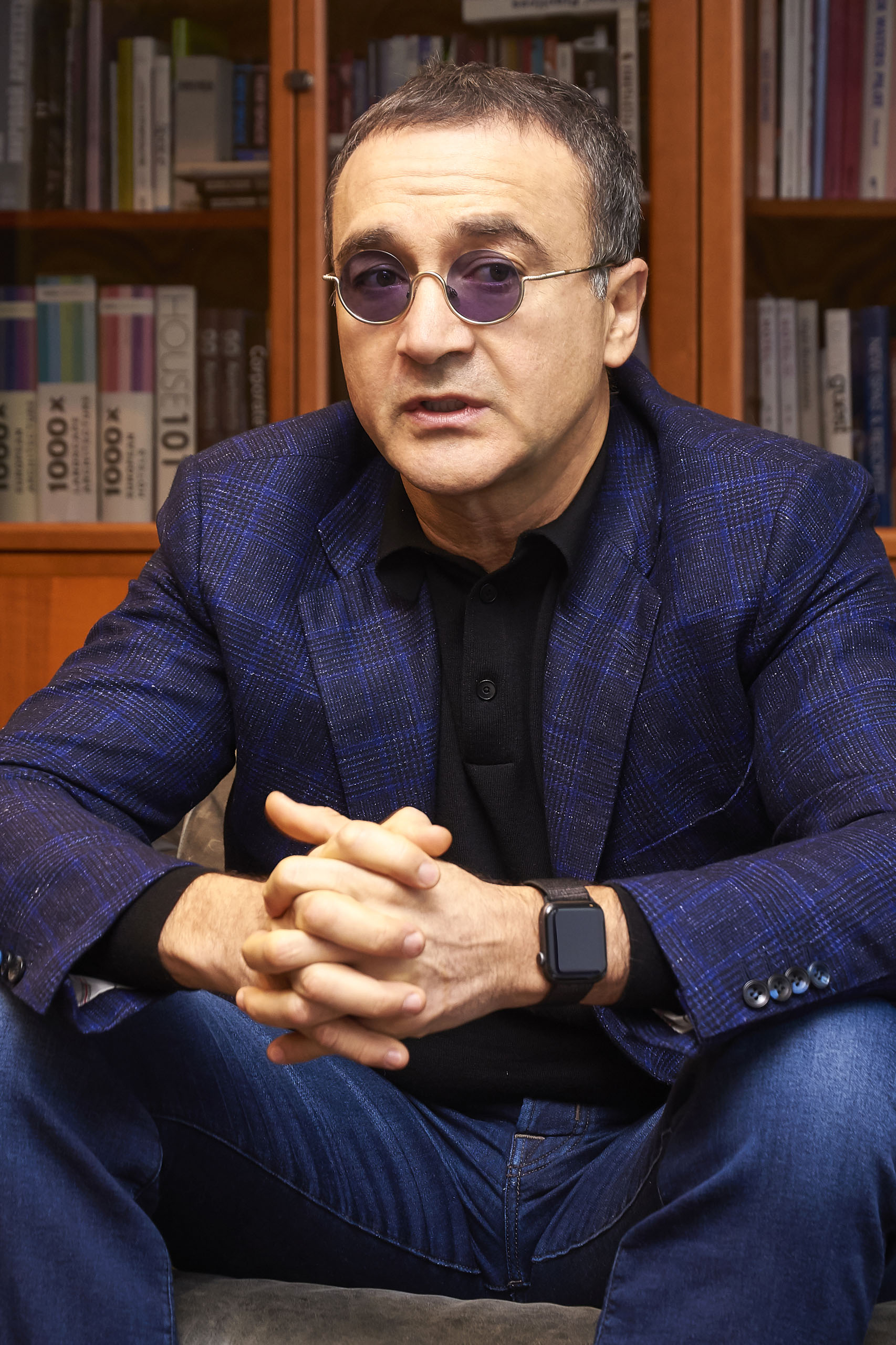
Igor Nikonov
A good developer monitors the totality of all factors: price, quality and deadlines. The owner of the company, even if it is seven feet in the forehead, is always under the sword of Damocles... Understand what the level of responsibility is! We have an eternal battle between businessmen and technicians: some want cheaper, others - better. And someone has to be the referee. In the end, I am responsible for everything, considering that the funds are either my own, or those of partners, or a loan. I bear personal responsibility. Therefore, of course, sometimes it is necessary to delve very deeply into the details of the project. In general, what concerns the appearance, ergonomics, the presence of infrastructure facilities and the concept - this is purely my work, as a rule, I do not delegate it to anyone.
I don't believe that a developer business can be run by just a manager
K.K.: How important is what happens to your projects after their implementation to you?
I.N.: Well, of course, it is very important! Sometimes we were forced, on the basis of agreements, some kind of partnership agreement, to give our projects into operation to partners who promised us gold mountains. Not even from the point of view of earnings, but from the point of view of the quality of management. And then it turned out that they do not manage very well. All this had to be dismantled by our own efforts - buyers, one way or another, appeal to our company. We have already finished with this practice of transfer of control and we do not intend to give our objects to anyone anymore.

K.K.: How do you feel about the image component of your projects, their victories in architectural competitions?
I.N.: Of course, we are happy when our projects receive awards in professional competitions. You yourself know that you definitely cannot call them banal. Once in Germany, I noticed very simple and at the same time very expensive housing. I said then that "Irony of Fate" should have been filmed there - it is very easy to get confused in absolutely identical German quarters. In my opinion, architecture is still some kind of picture, it should change all the time, and for monotony you don't need much mind. Among the projects we do, for example, archimatika and Andrey Pashenko, there are no identical ones. We somehow complained about the high cost of the design, to which the architects simply replied: "You want to get 70 different types of apartments at the same time!". And we approved the price offered by them (laughs).
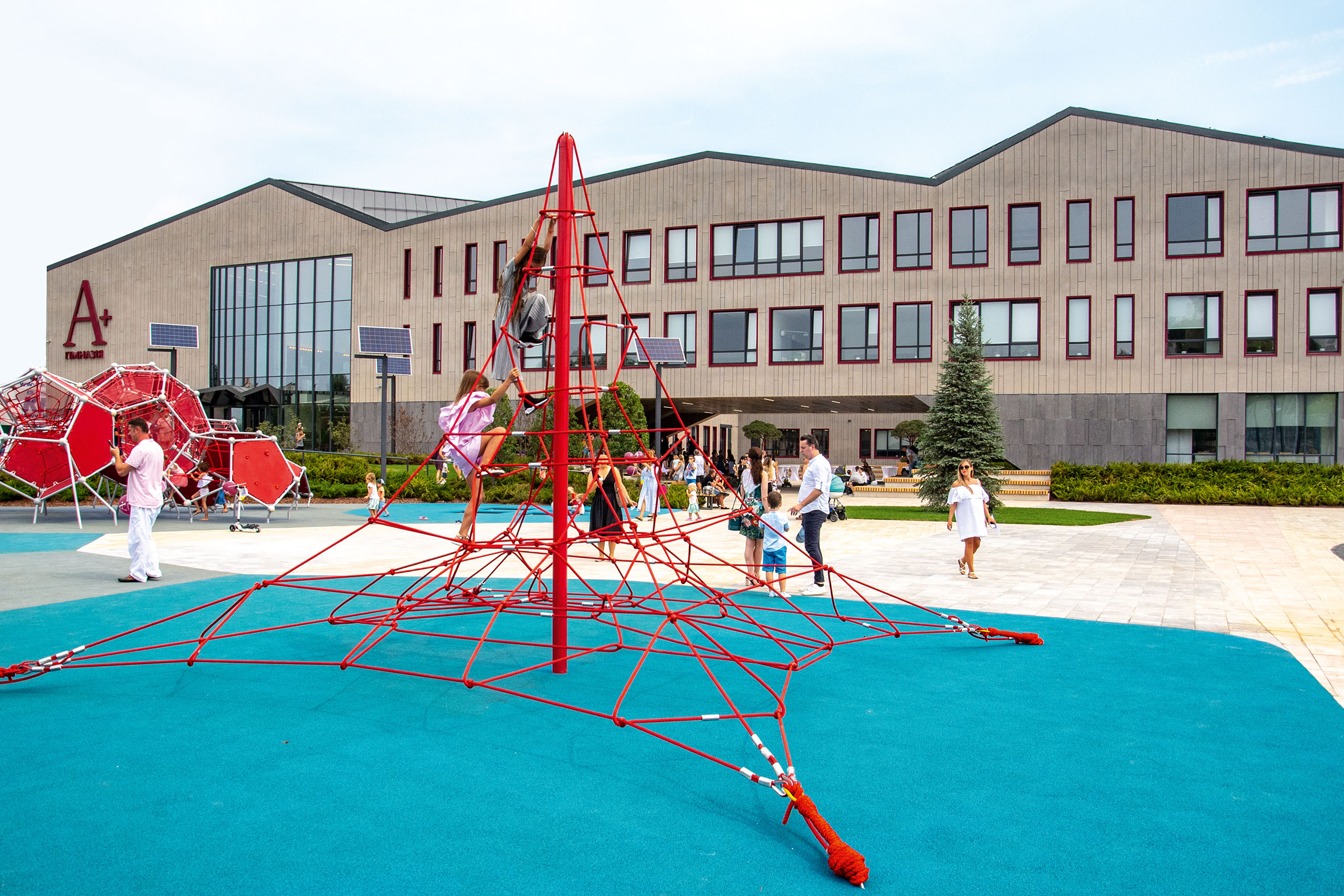
Gymnasium "A+", project KAN and archimatika
After all, we promote, strictly speaking, individuality. A person cannot and should not be a robot or a machine, a product of this same environment. We bring up individuality, sociability and creativity in children in the schools and kindergartens that we build ourselves (a network of educational institutions established by "A+"). The child must learn these three basic qualities. He must understand where to find information, how to communicate so that it is given to him, and being creative is very important. And Wednesday, I am convinced, has a very strong influence on this.
I am not a supporter of the theory of equalization, which is widespread, for example, in the countries of Scandinavian socialism. I think this is not progress. Let it sound too bold, but it is done by individuals, and they move society forward - people who are ahead of their time!
Andrey Vavrysh
General Director of SAGA Development
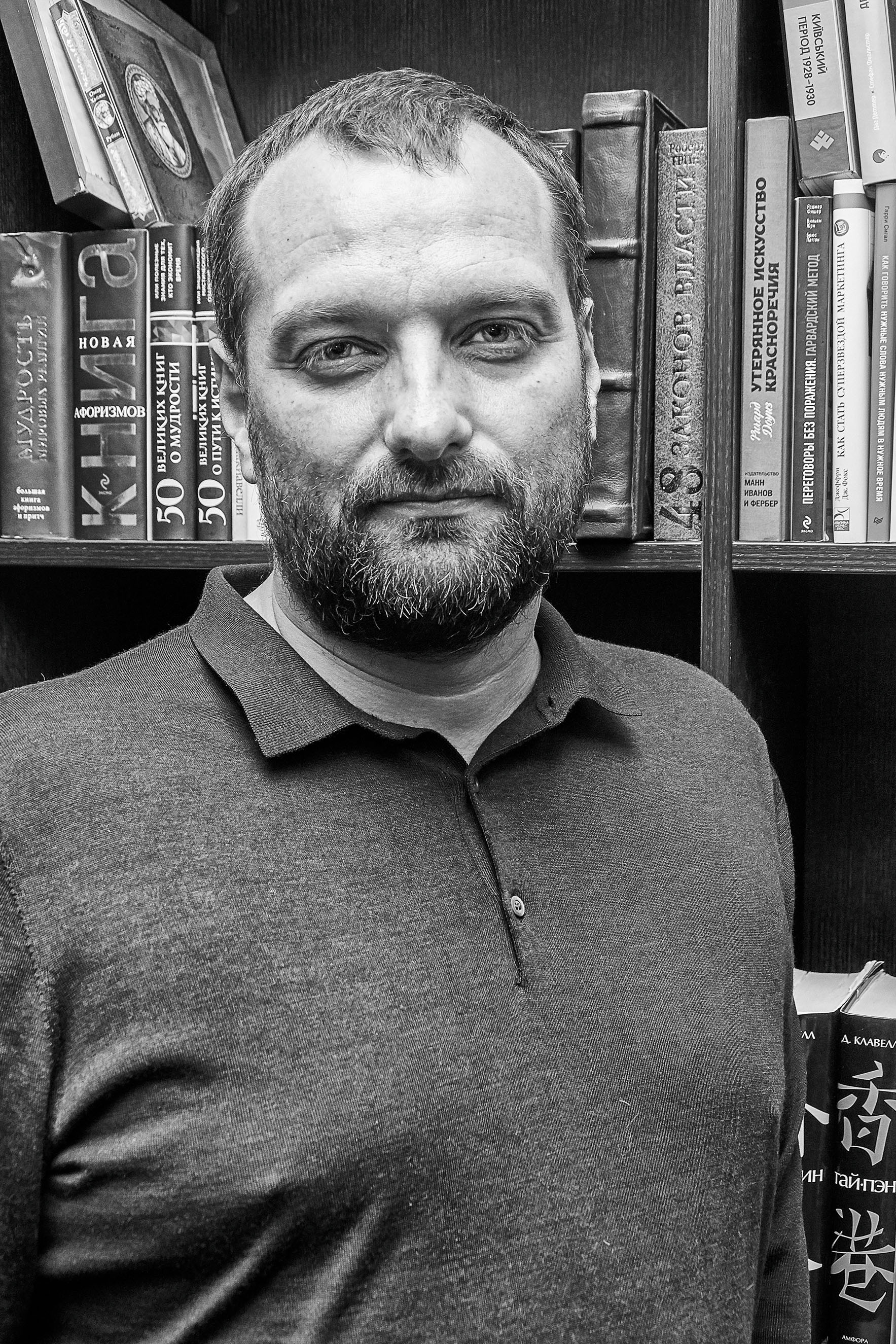
Andrei Vavrysh, CEO of SAGA Development
Konstantin Kovshevatsky: What does it mean for you to find yourself?
Andrei Vavrysh: Good question. Let's put it this way, with age you begin to understand that even if you hear music in yourself, you are looking for who you are in this music. Every person is in search of self-determination.
K.K.: Looking for yourself in art or art in yourself?
A.V.: This is not an "either-or" issue. Here vopros is in "and". Are you the object or the subject of this process? Are you an object, under whose right are you? After all, who defines who you are? And if you are a subject, you are responsible not only for yourself, but also for other subjects, and for the objects that you deal with. Next, you have a choice - do you create or do you consume? Either to what extent you create and to what extent you consume. Or you created something that consumes... Well, in a good way, you try to find a balance within such a framework. In nature, everything is about balance.
KK: I would say that nature is all about chaos. Nature does not strive for balance - for chaos.
A.V.: I don't agree. I think nature is the most powerful balancer. I cannot imagine a greater balance than in nature. It seems to me that people who bring something new all the time take circumstances out of balance. But nature is the greatest equalizer.
KK: Calibrator?
A.V.: Equalizer. For every action in nature, there is a counteraction. I would give such a comparison: personality development is largely determined by what and how you present yourself. What for you personally is on the "plus" side, what is on the "minus" side. That is, between what and what is the search. For example, for one, the search occurs between the sizes of accounts of one million dollars and two million. Is this a search? And at the same time, you put something on the second bowl of the scales instead. Someone puts their time, someone's life, someone's soul. Someone perceives this process as growth, and someone perceives it as a gaping hole. The search for balance is the quintessence of what we live for.
With age, you begin to understand that even if you hear music in yourself, you are looking for who you are in this music
K.K.: Is your search for subjectivity an attempt to change the world around you, or are they still focused on internal sensations?
A.V.: I thought it was obvious, based on what I had already managed to do (laughs). No, I, of course, believe that I am able, capable and know how to change what the focus of my attention touches.
KK: Okay. Let's move on to the objects of your attention. Do you live more with plans, forecasts, estimates or dreams?
A.V.: I am a romantic.
K.K.: Good. And if you postpone the romance and try to forecast - how do you plan to spend the next year and how do you assess the state of the market? What will it be — growth, decline, or will the market remain in some kind of balance that you just talked about?
A.V.: I think that these are three different questions - what will happen to the market, what are my plans in relation to it, and what is my attitude to it.
K.K.: Let's go in a row.
A.V.: As for the market... The market is a balancing system, and there are some critical factors that influence what will happen to it. Fortunately, the political risks of the election campaign do not affect us and the market. And in this respect, very big progress in the country is obvious to me.
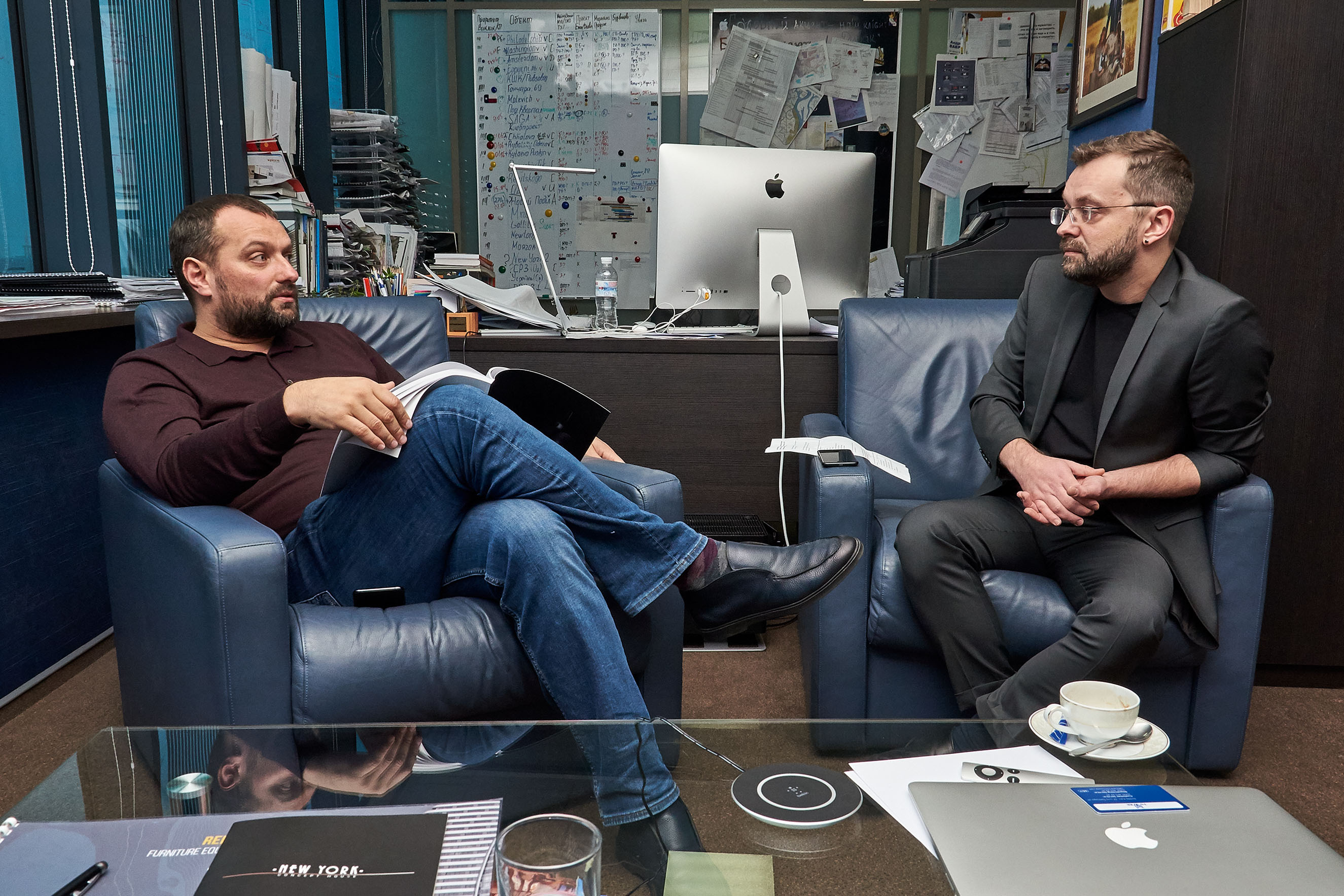
Andrei Vavrysh and Konstantin Kovshevatsky
K.K.: Why don't they influence? Please explain.
A.V.: The influence of the election in a broad context can be traced at the level of our future. But it is necessary to understand that we are in a situation where it is not a matter of life and death in the economic or socio-political plan, which is good. That is, it is not a question of choice - war or not war. And this is not a question of choosing a vector — East or West. After all, we are unequivocally oriented towards the West, and unequivocally, whoever comes, he will not have such a vote of independence as he once did. The role and functions of the country's leader have been changed by civic maturity, and this is now showing some inadequacy of individual candidates to the role that society has formulated as the quintessence of its expectations. And I am happy that ordinary, "mundane" economic activity in the real estate market does not depend on these processes.
KK: What are your personal predictions about the market?
A.V.: I feel sorry for those who felt that everything would be fine and it was possible to do nothing.
KK: Then let's talk about "windows of opportunity". Are there market segments that will demonstrate them?
A.V.: A year ago, at the strategic session, we outlined plans for 2018. Then they tried to formulate where is the niche they should fall into. Moreover, it initially seemed to us that there is a certain niche that needs to be described, formulated - and then we will get clearly defined boundaries, windows of opportunities to which we need to strive. No matter how many times we tried to do it, it turned out that the presented form does not work. And we found a cool analogy that concerns gas extraction. If earlier everyone tried to find a reservoir in the form of a huge underground deposit, now the technology of shale mining has appeared.
There is no single mechanism. The whole team needs to be on fire, looking for these windows of opportunity
In other words, there is no specific niche. But there is a "space between". And the point is that the tactics and strategy of work in the market should not consist in the search for such a niche in which no one is waiting for us and in which there is no one. It must consist in the fact that we must press, press, squeeze, pinch - with proposals, creativity, quality in small things, in details. As in the case of a shale deposit, squeeze out new opportunities. This is where we see our place. There is no niche — and we must move everywhere, in all directions, unequivocally squeezing the most out of even very small opportunities. And this can be done only if your team is able to bite. Because there is no and cannot be any specific guiding instruction - "let's go either this way or that way"! There is no single mechanism. The whole team needs to be on fire, looking for these "windows of opportunity".
K.K.: So this is such a competitive position — better than others, more interesting than others?
A.V.: Well I do not know. In my opinion, it is possible to compete only to the extent... It seems to me that this is not a competitive story, but rather a dialogue. But not a dialogue between construction companies. I think it should be a dialogue with a specific person whose heart you won. That is, this is a conquering position. You are fighting for a particular person, for the fact that he is so unique that you are ready to redesign the city for him. You should dedicate your work to this distance between a person and what you can offer him.
Therefore, I do not see the sense in competition here. In this case, you can only be pushed by the distance between you and the client.
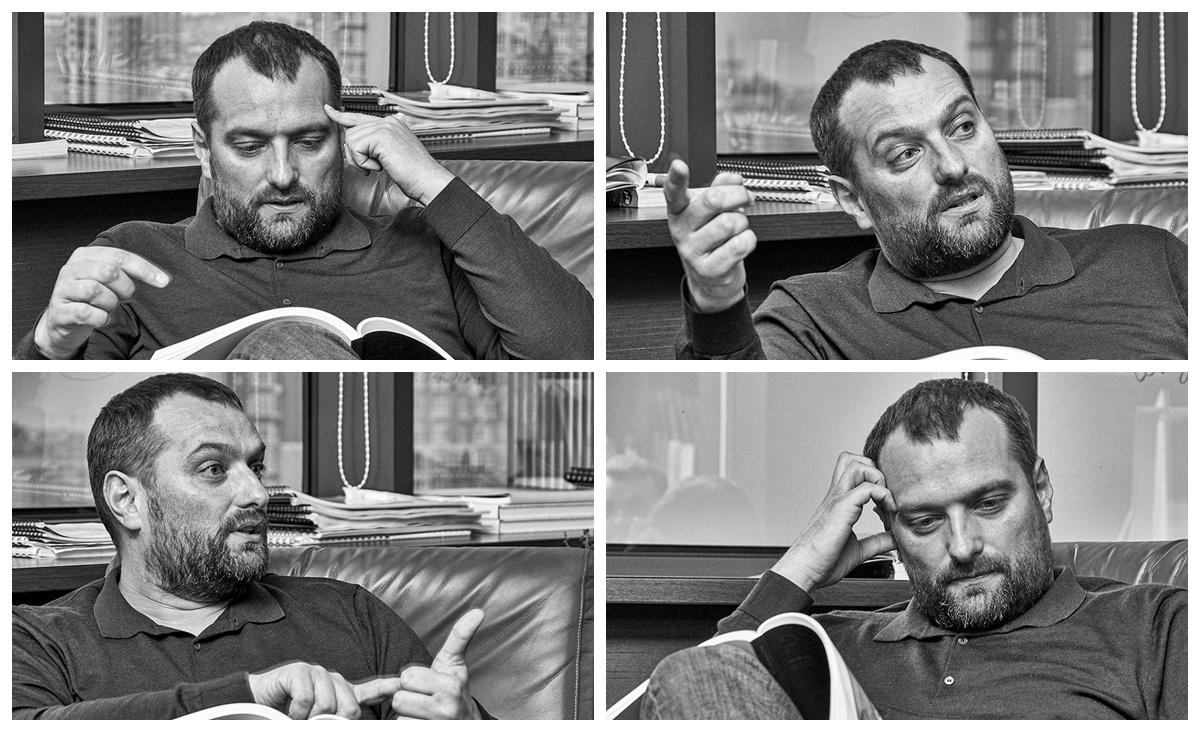
Andrey Vavrysh
KK: Is this one of the factors of the commercial success of the project?
A.V.: What is success? For me, an indicator of, let's say, a disease or a clinical case in the company is when separately taken developers come and say: "Listen, let your ZEK take away from us for maintenance the housing stock that we have set up here." That is, people built boxes and they don’t care what happens next - how people live in them, how satisfied or dissatisfied they are with this whole story... These developers do not value the social relations formed with the residents of the houses at all, trying to quickly monetize them, somewhere to sell They don't even care that a person can be either their lawyer or prosecutor. In other words, if they are able to part with such an invaluable resource as established relationships so easily, then this indicates that the resource for growth (space) in the market is simply crazy.
There are very well-known companies, they also have good, innovative commercials. At the same time, the company was renamed because condominiums with their former name are cursed by residents. They curse not because they did something very bad to them. And because in the process of building the company's relations with residents, a large number of those residents who do not pay their bills were discovered. And they could not reach these non-payers - probably, they lacked courage, oxygen, and ideas. It turned out that these people are dragging condominiums into the abyss. Here, for example, I know a story: a certain army general never paid utility bills from the moment he got his apartment. He has lived in this house for 15 years and has never paid for it! Now imagine what the residents of his entrance, who are billed for this general, think - they just don't know about it directly. It turns out that his neighbors pay more, because an individual general does not pay anything. I imagine what they would do with him, open all the cards to the condominium, and the company's image suffers at the same time.
Once you sold real estate to a person, you are responsible for everything that will eventually happen to it later
I think that this condominium lacks honesty and transparency, because they stretch their profit margin and therefore do not want to open their accounting. If the accounting department were to be opened, it would become completely and publicly available, then the topic of the general would surface. It turns out that they could not implement the model of absolute business openness. And the "general" buried them. He buried the business model itself. But it was also a "window of opportunity". If this story is relevant as an example of the market situation, then this indicates how many more niches in the market are not occupied. And how many of those who could not reach the hearts of clients. This indicates how many people have turned into prosecutors of companies that sell real estate.
K.K.: And yet, what is commercial success for you?
A.V.: This is a long-term relationship. How a declaration is good. But after all, long-term relationships should not mean loss for the company. The question is that they should be, how would I say it... objectively predetermined. Once you sold real estate to a person, you are responsible for everything that will eventually happen to it later. You made a deal. That is, let's say, he has already created an alliance with a person. You can divorce your wife or husband. And here, can you answer the question yourself - do you fight for these relationships or close your eyes and walk away? Changes in your own business model will inevitably be required if you build relationships with the client based on the understanding that they will change, develop, and something new will appear in them. And then you realize that you cannot take on obligations that you are not capable of fulfilling, you cannot talk about things that do not correspond to reality, you pay attention to the parity of honesty.
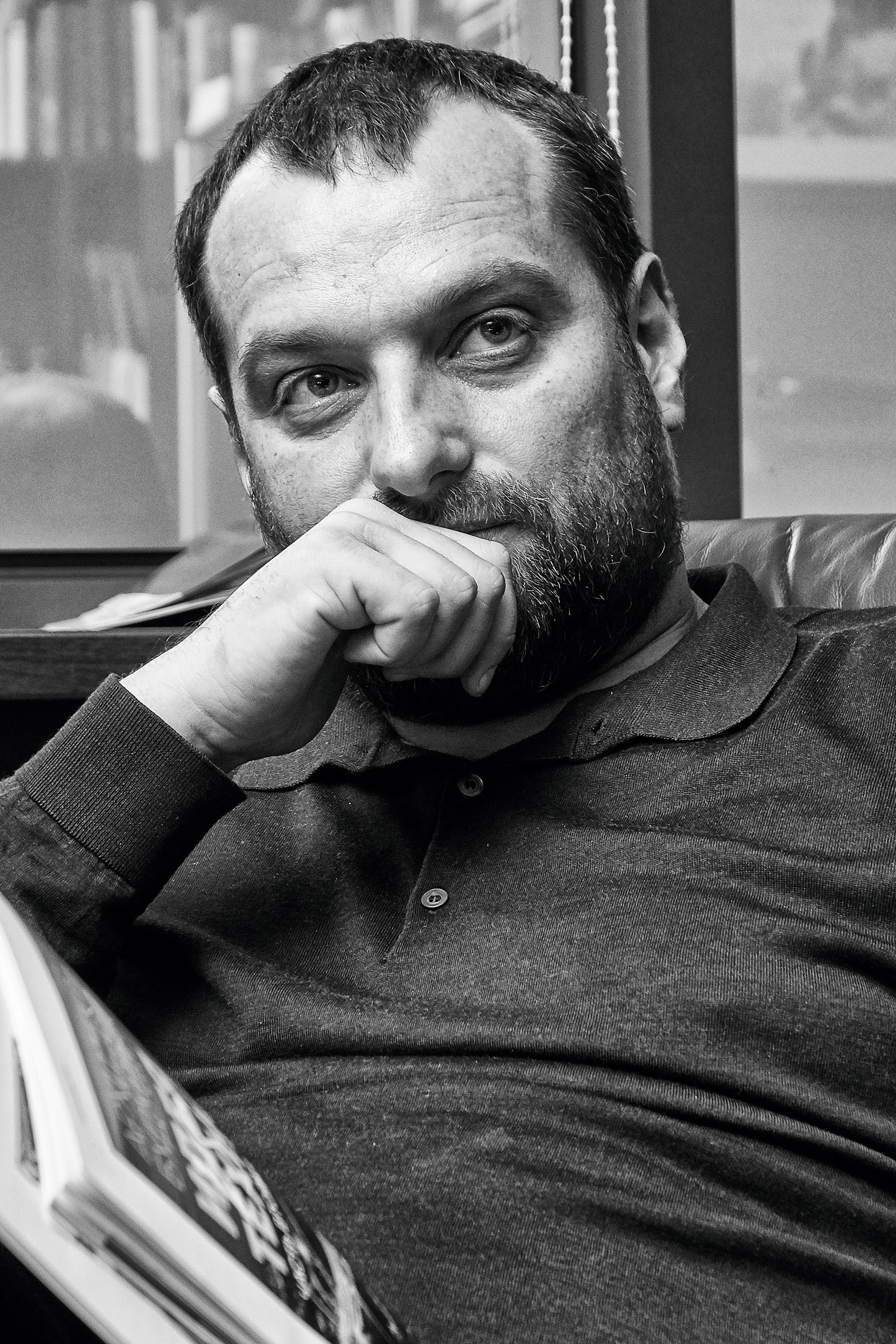
Andrey Vavrysh
For example, by making walls from foam concrete and realizing that they are much worse than bricks, you say that you are simply fighting for the cost price, and you do not care about the comfort of the client and the heat resistance of the house.
We now have a big battle unfolding - a client comes and says: "I want glass railings on my balcony, like in the neighboring section." I answer: "Well, my friend, your forged ones are no less beautiful, at the same time, sorry, there is a difference between 240 and 80 euros per linear meter." Of course, there is a factor of the architect's right to choose an architectural technique. He determines where glass is needed, and where something else is needed.
At the same time, I realize that I am talking with the client about the choice of material for the balcony fence! An hour ago it was unreal - there would have been a balcony! And now I am conducting a dialogue with the client on the topic of ethical boundaries: why is the neighbor better than him! You will not believe how much a client grows when you are open to him! When building a long-term relationship, you cannot fail to take into account the unprofessionalism of the other person. You are obliged to correct any of the existing situations, level it, find words and explain. In this respect, of course, dialogue is a difficult story. And we try to find points of contact in it.
Now it seems to me that architecture is precisely about relationships
KK: What role does project architecture play in these long-term relationships?
A.V.: I think that in general all this is architecture. Human relations are also architecture. It seems to me that we are finally getting to the true meaning of this concept. Previously, it was perceived exclusively as a creative process of creating a certain engineering structure, structure. Now it seems to me that architecture is precisely about relationships.
K.K.: And not only with a man. With the city, with the masses, with the state, and so on. So what role does it play?
A.V.: We are completely absorbed and are in the process of architectural transformations. Both in the context of the city and in the context of the company.
K.K.: I have a "homemade product" with a list of factors influencing the commercial success of architectural projects. Among them are the location, marketing, architecture, which we talked about, the cost of the project, its functional program, the reputation of the developer, the reputation of the designer. How much is this complex for you?
A.V.: It seems to me that one more point is missing - public perception. Or external perception of the project. This is the reverse reaction. I am absolutely sure that the public assessment occupies a very large share of the value of the project.
K.K.: How do you perceive it, how do you measure it?
A.V.: I can give an example. There are several houses on the slope of the Dnieper, between the Verkhovna Rada and, say, the Obelisk of Glory. And I did not meet people who would brag - they say, I worked here for so many years, I earned millions, I live here. I have never met people who are proud of the fact that they live on Hrushevsky. That is, a person spends all his life resources, but he cannot admit where he lives. How much of this kind of relationship to the object is included in the cost of a square meter? I will assume that it is at the level of a third to a half of the profit. Much more than the cost of materials, if you will.
The fact is that you need to find a balance between what is possible and what is necessary on the construction site. Everything is good in moderation.
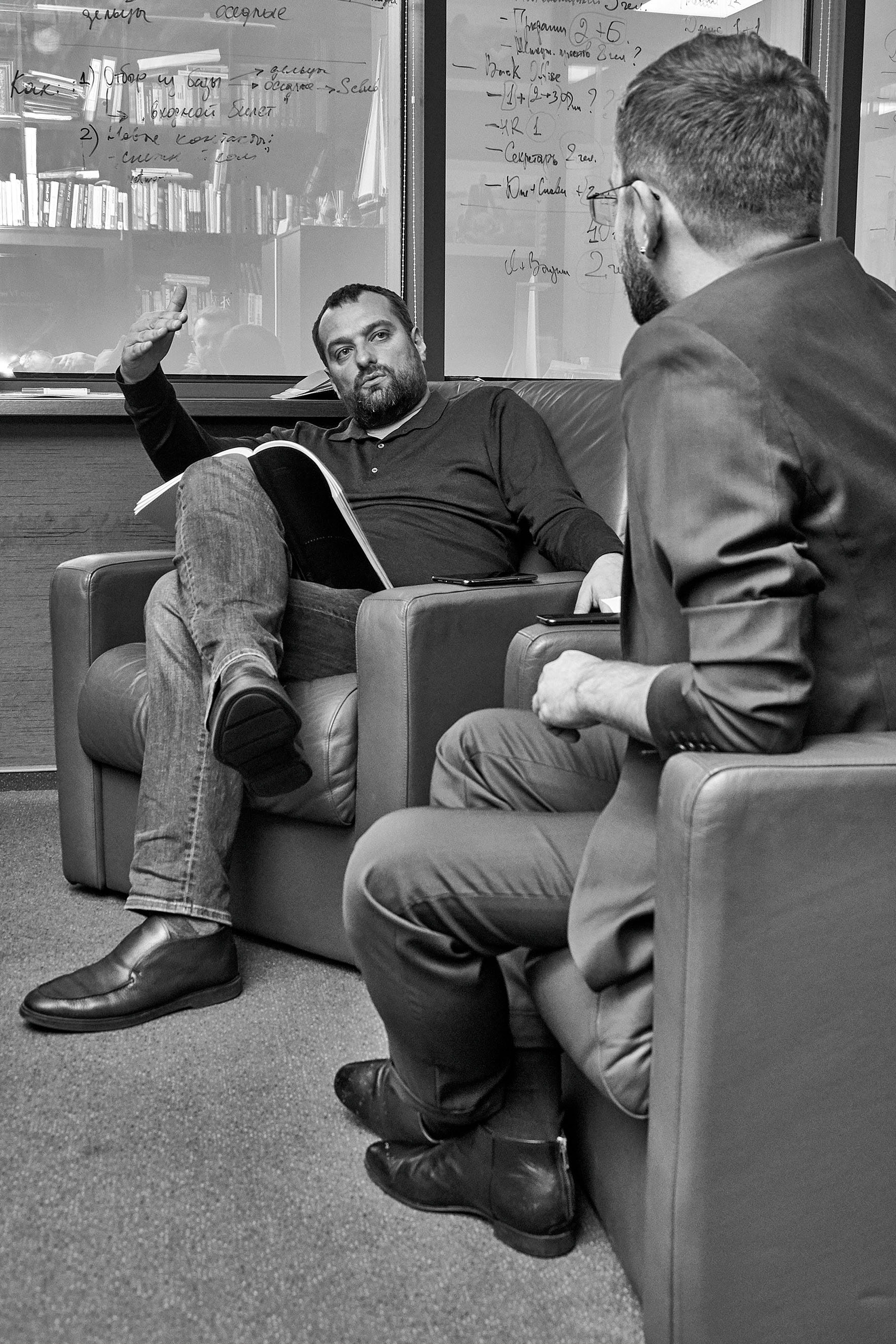
Andrei Vavrysh and Konstantin Kovshevatsky
K.K.: This is ethics.
A.V.: So you want to say that the Podol Theater is about ethics?
K.K.: Yes, of course. This is about ethics, clearly.
A.V.: I would say that there is much more than ethics. This is a matter of public legalization. We received an architecturally stunning object, where everything is perfect with proportions, with program, with functional content, with materials. Everything is fine on all points from your list. What is the fate of someone's humming in this case? How much would it affect the price of the theater if it were sold?
K.K.: Tell me.
A.V.: I know that it would affect a lot. Public legalization of the object has a significant meaning. But the physical object is one and the same! The fact is that when we ask what is the ideal size of an object, the question needs to be formulated differently: where is the public compromise regarding the size of the object? In my opinion, the theater is ideal in size. A public compromise was not reached. Let's imagine what would happen if the target indicator was the number of meters: the theater became one and a half times larger and more money would be earned per meters. Everything would be considered: an excellent example, good balance, enough meters. Developers are handsome! One and a half times more at the same site! This entire balance changes because of the third component, which is not present now. This is public legalization. The city belongs to everyone. And this point is very vague in principle, but it precisely determines the parameter of public legalization.
The object of architecture must cause resonance, must give rise to the feeling that it has changed the space - not spoiled it, but introduced new meaning
Ethics is a thing that develops together with society. Now her level is equal to sexes, views, the right to self-determination, to self-evaluation. And we proceed from this and build a new concept of public compromise. Then the question: Why is the indignation of citizens not part of this compromise? It seems to me that in such cases it is not important who is right or wrong, but whether or not you were able to convey your point of view. The problem is that work with public opinion is often based on the principle "I'll cut everything down here quickly before they wake up." And where are the ethical frameworks?
KK: Do you have it inside? Do you work with people who will potentially evaluate your future projects? If you work, how?
A.V.: Firstly, we are responsible for our own ethics. Secondly, it is an understanding of what we welcome and what we do not. Well, for example, I can proceed from the fact that classical architecture is the crown of human creativity and in no case should proportions be violated. And, based on this, we will evaluate the architectural work and say that it is only right. And someone starts from the fact that architecture is a search that must correspond to the time, a careful attitude to the existing context. At the same time, we are in the same city at the same time, with a common context. We perceive ethics in different ways.
Therefore, first of all, ethics is determined by goals and self-identity. This is the root of determining acceptable or unacceptable methods. And the distance between what is permissible and what you aspire to, is it circumstances of insurmountable force or your existing work front? The developer or architect, realizing that the act of creation begins with the act of destruction, must be responsible for how his ethics develop, where the limit of what is possible lies - before, during and after the implementation of the project.
Both I and my company — we perceive ourselves as a subject of the process with a mission, role and responsibility for what we do. And we understand that the concepts of ethics, morality, permissibility, and progressiveness should drive the framework. In all this, it is a big job, which consists in trying to explain, finding the right words for those who do not understand you yet.
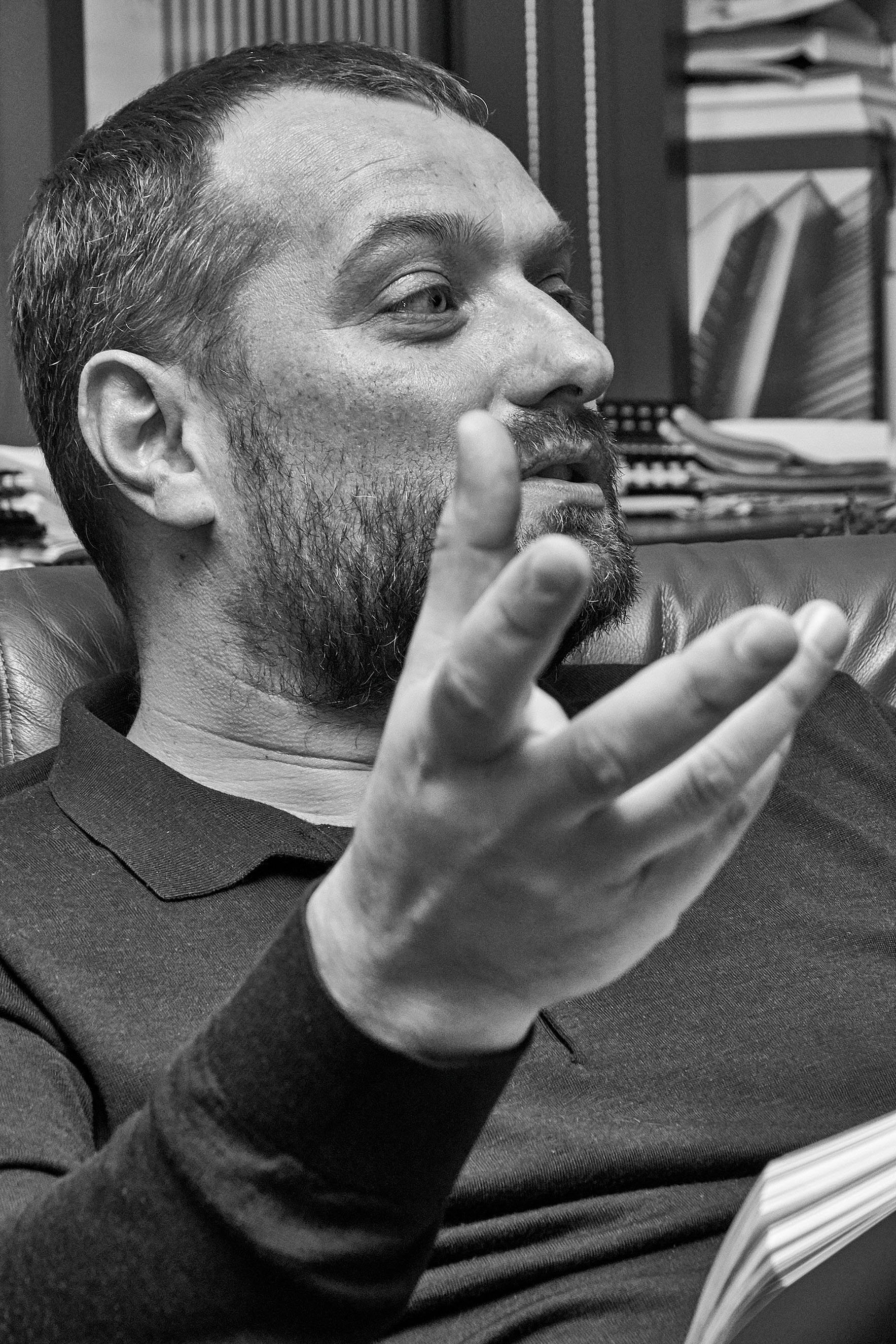
Andrey Vavrysh
K.K.: You have now shown us the new Saga project on Sahaidachnogo Street in Kyiv. Why did you choose Drozdov as an architect? What were the selection criteria?
A.V.: HYIP.
KK: Hype for this project or hype that will rise?
A.V.: I think we deserve quality architecture. One of our partners once said: "If a building is born and no one talks about it, it means that it died at the moment of birth." An object of architecture should cause resonance, should give rise to the feeling that it has changed the space - not spoiled it, but introduced a new meaning. We understood that we were taking on a very responsible project — this is the only site available for development on Sahaidachny. We understood that this is generally the only voice that will be heard here. And in this regard, by the way, I am sure that we succeeded.
K.K.: If we continue the topic of hype, do you take into account the component related to his participation in competitions when choosing your architect partner? The press likes to write about it, regarding the contests as an information occasion. Is this important to you?
A.V.: Unequivocal conclusion: competition is good. But I want to ask: who are the judges? Or even so: what do they judge? After all, this is such a powerful synthesis of available resources, platform capabilities, technologies, available solutions, regulations, DBNov, context, partners that it is very difficult to maintain competitiveness in its pure form. But, of course, it is impossible without competitions. We try to organize such things at the internal level. Competition takes on a completely different meaning in the context of work on public facilities.
Both I and my company - we perceive ourselves as a subject of the process with a mission, role and responsibility for what we do
For example, we are doing the "New Podol" project, and when last year we held a competition for the best embankment solution, despite the apparent similarity of the solutions, in fact they turned out to be fundamentally different. And you see how different the feelings of social compromise can be for architects. That's when you understand: what needs to be implemented on this particular embankment today is also different from what will be needed here in 5-10 years. And that's what was needed 5 years ago. As a result, the situation is changing, and no competition will provide the only concrete solution that will satisfy all requests in one fell swoop.
KK: Let's talk about modern technologies. BIM is already a necessity. Is the use of this technology a mandatory requirement for an architectural partner?
A.V.: Since March of last year, we have not done a single concept or project without BIM. A 3D model is also mandatory. Of course, these technologies have already affected and changed the work of designers.
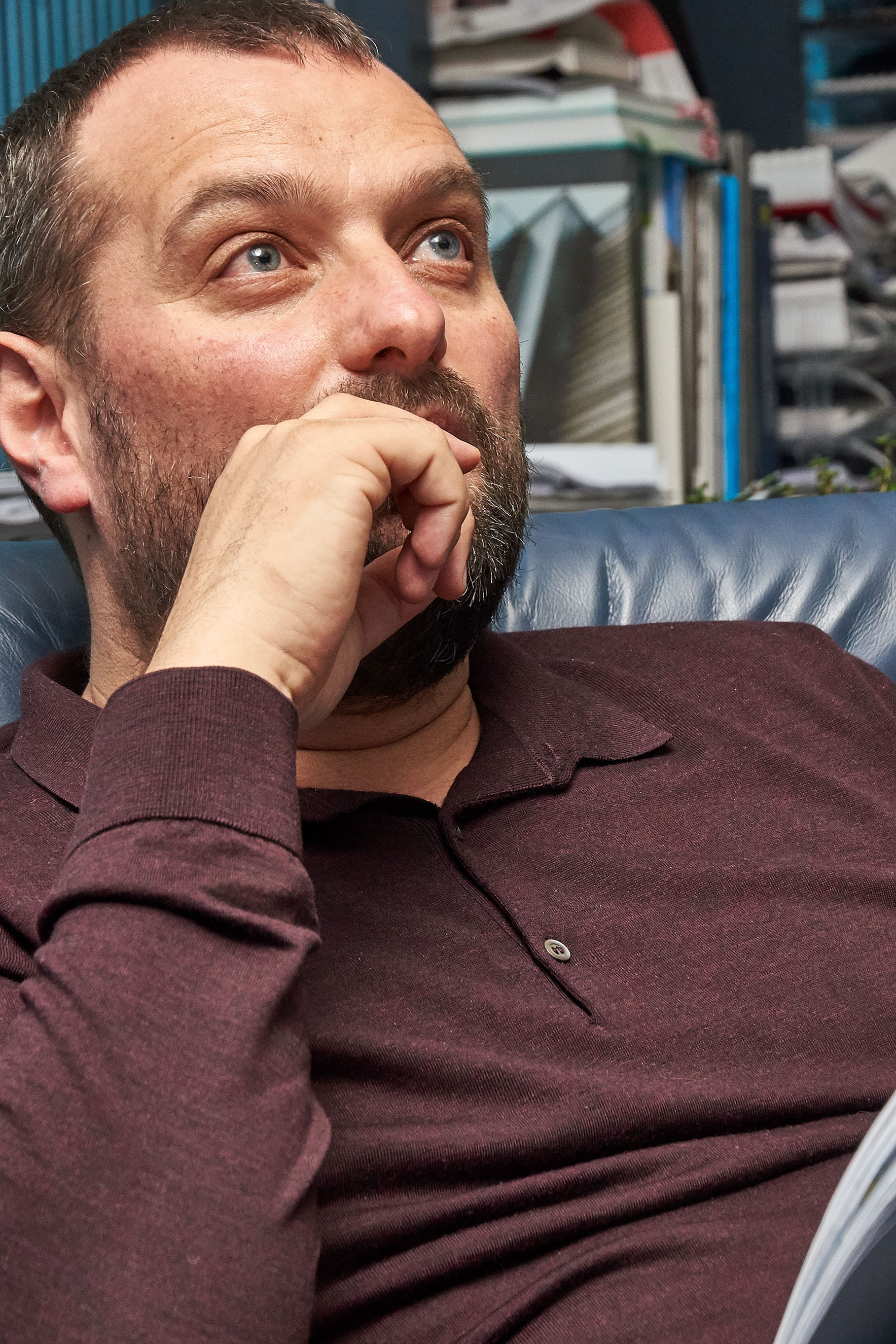
Andrey Vavrysh
KK: Do you have a sense of the difference in the approaches of foreign and domestic design companies?
A.V.: I spoke with a transport engineer who first worked in Russia, then returned here. He told how he once came to Germany, came to his colleagues, expecting to encounter the use of super-advanced methods of optimization of the city model of the transport system, how he suddenly realized that they were going through options for side stone together and discussing pockets for transport and bicycles. Time, two, three, five - pockets, lighting... We walked along the fasteners. All day they disassembled individual nodes, bolts and nuts. He says: boring. They say, in Moscow it was: in a flash — and the district road! That was a challenge! It's the same in Ukraine, but it's boring in Germany.
This is how work with Western colleagues is built. I'm not ready to spend six months just to form a contract. And without it, it is impossible - a western architect will fulfill exactly what is written in the agreement. What you don't write, you won't do.
KK: Isn't this a question of the very predictability to which we all strive?
A.V.: This is not a question of predictability. This is a "tonchylova" question. To deal with them during global changes is the same as not feeling the dynamics of the changes taking place. Delu vremya is a fun time.
Daria Kuharenko
Marketing Director of the A Development company
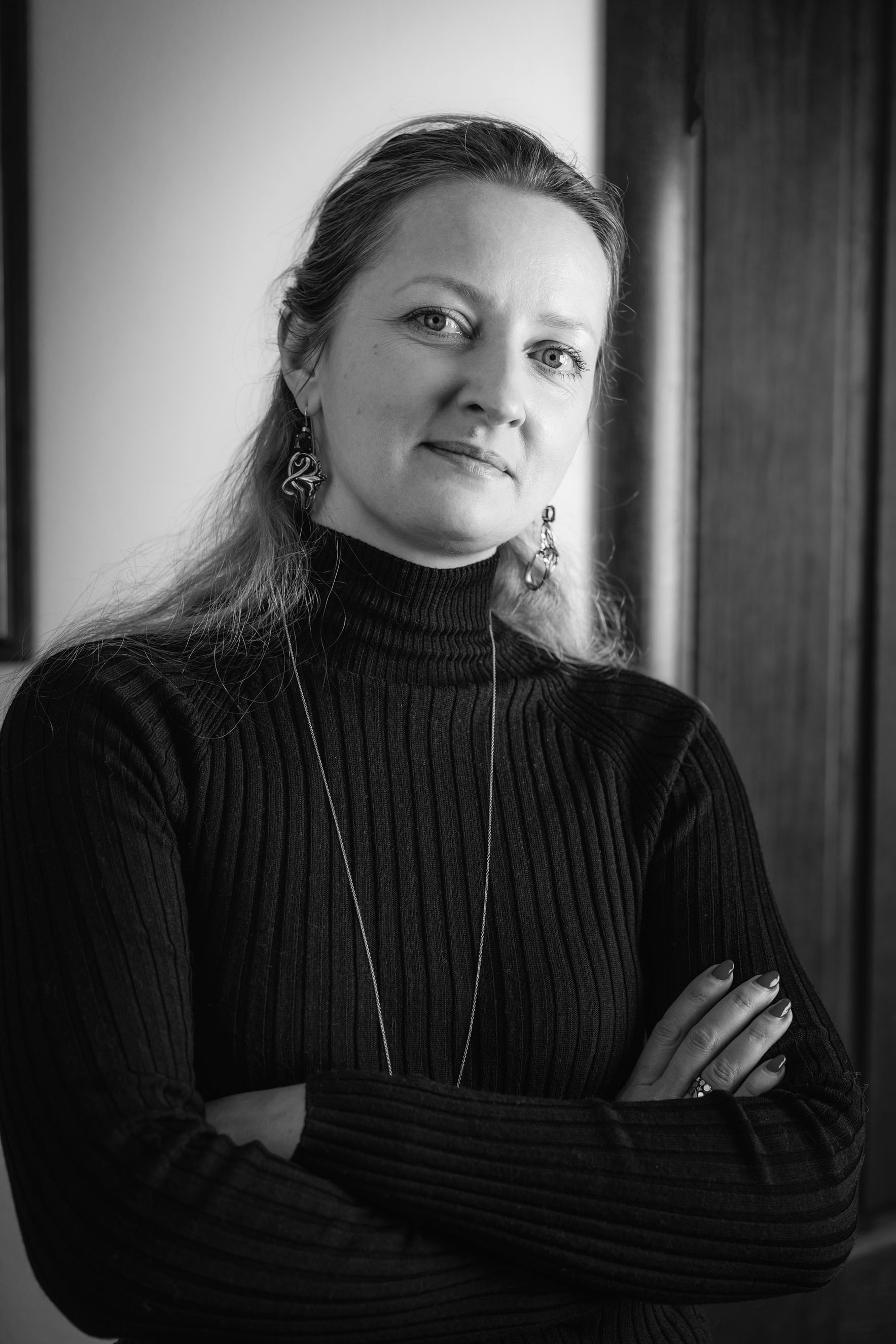
Daria Kuharenko
Konstantin Kovshevatsky: How would you assess the situation on the real estate market in 2019? What to expect?
Daria Kuharenko: My opinion is that our real estate market is not homogeneous in its composition. From my point of view, the market consists of at least two large, very different segments. The first is economy housing. This is all that applies to that type of housing, which covers the basic need of a person in his own apartment. This part of the market will always be in a state of very tough competition, namely at the price level, the possibility of providing installments - quite economic factors. The second segment that interests us the most as a developer is the housing market, represented by objects that provide advanced opportunities for self-realization, self-identification, not just protection and safety, but also a wide range of "utility" functionality built around this housing.
In the end, we say that the resulting factor here is the price — on average, from $ 1 per square meter. meter and higher. And in this segment, for us as developers, there is no big difference: we immediately begin to compete with all objects on the market that have some kind of advanced characteristics. Agree, in Kyiv and, probably, in Ukraine as a whole, there has not yet been a situation in which people, based on belonging to one or another class or income category, say: "No, I will not buy housing costing up to two thousand dollars per meter, because that this does not correspond to my level." In other words, we compete with everyone at once.
If there are no force majeure events, I do not expect any serious negative impact on our market segment
Our clients are people who are ready to live in a good complex in Holoseevo, in a good complex in Obolony, and in a good complex in Pechersk - for them there is no blocking factor in the area. In our country, all this is not so divided and structured as, for example, in America and Europe, where such segregation is expressed harshly. For this reason, in our country, all complexes of a similar class compete with each other at the same time. We with White Lines compete with the Central Park residential complex, for example, which is much more expensive in terms of cost per meter, or with the same Tetris Hall residential complex. Apartments in all these complexes are viewed by people of the same category. When they come to us, they say like this: "Oh, it's cool with you, because we can walk with our children in the Holoseev forest, and it's very cool." That is, clients with status make such decisions very easily. If we are talking about this segment of the market, it seems to me that it is possible to predict a fairly stable situation, despite all the pre-election vicissitudes. There is a small chance of a certain vacuum before the elections themselves, when everyone will look at the fight with dismay, but this is still a deferred demand that will be converted later.
And in the end, if there are no force majeure events, I do not expect any serious negative impact on our market segment in 2019. It will be fueled by these, let's say, "conscious buyers" - the main source of additional income, and the situation will be enough calm Competition will consist of qualitative characteristics, because it is image-based, it is competition in the plane of understanding the product, understanding the needs of clients.
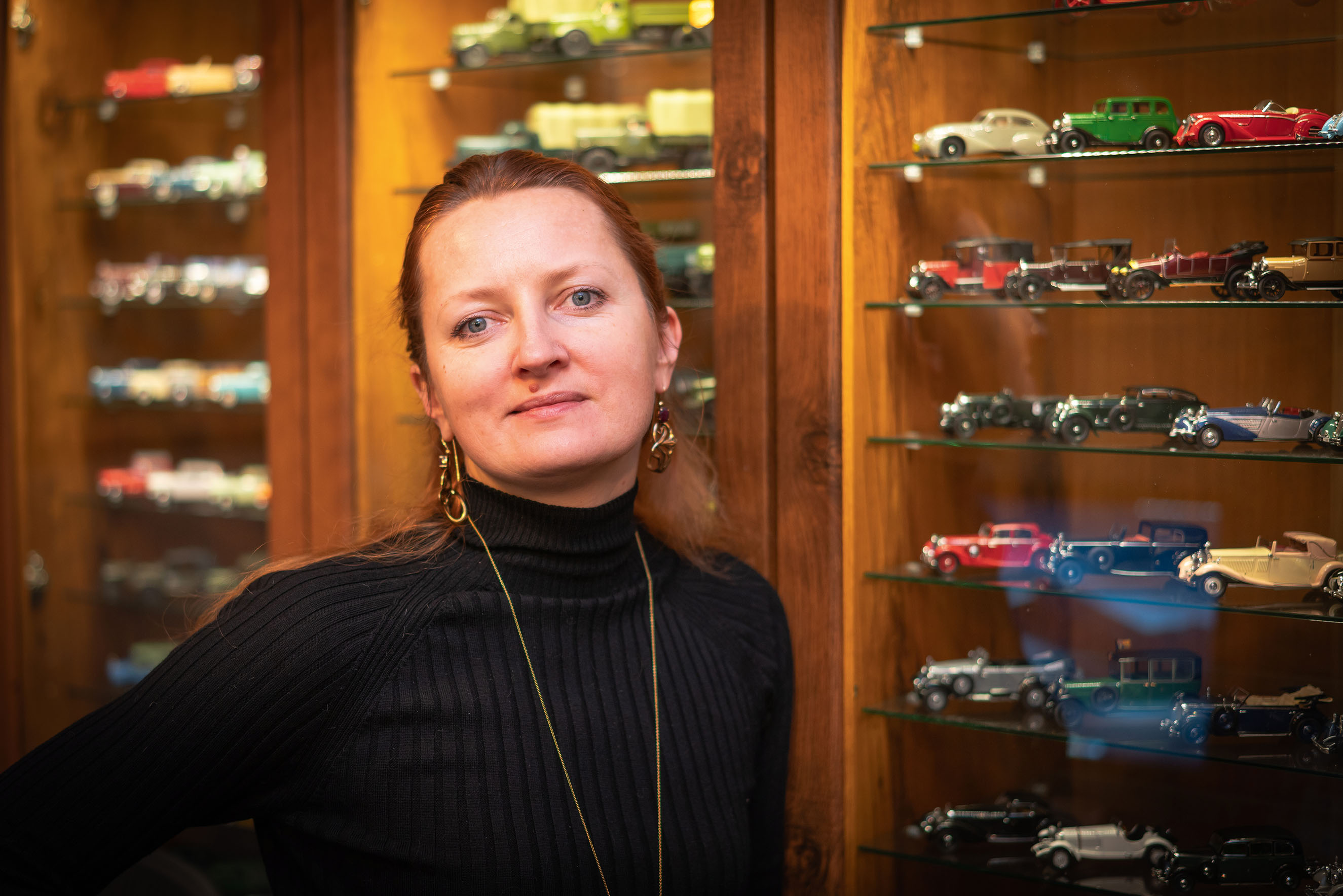
Daria Kuharenko
K.K.: That is, these quality characteristics of housing will be a "window of opportunity" on the market for developers?
D.K.: If talking about our complex and its concept, then I must note its honesty in relation to city residents. We have all our facilities in close proximity to the metro. It would seem that this type of transport is not an important factor for future residents when choosing housing. After all, the vast majority of these people drive cars. But you should not discount the forecasts of the development of the transport infrastructure and the situation on the roads in general, which will only worsen from year to year. I believe that in two years it will not be a shame to go somewhere by metro. People already keep this "plan B" in their heads when making their choice. In addition, the presence of a metro junction increases the investment attractiveness of this housing, considering the possibility of renting or selling the housing. Metro carries an additional convenience, which by default will always be in this complex and which is then very easily converted into saved time. And time is the most scarce resource among citizens, especially if we are talking about people who lead an active lifestyle - they always lack time. If we offer the implementation of similar functions without unnecessary waste of time, then, I am sure, comments like "it's worth nothing" will not arise from anyone.
A person should not spend time traveling to satisfy his desire to do sports, go to the cinema or to a restaurant
Therefore, even those complexes that do not have any advanced capabilities due to their territorial location try to play on this territory, in such a "luxury fashion". In fact, in their case, this is an attempt to mask a functional failure, which in the future will entail significant time costs for the tenants. Operating in our own class, we believe that we must provide all the opportunities to satisfy the full cycle of the advanced needs of the tenant - this cycle must be closed on the territory of the residential complex. A person should not spend time traveling to satisfy his desire to do sports, go to the cinema or to a restaurant. Everything can be nearby. This is a completely different level of comfort and life. Agree, getting only what you want from the city is a special skill for living. And our complexes are for those who know how to live. I think that the "window of opportunity" in the market will appear among those developers who will be able to adapt to the life of citizens.
K.K.: And in the case of White Lines, what came first — the study of the existing needs of citizens, or your attempt to anticipate needs that do not yet exist?
D.K.: In the case of White Lines, such a good Ukrainian devil played a role - when we want this, this, and even here, he will plant cucumbers there (laughs). We created a kind of dream complex where we ourselves would like to live. Our entire team wants to live in this complex, including investors. We worked for ourselves, and everyone took into account his feeling of what he lacks where he lives now. Therefore, White Lines combined all functions in a single complex.
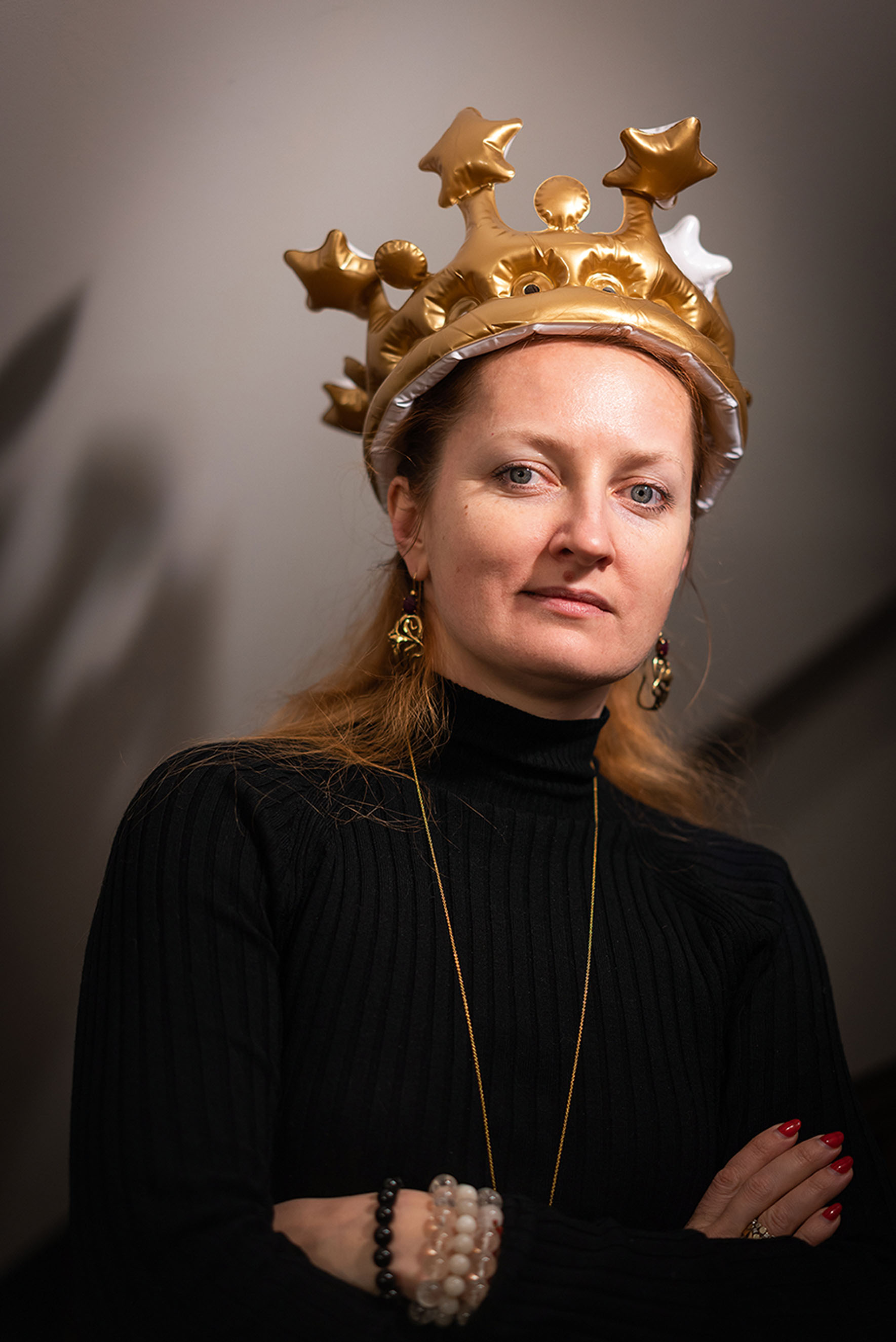
Daria Kuharenko
I would also like to mention vertical segmentation - we have been promoting it for a long time, since our first Smart Plaza complex. In this case, the price of a square meter changes significantly depending on the number of floors. It is necessary to understand that the basic needs of those who buy a square meter for two thousand dollars and those who buy it for one and a half dollars are the same. These needs are already determined by the urban lifestyle. But the possibilities are somewhat different. Therefore, we build the housing structure in such a way as to satisfy the needs of everyone — both those who are ready to compromise on living on 10-12 floors, and those who are ready to pay for a beautiful view from the window. Competition in this plane will be observed in an hour or two, when only projected objects, which I hope are fueled by this ideology, will enter the market.
K.K.: Let's try to talk about the success of the project. When we compiled a list of questions, we tried to find the factors of ego success. And what determines the success of your project for you? Is it purely economic indicators or the narrative around it?
D.K.: The financial side will always be profitable for the business. What can be measured is the execution of the business plan. In our market, it is impossible to fulfill it if the plan is not based on some right things, if there is no right product. You will not sell the project if you have not reached the target audience and its needs. This means that you are building incorrectly, you do not understand your customers, you do not understand the market and the times. In this case, the implementation of the business plan is a very honest measure of the success or failure of the project, and not even so much from the point of view of pragmatism and money, but taking into account how well the project was formulated. But money always results. Realization of the figures set in the business plan does not mean that we sold more expensively. This means that we have created such an object, in which a larger number of people want to live than we thought at first.
The financial side will always be profitable for the business
K.K.: What role does quality architecture as such play in the success of the project?
D.K.: It seems to me that such a category as quality architecture is... like a spherical horse in a vacuum. Architecture must meet certain tasks, take into account certain prerequisites. Architecture should always take into account the country, place, city, regional features, and time. And here we are to some extent talking about the correspondence of bites. On the other hand, architecture is the thing that develops, provides a breakthrough. Quality architecture is a story similar to art: to be mediocre, you don't need to prove something to someone, but in order to assert yourself, you need to take a risk. And in this case, quality architecture for me breaks down into several components: how well and correctly are the planning solutions that ensure the quality of product use; to what extent these solutions are optimal from the point of view of the cost of construction, that is, professional, but invisible to the user - only the one who builds can see this. And the third point is probably obvious to everyone: how well does the project fit into the urban environment and how much the citizens like or dislike it. It seems to me that, when discussing quality architecture, we are still talking about the third factor. In my opinion, everything is simple: if after an hour someone appears who builds "the same thing, but with mother-of-pearl buttons", then the architecture was cool. She received a response from professionals and non-professionals. They talk about it, they want to repeat it. Quality architecture affects the entire market. But how can it be measured in one project? We never built so that it was good inside and ugly outside.
You will not sell the project if you have not reached the target audience and its needs
K.K.: Continuing the theme of the spherical horse in a vacuum: a certain residential complex in a certain city — can it break out of the urban fabric?
D.K.: Let's remember Prague, Berlin, Vienna with their very strong urban planning foundations. These cities themselves are highly regulated spaces. There we see bright modern objects mainly on the periphery. Because even advancedness and coolness can never be brought to the center. But if we mean the cities of the Soviet construction, where the primary focus was functionality and where there are many faceless gray districts of different periods, then it says that now we must build, focusing on the surrounding facelessness, it seems to me a crime against the city. After all, the city is not developing at the expense of grayness! The city develops due to bright objects. Even in London, which is oversaturated with modern architecture, Foster's "Cucumber" was far from being perceived as a "fan". The project unleashed a flurry of criticism, but it developed the district, became dominant, people come to watch it. This is a system of new symbols. As for Kyiv, should we, for example, take into account the established image of Podol? Yes, of course. But when they say that it is necessary to take into account Troeshchyna's image, I am against it.
KK: Let's talk about how you choose design partners for your projects. Who are they, what should they be, what requirements do you have for them?
D.K.: We, of course, estimate that interesting things have been built in Kyiv recently, we look at who designed it. In this sense, we are quite conservative. And they have not yet come out with similar requests on the international market, because it has its own specifics.
K.K.: If you try to look at it from the point of view of world trends, do you need to understand that the company you work with is sufficiently avant-garde and open to change? And what do they feel a new paradigm?

D.K.: It is necessary for the company to have its own vision, so that it follows the development of the industry not only in Ukraine - this is a huge advantage, which also motivates us.
For us, the only opportunity to develop is to communicate in a professional environment. In my opinion, the right architecture companies should have enough resources so that five percent of the total number of employees are doing nothing. They just watched what was happening in the world. Fresh ideas were generated. For me, an architectural office is not so much a creative collective as a very systematic business. And if now in Ukraine they have such an opportunity to have an advantage simply by following what is happening in more advanced markets, then they should use it.
We see how the IT industry is developing in Ukraine and it is super competitive. But architecture is a similar industry. Because it sells people's expertise: architects work on the same computers with similar software. They can compete everywhere and with everyone. I very much hope that our guys will not only monitor what is happening in foreign markets and help the customer to understand new needs, but will also go out of their way to not only ideologically, but also technologically force us to build in a different way.
K.K.: To the question of technologies. Do you feel the need to work with companies that use BIM technologies in Ukraine today?
D.K.: It seems to me that, as a whole, the construction industry in Ukraine is very homogeneous. Construction is a tough business in itself. Why is it obtuse? Because this is the most technologically imperfect industry, which is very expensive and provides the most basic needs. They will not go anywhere as long as there is a person. And while in the last ten years the connection, for example, has undergone incredible technological changes, practically nothing has happened to the building during this time from the point of view of technology. This is not just a superficial impression. The business thinking of the entire industry is old.
In my opinion, the right architecture companies should have enough resources so that five percent of the total number of employees are doing nothing
On the one hand, to be honest, the realization of the importance and convenience of such an approach comes gradually, because innovations of this kind always cost money. We decided for ourselves the question that we are willing to pay for a separate object. In the end, we will see if this decision was effective from the point of view of investments and how much we won in time, in the absence of alterations. We must see the economic feasibility. This can be calculated after the fact when the project is closed.
Perhaps it is easier and more profitable for architects to use these technologies, but are developers willing to pay for it? If it's easier, but the work costs one and a half times more, will they be able to sell their services and be competitive in the market? I would say this: if this is the standard in the market of Australia or the USA, architects need to enter these markets and start designing there. And ours will stretch. I repeat, construction is an old, ossified business. And as long as 85-90% of our ego players build "cubes", no breakthrough will happen.
K.K.: Now you called money the main competitive component, and when you talked about the state of the market and forecasts, you said that the concept opens a "window of opportunity".
D.K.: About 90% of the market is economy housing. Such is the reality.
We see how the IT industry is developing in Ukraine and it is super competitive. But architecture is a similar industry.
K.K.: If we are talking about the fact that the economic expediency and cost of your contractor's work is one of the main selection criteria, is it possible to conclude that the reputation of your partner is important to you? And are you ready to pay for reputation?
D.K.: Reputation is experience, if you and I translate this word into some understandable things for digitization. And the partner's experience is, of course, monetized. Experienced companies need significantly less time to perform work. And the number of errors will be lower — and this directly affects the budget. I can talk about our projects, about our approach to complex projects: we very much welcome and pay serious attention to the presence of a partner with similar experience in the design of complex objects. Otherwise, even with lower design costs, we will receive much higher construction costs, which will be associated with suboptimal solutions and deadlines. And this part of the budget is only ours.
If the designer is experienced in precisely those issues that are needed, we will be ready to pay for his experience.
KK: Do architectural competitions and awards play a role for you? Does the nomination of one of your projects at the World Architecture Festival mean anything to you?
D.K.: For us, the nomination was a pleasant addition. Our partners from archimatika. But we considered for ourselves the need to necessarily take into account the competitive component in the future. We will definitely submit our projects and independently come up with such initiatives. It is not the award itself that is important here, but the fact of participation, gaining experience. And of course, the opportunity to directly ask questions of those who implement grandiose projects that you just read about on the Internet. This is a very cool thing. In this case, we as a customer are much more interested in commercial issues, in which the participants of the contests are usually well versed. Competitions are an invaluable platform for professional communication.
Elena Beletskaya
Head of the sales and marketing department of the construction group "Fundament"
Elena Beletskaya
Konstantin Kovshevatsky: What dreams do you have for 2019? And which of them, perhaps, have already turned into real plans?
Elena Beletskaya: Dreams are more objects, more projects. We took a long time to start the sale of one of them, the "Privitny kvartal" residential complex in Bortnychy. And unexpectedly for myself, sales began in December 2018. This is usually the case in the real estate market - we wait for a long time, then we open very quickly. Interestingly, at the stage when we started preparing the scripts, descriptions of the object, absolutely everything - both I and the marketers - changed the stereotyped ideas about the Bortnychs. We are used to the fact that Bortnychi are associated with the station - these are negative associations, and therefore at first we were wary of this project. But when we began to describe the advantages of the residential complex, it turned out that there is a beautiful forest, a steep lake, many villas of famous people, great views. I dream of making people not afraid of stereotypes about the location. I want them to come and evaluate the benefits themselves. And, of course, we count on good sales.
The same applies to our second project - "Welcome Home on Stetsenko". Of course, I dream of selling everything by the end of next year. What is unusual and interesting about this residential complex is the spatial environment and magnificent open views, despite the fact that there is a 6-7-storey building around. We have a very good demand here, although we made the price of the last turn significantly more expensive.
The factor that always drives the developer is economic expediency. This is the profit he wants to get
K.K.: And what factors affect the formation of value?
E. B.: The factor that always drives the developer is economic expediency. This is the profit he wants to get. Initially, when sales are only being planned, the developer wants to receive a certain cost per square meter per circle - for the entire complex. At some objects, we started with the minimum price and gradually increased it, for example, as in Stetsenko. We sold the first batch at minimum prices. The price of the second phase approached the average market price, but remained lower than that of our competitors in monolithic construction. With such a smooth increase in prices, we demonstrate to our customers and the market as a whole that prices will not fall. And this gives us the opportunity to receive the margin that we initially included in the price. Commonly known market statistics: the cost of construction increased by 20% compared to last year, and builders' prices increased by up to 10%. It's the same with us - we have to pay the cost price, the plant, shares and, of course, make a profit.
Elena Beletskaya
KK: Let's talk about the real estate market in 2019. What will he be like?
E. B.: I can't predict its fall and I don't see stagnation in the market either. I believe that a fairly stable demand will remain. This is largely because we still have an attractive investment in real estate. Among our clients, there are consistently many who, buying apartments for themselves in the premium segment, also invest in economy housing, considering it as additional income, a more liquid and reliable asset than a bank deposit. And among these investors there are many wholesale buyers. There are also clients who buy at the minimum price at the stage of the beginning of construction, and later, even before the building is put into operation, transfer the property to an ordinary buyer who did not have the opportunity to buy it at the initial stage. At the same time, such a purchase is cheaper and more profitable than in a leased house with the right of ownership. That is, I believe that it is possible to assume that the demand from investors is still quite high. In the cases I mentioned, the profit can reach 50%. And with great efforts and time spent — up to 130%.
K.K.: And what terms are we talking about?
E. B.: About two years. We started selling the residential complex "Welcome Home on Stetsenko" for UAH 13, and at the stage of commissioning, our prices reached the mark of UAH 900. UAH per square meter.
Publicity presupposes a thorough approach to project development
K.K.: What "windows of opportunity" do you see in the field of construction in 2019?
E. B.: Since our company owns a factory for the production of reinforced concrete panels and we sell apartments in complexes that are built from our materials, we will develop this direction. I believe that housing in the economy segment will continue to be in high demand. And in order to support this demand, we are developing special investment proposals within the company. The investor will be able to receive interesting special conditions, a loyalty program. We develop investment packages. I see our development in this direction, and we focus on this. Just an hour ago, we were not so attentive to investors, but now we analyze their behavior, their intentions, changes in their expectations, evaluate how they track our objects. We inform them with the help of chatbots in the Telegram channel. We strive to do everything possible so that they learn about our offers in time. We understand that those who bought apartments in our early projects are now reselling them and accumulating free funds to invest in our other projects. So, we have good sales in Kamerton residential complex - it's business class. It is possible to say with confidence that the demand for quality housing is also high.
KK: What is a successful project for you? Are these financial indicators, quick liquidity, something else?
E. B.: If evaluated as a whole, our projects in the field of panel construction are successful. They are sold out even before they are put into operation. And this is primarily a financial indicator. Such liquid projects give us the opportunity to develop, start new projects, and start construction on time. But after all, success is also an image component, when our residential complexes become recognizable. "Fundament" is recognized, it is heard, and this is also pleasing.
Elena Beletskaya
K.K.: Let's try to rank the success factors of the project in the order of their importance.
E. B.: Probably, let's start with those that affect commercial success. Location is first of all. When we introduce a new object, the neighbors are the first to be interested in it. The first buyers are those who live nearby. They invest in real estate in the neighborhood because they get used to living in a particular area. Infrastructure issues, transportation, familiar shops, kindergartens, hospitals, summer cottages are fixed here. And for any person, moving to another location is stressful. Therefore, from the buyer's point of view, location is important. One of the competing companies built a residential complex right at the entrance to the subway. Of course, they will have great sales! Transport interchange is very important in the case of business class housing. The metro is appreciated by the younger target audience - it is often easier and faster for them to ride in the underground.
The presence of infrastructure nearby is important. In Kamerton, for example, I cannot say that the presence of a subway nearby is one of the key issues. All the same, the transport junction is important, which allows you to leave the area. Location is very important from the point of view of advertising — the visual accessibility of construction, the presence of construction in visible places, near the highway, which always attracts more attention. And again, the pace of construction is important — this in itself saves the budget for advertising, and significantly so.
Recently, I had a customer who voiced an interesting opinion. Earlier, we considered Obolon to be a good area for living in the category of business class and above. Today, these people are not ready to live in the Obolon district. According to this buyer, it is run by a weak householder. Today, the client is considering the Podolsky district, where the administration is stronger, which means that there is higher security, and also cleaner, and better schools there.
It seems to me that the functional program of the project and marketing are interconnected. These two components cannot be separated
Cost will not disappear anywhere, it will always be important. Numbers always mean something to the owner. Thus, the cost price remains in the second position.
It seems to me that the functional program of the project and marketing are interconnected. These two components cannot be separated. We understand that few people are interested in housing as a box or as a wall. When buying, the functional and emotional components immediately follow the economic factors.
When choosing a housing layout, the client considers it from the point of view of functionality, his needs. And here constructive and design solutions come into play. After all, it is no secret that one and the same apartment can be presented to the buyer in different ways. And the success of its sale depends on our flexibility, on how we can beat the layout. In one of our complexes there was such a feature - based on the requirements of insolation, it was impossible not to build three-room apartments. However, it turned out that three-room apartments are not for sale. We fought over these little things, and an hour ago they reduced the price to a ridiculous amount. They were already sold at a price of 12 per square meter. m - it did not work. And then we decided to look a little further.

Marketing played its role here: we analyzed what the market wants. One-room apartments were needed in that area, in the immediate vicinity of the metro station. We came up with an architectural solution — we moved the two bathrooms in different directions and managed to functionally divide each bathroom into two units. This made it possible not only to sell off "illiquid" - we raised prices, and demand continued to grow. We offered two one-room apartments at the same price per square meter as a three-room apartment. It is ideal for those who invest in real estate for rent. And here is such a solution, when both marketing and architects worked, it made it possible to sell these apartments.
In the residential complex "Welcome Home on Revutsky", for example, we had two-room apartments with an area of 63 square meters. m, which were not in demand. Apartments with an area of 54 square meters. m sold well, but these did not: a small kitchen, huge rooms, a typical Soviet solution. We moved the bathroom, made a huge kitchen niche. The apartment, in fact, has already become like a three-room apartment - very often the kitchen-dining room is perceived as a separate room. And such a solution also allowed us to successfully sell these apartments.
Numbers always mean something to the owner
K.K.: And what was primary in these cases — the architect's proposal or the market analysis?
E. B.: My analysis was primary. We see that we have "standers" who do not go away - neither discounts nor shares are saved. We conduct an analysis with sellers - they are the first to receive feedback "in the field". And after that, the architect responds to the market request formulated by us, which we refine, visualize, make cool layouts, landing.
K.K.: Based on the changes dictated by the market, do you take into account similar points when designing your future complexes, the next stages?
E. B.: Of course. There are many restrictions in panel construction: the house must be entered into the plot, and all the standards of the State Commercial Building must be met. And we need to enter the project indicators that we want to get from this site, connect them with the features of our panel construction, plus correspond to the market, take into account its requests. And taking into account mistakes in previous projects, we make such layouts that allow combining apartments, for example, 2+1, 1+1. We take into account not only planning decisions, but also landscaping. For example, if earlier we had standard children's playgrounds, today we introduce various innovations - musophones, tubophones, climbing frames.
Elena Beletskaya
KK: Let's talk about the role of high-quality modern architecture in the success of the project. How to measure it?
E. B.: This is a very important factor. Of course, it is impossible to measure and digitize it, but it increases the cost of a square meter and our profit. We see this very clearly. For example, with trivial planning decisions, but with a cool facade, a good marketing pitch, and the whole complex is colossally expensive. There is our competitor in Pechersk: the facade design is very unusual, and the layouts are generally uninteresting. But, I think, housing there will be in demand thanks to the image component and, of course, the location.
K.K.: How do you choose design partners for your complexes?
E. B.: First of all, our projects are developed by Fundament Project. We don't have to choose here. As for external architects, their image plays an important role. He is doing two projects for us archimatika. They are cool and there is no doubt that cooperation will give a guaranteed high-quality result, including in sales. Good project solutions facilitate the further work of both me and my managers.
Elena Beletskaya
K.K.: In Ukraine today, is BIM-projecting a necessity or something else like art?
E. B.: We see how the world is rapidly developing and digitizing. The figure makes it possible to carry out an accurate analysis, to consider errors at an early stage. And if earlier we made assessments based on someone else's opinion, now for me the opinion is only an addition to the number. Once upon a time, we collected information from managers, asking them: "What do they say to you?", but now I can clearly see how many calls there were from clients on a specific apartment, how many were contacted, what exactly people want. And by digitizing any data, we get a better analysis and can accurately predict further actions. This reduces both time and costs. I think that this is the future.
In order to support demand, we develop special investment proposals within the company
K.K.: What do architectural competitions mean to you, do you participate in them, do they make sense today?
E. B.: Observing the market, I can confidently say that competitions are important. Any publicity presupposes a more careful approach to the development of the project, and in the end, the young generation follows advanced architects, and our city, our world changes. Award and participation create additional credit of trust to the company.
K.K.: Did the awards received in competitions by, say, archimatika somehow influence the choice of this company as a partner, or did you primarily look at already implemented projects?
E. B.: Of course, we looked at the numbers. Depending on the plot, we can get a different amount of space for sale. And what in archimatika use advanced technologies, gives them the opportunity to design more efficiently, offering us, under the same conditions, greater design capacity, which, accordingly, will bring us more profit. And planning, functional and marketing solutions will give us the opportunity to sell the project more expensively.
Galina Martynenko
Manager of corporate communications of City One Development
Galina Martynenko
Konstantin Kovshevatsky: What dynamics of the real estate market do you predict in 2019? Is it worth expecting ego growth, decline or stagnation?
Galina Martynenko: There are no prerequisites for market stagnation and decline. New projects are launched every quarter, offering buyers a wide range of real estate options. Buyer demand for new housing is high, because more than half of Ukrainians need it. The old fund is gradually wearing itself out, cities and residents need new projects — modern, technological, convenient. The real estate market, of course, is very sensitive to macro- and microeconomic factors, the military-political situation. With the relative stability of the above-mentioned factors in 2019, it will continue its development. An increase in the share of luxury and business-class residential real estate is observed, and buyers are becoming more and more selective and demanding. This, in turn, increases competition in the market, stimulating companies to improve their products and services.
KK: Which of the real estate market segments, in your opinion, demonstrates the most optimistic behavior and will provide developers with a "window of opportunity" in 2019?
H. M.: Comfort and business. According to our company's analysts, the number of projects in the comfort class is increasing. In 2017-2018 the proportion of residential real estate projects in the business class also increased. This is primarily due to the fact that buyers increasingly pay attention not only to the price per square meter, but also to the liquidity of the project in the future, to its quality characteristics, additional services from the developer.
Buyer demand for new housing is high, because more than half of Ukrainians need it
KK: Which of the listed factors affect the commercial success of your projects? Rank in order of importance.
H. M.:
- location
- infrastructure, functional program of the project
- architecture
- builder reputation
- marketing
- the designer's reputation
- cost price
K.K.: How would you rate the impact of quality architectural solutions on the success/profitability of the project?
H. M.: In the conditions of increased competition on the market, the architectural concept is certainly a competitive advantage and an important component of the product's uniqueness for the client. This applies to all housing classes. Architectural solutions allow businesses to compete on the market, stand out and create a unique product. For the client, this is an opportunity to get additional functionality, new opportunities for life and recreation in the selected real estate object.
K.K.: In your opinion, what architectural solutions will be important for the final buyer / user of real estate in the coming year? What changes in expectations of commercial and residential architecture do you predict?
H. M.: Modern architectural solutions are becoming increasingly economical and environmentally friendly. More and more attention in the architectural project is paid to the creation of a comfortable environment for human life inside the building itself. Also, the factor of energy efficiency of the object and its influence on the environment plays an important role. The so-called green architecture is becoming more and more relevant and in demand. Modern science and technology make it possible to create whole ecosystems for life in a large metropolis, where a full-fledged symbiosis of a person and his natural habitat is possible without negative impact on the surrounding natural environment, using alternative (renewable) energy sources. This is the future, because people need clean cities, buildings where living and working will be not only comfortable, but also healthy.
Architectural solutions allow businesses to compete on the market, stand out and create a unique product
K.K.: By what criteria do you evaluate the quality of project solutions? Rank in order of importance.
H. M.:
- relevance of architectural and design decisions
- functionality of layouts
- the quality of interconnection between architectural, constructive and design decisions
- the quality of working out nodes and details
- the cost of the design solution
K.K.: There are many project organizations in the Ukrainian market. Which of them do you work with? What are the criteria for choosing an architectural company?
H. M.: At the moment, we cooperate with the design company "BIP PM", "Pecherska Architectural Workshop".
K.K.: Do you see shortcomings in the field of design in Ukraine? Are you planning to work with foreign architects? What are your expectations from such cooperation? How, in your opinion, do foreign designers differ from our architects?
H. M.: The company has repeatedly involved foreign specialists and experts in the field of architecture, in particular, in the projects of the residential complex "Novopecherskie Lypky", the Arsenal Square shopping and office center.
Such cooperation is due to the desire to implement the vision of different architectural schools. After all, there are enough of them in the world. Sometimes a different, original vision and solution can give the project that highlight that will add uniqueness and additional value to the project.
The so-called green architecture is becoming more and more relevant and in demand
K.K.: In the world, more and more attention is paid to the growing trend of "usefulness" of architecture for the city and the environment. Is this trend relevant for our country? Does your company use such an approach in the process of implementing projects?
H. M.: Absolutely. We use environmentally friendly building materials in our projects, carefully select their manufacturers. Due to the growing relevance of technologies and innovations in construction, we are actively working on their implementation in projects. More recently, we became partners with the University of California at Berkeley, and thanks to this cooperation, we will be able to implement the latest developments and research in the field of energy-efficient development.
K.K.: Today there are many different architectural prizes and competitions - both national and foreign. Do you nominate your projects for them? Do you find such awards prestigious? Does their presence in the design company's portfolio affect your choice of partner?
H. M.: Yes of course. Our company's projects have repeatedly become nominees and winners of domestic competitions, and have received prestigious foreign prizes and awards. For example, the premium-class residential complex "Bulvar Fontanov" became the owner of the prestigious international property awards 2017-2018. Residential complex "Novopecherskie Lypky" was awarded the EEA Real Estate Forum & Project Awards.


