

But how will elitism get along with the agenda of universal equality and gender diversity? How does a hedonistic (if not to say selfish) agenda fit in with trends towards reducing consumption and giving up the usual trappings of comfort - from traveling by private vehicles or, surprisingly, from the use of plastic bags? How does the desire to enjoy things without restrictions correlate with cultural context and the inadmissibility of cultural appropriation? And in an applied sense: how to borrow the best of Western practices without descending into the cargo cult?
Let's try to understand this tangle of contradictions and find out what trends will affect the creative industry, urban planning and design. We analyze summer trends, open envelopes with forecasts and listen to opinion leaders.
What doesn't kill us makes us richer
The seeds of new life sprout from urban decay. This is manifested in new preferences, the most popular of which are formed into trends and tendencies. City streets temporarily closed to vehicular traffic in the first six months of the pandemic have remained closed to this day. They were occupied by open areas of cafes, restaurants and parklets-microgardens.
"Shares" are green and open urban spaces as the most important assets have grown significantly. The pace of digitization has accelerated 7 times and continues to gain momentum. The negative trend towards monocentricity, when residents of the regions move en masse to the capital, seeking to increase their profits, has declined. Emissions of greenhouse gases have decreased, and in general, "nature has become cleaner."
See also: Anyone who does not take risks is not Bjarke Ingels
The pandemic has demonstrated the need to step up action to combat climate change and social inequality, and has sparked a surge of interest in urban gardening, which is small but has reduced the risks of a food crisis.

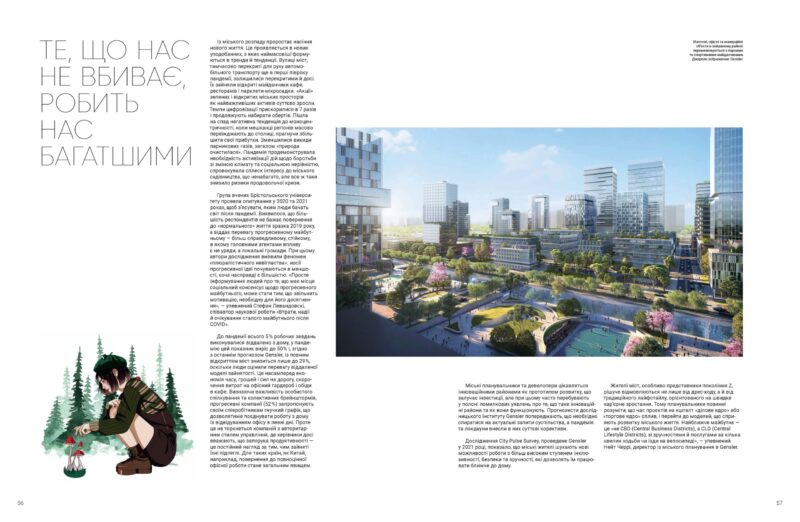
Residential, office and commercial properties in the mixed area are interspersed with parks and sports grounds.
Image source: Gensler
A group of scientists from the University of Bristol conducted surveys in 2020 and 2021 to find out how people see the world after the pandemic. It turned out that the majority of respondents do not want a return to the "normal" life of the 2019 model, but prefer a progressive future - a fairer, more sustainable one, in which the main agents of influence are not governments, but local communities.
At the same time, the authors of the study discovered the phenomenon of "pluralistic ignorance": the carriers of the progressive idea feel in the minority, although in fact they are the majority.
"Simply informing people that there is a social consensus for a progressive future can be what releases the motivation needed to achieve it," believes Stefan Lewandowski, co-author of the scientific paper Losses, Hopes and Expectations of a Sustainable Future after COVID.

Before the pandemic, only 5% of work tasks were performed remotely from home, during the pandemic this figure has risen to 50% and, according to Gensler's latest forecast, will decrease to only 29% with the full reopening of cities as people appreciate the advantage of the remote employment model.
This is, first of all, saving time, money and effort on the road, reducing costs for office wardrobe and lunches in cafes. Recognizing the importance of personal communication and collective brainstorming, progressive companies (52%) will offer their employees a flexible schedule that allows them to combine work from home with visiting the office on certain days.
However, this will not affect companies with an authoritarian management style, where managers still believe that the key to productivity is constant supervision of what their subordinates are doing. For countries like China, for example, a return to full-time office work will become commonplace.
Urban planners and developers are interested in innovation districts as a model for investment-attracting development, but are often plagued by misconceptions about what innovation districts are and how they function. Forecasters of the Gensler research institute warn that it is necessary to rely on the current requests of society, and the pandemic and lockdowns have made significant adjustments to them.

Gensler's 2021 City Pulse Survey found that city dwellers are looking for new work opportunities with a higher degree of inclusivity, security and convenience that allow them to work closer to home.
City dwellers, especially representatives of generation Z, resolutely reject not only the dress code, but also the traditional lifestyle focused on rapid career growth. Therefore, planners must understand that the time for projects like "business core" or "shopping core" has passed, and move to models that contribute to the development of urban life.
The immediate future is "not CBDs (Central Business Districts), but CLDs (Central Lifestyle Districts), with amenities and services within a few minutes' walk or bike ride," believes Nate Cherry, director of urban planning at Gensler.
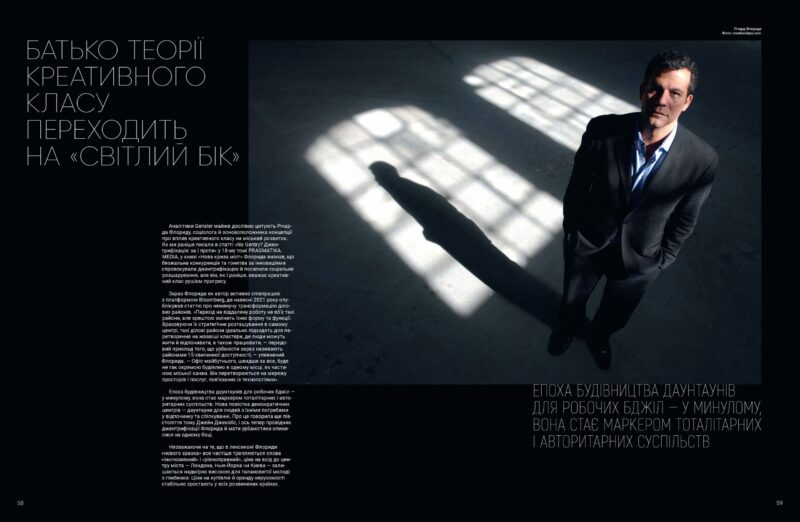
The father of the theory of the creative class turns to the "bright side"
Gensler analysts quote Richard Florida, a sociologist and founder of the concept of the influence of the creative class on urban development, almost verbatim. As we previously wrote in the article "No Gentry? Gentrification: Pros and Cons” in the 18th volume of PRAGMATIKA.MEDIA, in the book “The New Crisis of Cities”, Florida admitted that ruthless competition and the pursuit of innovation provoked gentrification and increased social stratification, but he still considers the creative class to be the driver of progress.

Richard Florida
Photo: creativeclass.com
Currently, Florida as an author actively cooperates with the Bloomberg platform, where in the spring of 2021 he published an article about the inevitable transformation of business districts. "The shift to remote work won't kill such neighborhoods, but it will eventually change their form and function.
Given their strategic location in the heart of the city, such business districts are ideal for transformation into more vibrant clusters where people can live, relax, and work, a prime example of what urban planners are now calling 15-minute neighborhoods, Florida believes. — The office of the future, most likely, will not be a separate building in one place, but a part of the urban canvas. It is turning into a network of technology-related spaces and services."
The era of building downtowns for worker bees is in the past, it is becoming a marker of totalitarian and authoritarian societies
The era of building downtowns for worker bees is in the past, it is becoming a marker of totalitarian and authoritarian societies. The new agenda of democratic centers is downtowns for people with their recreation and communication needs. Jane Jacobs spoke about this half a century ago, and now Florida, the leader of gentrification, and the mother of urbanism are on the same side.
See also: Big city lights: design activism in action
Despite the fact that the words "inclusive" and "equal" appear more and more often in the lexicon of Florida's "new model", the price of entry to the inner city - London, New York or Kyiv - remains prohibitively high for talented young people from the hinterland. Prices for buying and renting real estate are steadily increasing in all developed countries.
Traditional business model or green grow?
From the light hand of Florida, the creative class is considered the main driver of urban development, as it has the ability to attract investment. In the first decades of the XNUMXst century, many strategies-accelerators appeared, aimed at revitalizing the local economy with the help of entrepreneurship and investment training. But the programs that worked so well in Silicon Valley didn't work at all in poor neighborhoods.
In January 2022, the Harvard Business Review published an article on the results of an eight-year study of the activities of organizations involved in the regeneration of Detroit. The article gives an example of two companies that sought to develop themselves and develop the city, but took different paths. The first company used donor funds and venture capital investments for development, while the second relied on local creative potential and resources, guided by the philosophy of natural, living growth.

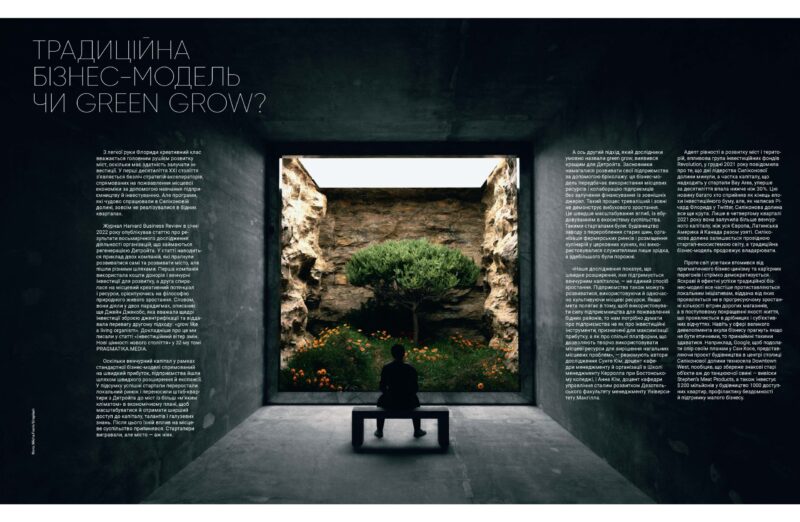
Photo: Micha Frank / Unsplash
In a word, they operated in two paradigms described by Jane Jacobs, who considered generous investments a weapon of gentrification and preferred the second approach: "grow like a living organism." We wrote more about this in the article "Investment wind of change. New values of the new century» in the 32nd volume of PRAGMATIKA.MEDIA.
Since venture capital is a standard business model focused on quick profits, businesses have followed a path of rapid expansion and expansion. As a result, successful startups outgrew their local market and moved their headquarters from Detroit to cities with more economically "softer climates" in order to scale and gain greater access to capital, talent and industry knowledge. After that, their influence on the local society stopped. Startups won, but the city did not.
But the second approach, which the researchers tentatively called green growth, turned out to be better for Detroit. The founders tried to develop their enterprises with the help of bricolage: this business model involves the use of local resources and the collaboration of entrepreneurs without attracting funding from external sources.
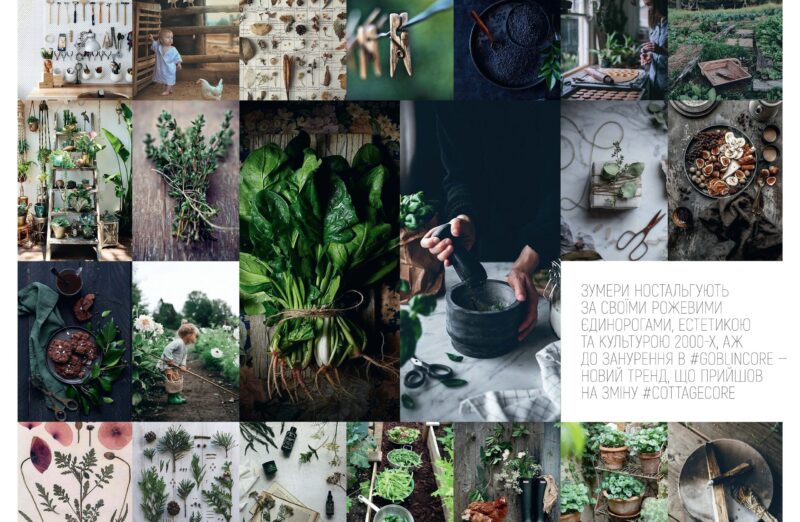
Zoomers are nostalgic for their pink unicorns, 2000s aesthetics and culture, to the point of diving into #goblincore, the new trend that has replaced #cottagecore
This process is longer and outwardly does not show explosive growth. It's more about scaling deep, with embedding into the ecosystem of society. These startups included building a tire recycling plant, organizing farmers markets, and hosting cookouts in church kitchens that were only occasionally used by ministers and mostly empty.
“Our research shows that rapid expansion backed by venture capital is not the only way to grow. Businesses can also grow by using and simultaneously cultivating local resources.
If the goal is to harness the power of entrepreneurship to revitalize poor neighborhoods, then we need to think of businesses not as investment vehicles designed to maximize profits, but as collaborative platforms that allow creative use of local resources to solve pressing local problems.” , - summarize the authors of the study, Suntae Kim, Associate Professor of the Department of Management and Organization at the Carroll School of Management at Boston College, and Anna Kim, Associate Professor of the Department of Sustainable Development Management at the Desotel Faculty of Management, McGill University.

An adept of equity in urban and regional development, influential investment fund group Revolution reported in December 2021 that the days of Silicon Valley's leadership are over, with the share of capital flowing into Bay Area startups falling below 30% for the first time in a decade.
The news was hailed by many as the end of an investment boom era, but as Richard Florida tweeted, Silicon Valley is still cool. In the fourth quarter of 2021 alone, it attracted more venture capital than all of Europe, Latin America and Canada combined. Silicon Valley remains the world's leading startup ecosystem, and the traditional business model continues to rule.
See also: Metaversion of the new world: from interactivity to virtuality
However, the world is still tired of pragmatic business cynicism and career racing and is rapidly democratizing. Bright and spectacular successes of the traditional business model are increasingly opposed to local initiatives, the return of which is manifested not in the progressive increase in the number of windows of expensive stores, but in the gradual improvement of the quality of life, which is manifested in small things and subjective feelings.
Even in the field of large development, business sharks strive to be, if not ethical, at least appear so. For example, Google, to overcome resistance to its plans in San Jose, presenting a construction project in the heart of the Silicon Valley capital of the Downtown West technovillage, promised to preserve the iconic old objects down to the dancing pig - Stephen's Meat Products sign, and also invest $ 200 million to build 1000 affordable apartments, prevent homelessness and support small businesses.
The influential voice of the street
What will the urban scene look like in 2022 when it gets warmer and the streets are filled with people? A hero of indeterminate gender with multicolored hair scattering wildflower and grass seeds around him is the collective image that comes to mind after studying numerous reports on design and consumer trends for 2022.
The attention of corporations, consulting and marketing companies to youth subcultures and close analysis of the lifestyle of generations is by no means an unfounded curiosity. The goal is to identify a new audience, monetize requests and determine market benchmarks.

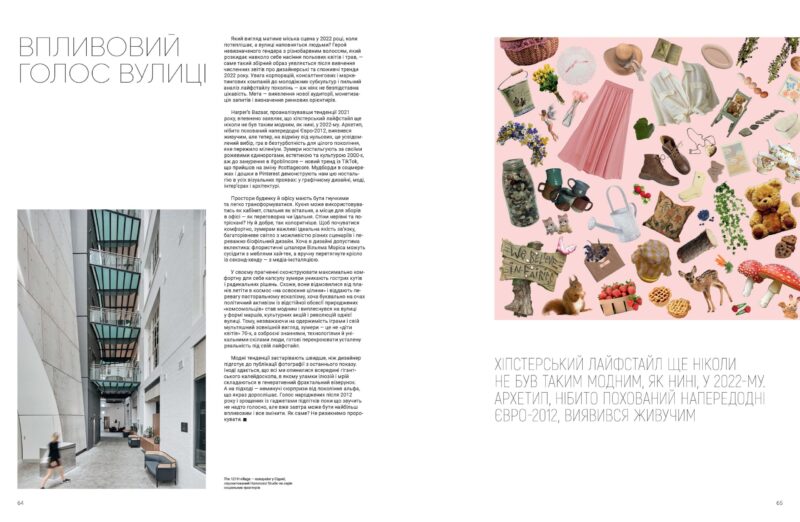
The 121H village is a coworking space in Sydney designed by Hammond Studio as a series of social spaces
Harper's Bazaar, having analyzed the trends of 2021, confidently declares that the hipster lifestyle has never been as fashionable as it is now, in 2022. The archetype, supposedly buried in the run-up to Euro 2012, has proved to be durable, but now, unlike the zeros, it is a conscious choice, a game of indifference for an entire generation that has survived the millennium.
Zoomers are nostalgic for their pink unicorns, 2000s aesthetics and culture, to the point of diving into #goblincore, the new TikTok trend that has replaced #cottagecore. Social media moodboards and Pinterest boards show us this nostalgia in all its visual manifestations: in graphic design, fashion, interiors and architecture.
Home and office spaces should be flexible and easily transformable. The kitchen can be used as a study, the bedroom as a living room, and the meeting place in the office as a meeting room or dining room. Are the walls uneven and cracked? Oh well, it's more colorful that way.
The hipster lifestyle has never been more fashionable than it is now in 2022. The archetype, supposedly buried on the eve of Euro-2012, turned out to be alive
To feel comfortable, buzzers need perfect communication quality, multi-level light with the possibility of different scenarios and mainly biophilic design. Although eclecticism is permissible in the design: floral wallpaper by William Morris can be adjacent to high-tech furniture, and a hand-pulled second-hand armchair - with a media installation.
In their desire to construct the most comfortable capsule for themselves, buzzers avoid sharp corners and radical solutions. It seems that they have abandoned plans to fly into space "to explore the virgin land" and prefer pastoral escapism, although literally before their eyes, political activism from the stale obsession of born "Komsomol" became fashionable and spilled out into the streets in the form of marches, cultural actions and revolutions of one street.
Therefore, despite their obsession with games and their cartoonish appearance, Zoomers are not the "flower children" of the 70s, but armed with knowledge, technology and unique skills, people are ready to reshape established reality to fit their lifestyle.

Fashion trends become outdated faster than a designer can prepare for publication a photo from the latest show. Sometimes it seems that we are all inside a giant kaleidoscope, in which fragments of illusions and dreams are assembled into a generative fractal pattern.
See also: City of strangers: watch yourself, be careful!
And on the approach - inevitable surprises from the alpha generation, which is just coming of age. The voice of teenagers born after 2012 and fused with gadgets does not sound too loud yet, but tomorrow it can be the most influential and change everything. How exactly? We will not venture to predict.
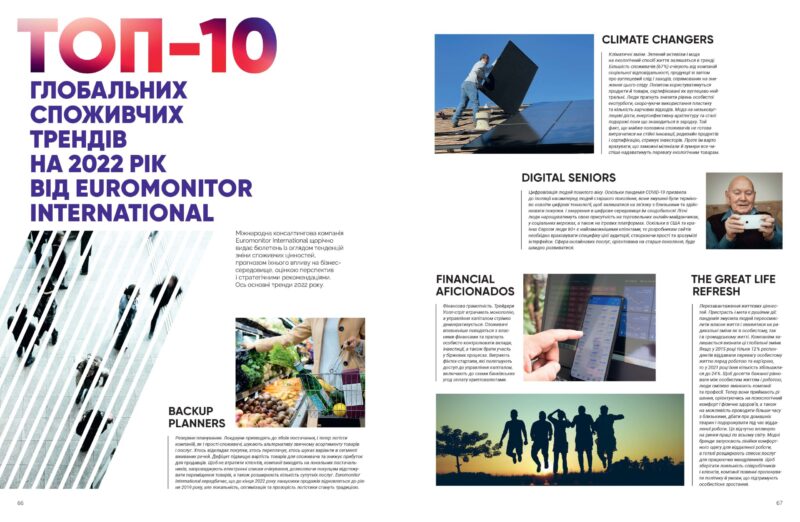
Ten global consumer trends for 2022 from Euromonitor International
The international consulting company Euromonitor International annually issues a bulletin with an overview of trends in changing consumer values, a forecast of their impact on the business environment, an assessment of prospects and strategic recommendations. Here are the main trends of 2022.
BACKUP PLANNERS

Backup planning. Lockdowns lead to supply disruptions, and now company logisticians, like ordinary consumers, are looking for an alternative to the usual range of goods and services. Someone postpones purchases, someone overpays, someone looks for options in the second-hand segment. A shortage increases the cost of goods for consumers and reduces profits for sellers.
In order not to lose customers, companies go to local suppliers, introduce electronic waiting lists, allowing buyers to track the movement of goods, and also expand the number of related services. Euromonitor International predicts that by the end of 2022, sales chains will recover to the level of 2019, but locality, optimization and transparency of logistics will become a tradition.
CLIMATE CHANGERS

Climatic changes. Green activism and fashion for an ecological lifestyle will remain in trend. The majority of consumers (67%) expect from companies social responsibility, products with a carbon footprint report and measures aimed at reducing this footprint. Products and goods certified as carbon neutral will be in demand.
People strive to reduce the level of personal environmental care by reducing the use of plastic and the amount of food waste. The fad for low-carbon diets, energy-efficient architecture and sustainable travel is still in its infancy. The fact that nearly half of consumers are unwilling to spend on sustainable innovation, product redesign, and certification deters investors. However, they should consider that affluent millennials and boomers will increasingly prefer green products.
DIGITAL SENIORS

Digitization of the elderly. As the COVID-19 pandemic has isolated older people in particular, they have had to urgently master digital technologies to stay in touch with loved ones and make purchases. And they liked the immersion in the digital environment! Seniors will increase their presence on online shopping sites, social networks, and gaming platforms.
Since people 60+ are the most affluent customers in the US and European countries, site developers need to take into account the specifics of this audience, creating simple and understandable interfaces. The field of online services aimed at the older generation will develop rapidly.
FINANCIAL OFFICERS

Financial literacy. Wall Street traders are losing their monopoly, and capital management is rapidly democratizing. Consumers are more confident with their own finances and seek to personally control deposits and investments, as well as participate in exchange processes. Fintech startups that facilitate access to capital management, include payments in cryptocurrencies in the scheme of banking transactions, will benefit.
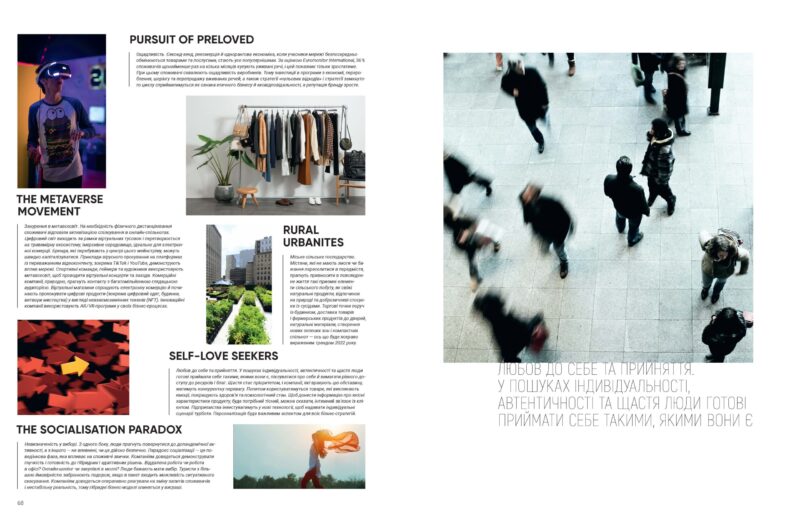
Self-love and acceptance. In search of individuality, authenticity and happiness, people are ready to accept themselves as they are
THE GREAT LIFE REFRESH

Reloading life values. Passion and purpose drive action: the pandemic has forced people to rethink their own lives and decide on radical changes in both personal and public life. It remains for companies to recognize these global changes. If in 2015 only 12% of respondents preferred personal life to work and career, then in 2021 their number increased to 24%.
To achieve the desired balance between personal life and work, people boldly change companies and professions. Now they make decisions based on psychological comfort and physical health, as well as the ability to spend more time with loved ones, take care of pets and travel while working remotely. This has had a significant impact on labor markets around the world.
See also: City scenography. You can't leave, you can't stay
Fashion brands launch lines of comfortable clothing for remote work, and hotels expand the list of services for working travelers. To maintain employee and customer loyalty, companies must offer policies and conditions that support personal growth.
PURSUIT OF PRELOVED

Thrift. Second-hand, re-commerce and peer-to-peer economies, where network participants directly exchange goods and services, are becoming increasingly popular. According to Euromonitor International, 36% of consumers buy used things at least once every few months, and this figure will only grow. At the same time, consumers approve of thriftiness of producers.
Therefore, investments in saving, recycling, sharing and reselling programs, as well as zero-waste and closed-loop strategies will be perceived as a sign of ethical business and eco-responsibility, and the brand's reputation will increase.
THE METAVERSE MOVEMENT

Dive into the metaverse. Consumers responded to the need for physical distancing by intensifying communication in online communities. The digital world goes beyond virtual hangouts and turns into a three-dimensional ecosystem, an immersive environment perfect for e-commerce. Brands at the center of this mainstream can capitalize quickly.
Examples of viral promotion on video-dominant platforms such as TikTok and YouTube demonstrate the influence of the network. Sports teams, gamers, and artists use the metaverse to host virtual concerts and events. Commercial companies naturally seek contact with a multi-million audience.
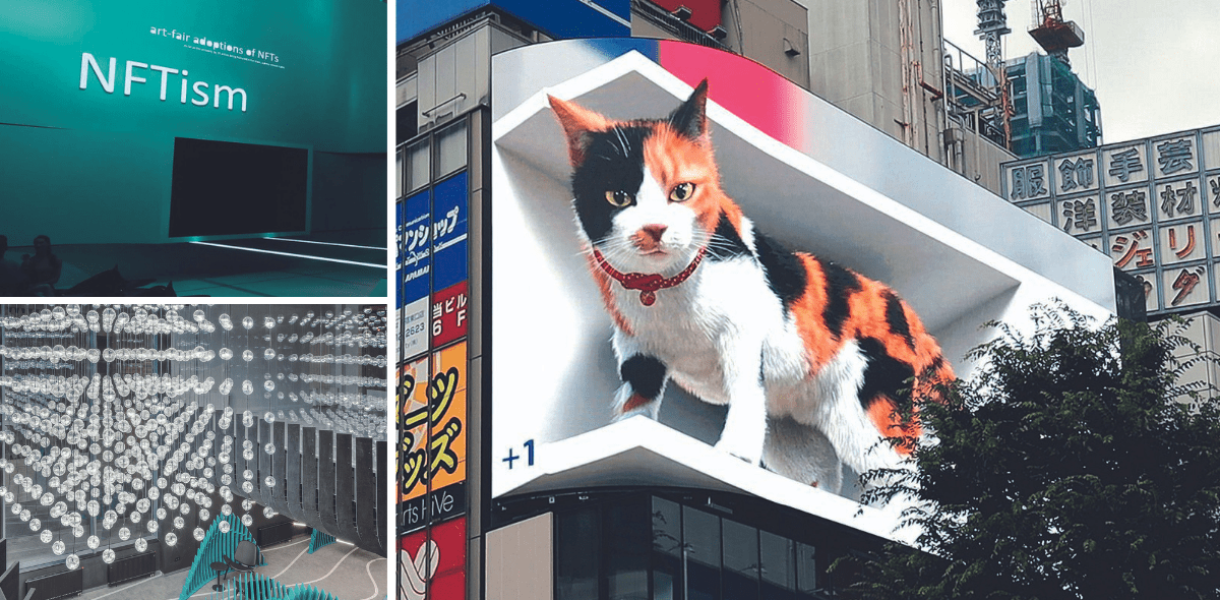
Virtual stores are simplifying e-commerce and starting to offer digital products (including digital clothing, homes, artwork) as non-fungible tokens (NFTs). Innovative companies use AR / VR programs in their business processes.
RURAL URBANITES

Urban agriculture. Townspeople who do not have the ability or desire to move to the suburbs seek to bring into their everyday life such pleasant elements of rural life as fresh natural products, recreation in nature and friendly relations with neighbors.
Shopping points near the house, delivery of goods and farm products to the door, natural materials, creation of new green areas and compact communities - this will be a pronounced trend of 2022.
SELF-LOVE SEEKERS

Self-love and acceptance. In the search for individuality, authenticity, and happiness, people are willing to accept themselves as they are, take care of themselves, and demand equal access to resources and benefits. Happiness becomes a priority, and companies that take this into account will have a competitive advantage.
Products that evoke emotions and improve health and psychological state will be in demand. In order to convey information about the quality characteristics of the product, a close, one might say, intimate relationship with the client will be required. Businesses will invest in new technologies to deliver personalized care scenarios. Personalization will be an important aspect of all business strategies.
THE SOCIALIZATION PARADOX

Uncertainty in the choice. On the one hand, people are eager to return to pre-pandemic activity, and on the other, they are not sure if it is really safe. The socialization paradox is a behavioral phase that affects consumption habits. Companies will have to demonstrate flexibility and readiness for hybrid and adaptive solutions. Remote work or office work?
Online shopping or shopping in the mall? People want to have choices. Tourists are more likely to book a trip if the package includes the possibility of situational cancellation. Companies will have to quickly respond to changing consumer demands and an unstable reality, so hybrid business models will benefit.
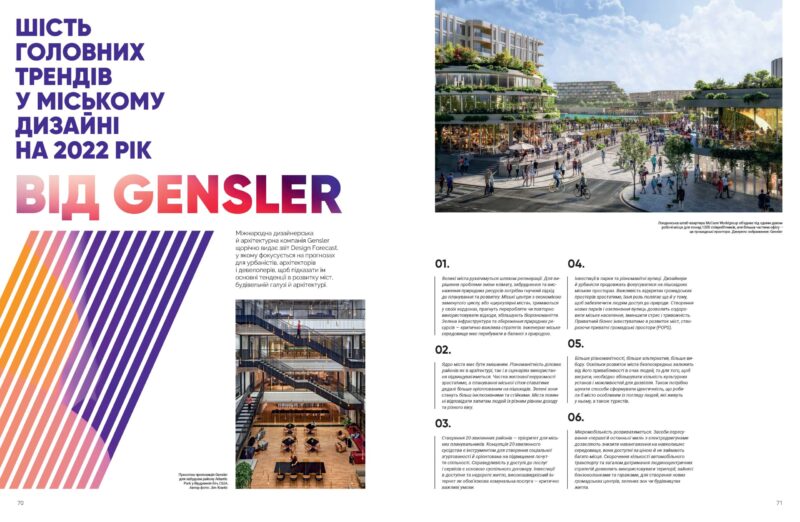
Six main trends in urban design for 2022 from Gensler
Gensler, an international design and architecture company, publishes its annual Design Forecast report, which focuses on forecasts for urban planners, architects and developers to inform them of the main trends in urban development, the construction industry and architecture.
01.
Big cities will move through regeneration. Addressing climate change, pollution and natural resource depletion requires a flexible approach to planning and development. Urban centers with a closed cycle economy, or "circular cities", stay within their boundaries, seek to recycle or reuse waste, and increase biodiversity. Green infrastructure and conservation of natural resources is a critical strategy. The engineered urban environment must be in balance with nature.

Gensler's project proposal for the development of the Atlantic Park area in Virginia Beach, USA.
Photo credit: Jim Krantz
02.
The core of the city should be mixed. The diversity of business districts in both architecture and usage scenarios will increase. The share of residential real estate will grow, and the planning of the city grid will become increasingly pedestrian-oriented. Green areas will become more inclusive and sustainable. Cities must respond to the demands of people of different income levels and different ages.
03.
Creating 20-minute districts is a priority for city planners. The 20-minute neighborhood concept is a tool for creating social cohesion and is aimed at increasing the sense of community. Fairness in access to services is the basis of the social contract. Investments in affordable and affordable housing, high-speed Internet as a mandatory utility service are critically important conditions.
04.
Investments in parks and various streets. Designers and urban planners will continue to focus on pedestrian urban spaces. The importance of open public spaces will grow, their role is also to provide people with access to nature. The creation of new parks and landscaping of the streets will improve the health of the urban population, reduce stress and anxiety. Private businesses will invest in urban development by creating private public spaces (POPS).

McCann Worldgroup's London headquarters will house more than 1200 employees under one roof, but most of the office is public space. Image source: Gensler
05.
More variety, more alternatives, more choice. Since the development of the city directly depends on its attractiveness in the eyes of the people, in order to win, it is necessary to increase the number of cultural institutions and opportunities for leisure. It is also necessary to look for ways to form an identity that would make the city special from the point of view of the people who live in it, as well as tourists.
06.
Micromobility will develop. Electric first-mile and last-mile vehicles are environmentally friendly, affordable, and space-saving. Reducing the number of automobiles and generally following people-centered strategies will allow the use of areas occupied by gas stations and garages for the creation of new public centers, green areas or housing construction.
Main photo: Kunkun Liu, 2021 Sony World Photography Awards


Text: Iryna Isachenko