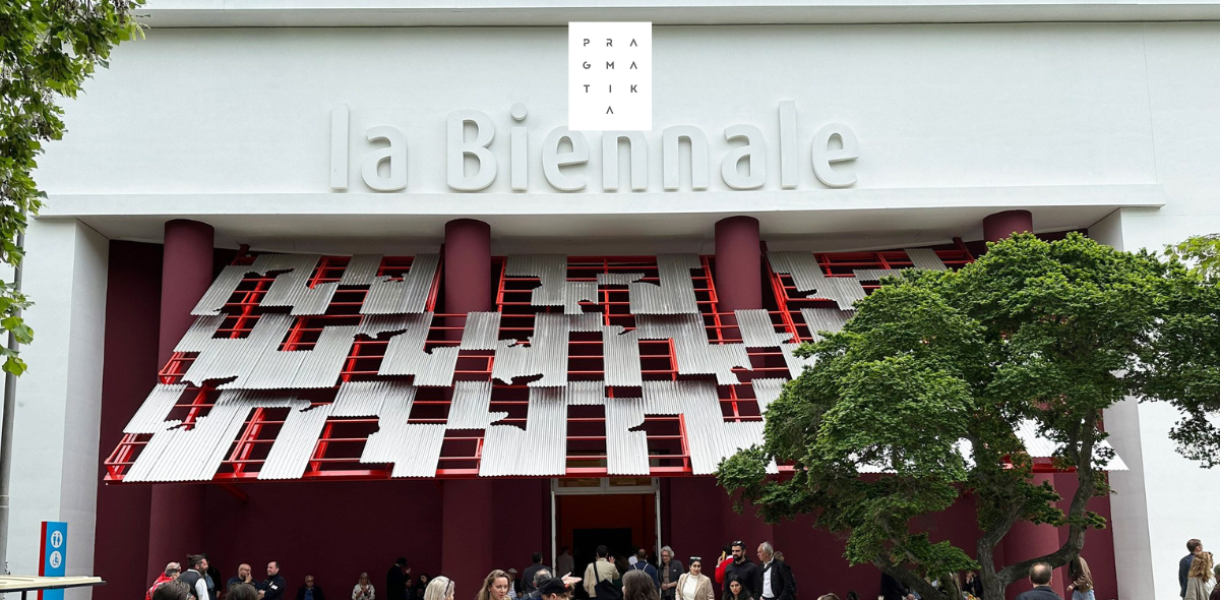
dezeen write, that a selection of the best pavilions was compiled by editor Tom Ravenscroft.
The theme of this year's Venice Architecture Biennale, curated by Leslie Locko, is "Laboratory of the Future." Many national pavilions focused on issues of decolonization and decarbonization.
Ukrainian pavilion: "Before the future"
The list included our pavilion, which was divided into two exhibitions. The first is a space that refers to Zmeivyh Valy - networks of fortifications of the 10th century in the Kyiv region.
"Unusual buildings, which after the Russian invasion of Ukraine became a symbol of a sense of security in Ukrainian society," the curators noted.

Photo: Oleksandr Kurmaz
French Pavilion: Ball Theater
The French Pavilion was designed to "awaken our desire for utopia." It was designed by architectural studio Muoto and presents a reflective hemispherical stage on which a series of performances will be held during the biennale.

Photo: Schnepp Renou
"It was a way to respond to this year's theme of the biennale. Theater is a laboratory because you can do anything. You can put on a hat, apply make-up and you are already someone else. This is a place for self-expression and inclusiveness," said Muoto architect Yves Moreau.
Brazilian pavilion: Terra
The exhibition aimed to tell how the land of Brazil shaped the understanding of heritage and identity, so the Brazilian pavilion was filled with earth, which gave it a sense of peace and an incredible aroma.
"The meaning of land is deeply rooted in the concepts and narratives of Brazilian national formation and representation," said pavilion curators Gabriela De Matos and Paulo Tavares.

Photo: Astrid Fadnes
Pavilion of the Nordic countries. Girjegumpi: The Sámi Architecture Library
Another pavilion that evokes a sense of hospitality was the northern pavilion, which was filled with a nomadic library containing 500 books on indigenous architecture collected by architect Joar Nango.
The library is featured alongside artworks, films, materials and found objects in an exhibition curated by Carlos Mínguez Carrasco and James Taylor-Foster.

Photo: Laurian Ghinițoiu
British Pavilion: Dancing before the moon
Through a selection of impressive artworks and a film, the pavilion demonstrates how diasporas project a shared space. The curators wanted the pavilion to showcase the incredible diversity inherent in Britain, diverting attention from conventional traditions.

Photo: Taran Wilkhu
Estonian pavilion: Home stage
The pavilion is located outside the main exhibition areas. The installation was placed in a rented apartment, where the actress performs daily rituals. In this way, the problems of owning one's own home are investigated.

Photo: Estonian Pavilion
Pavilion of applied arts. Tropical Modernism: Architecture and Power in West Africa
The exhibition focuses on how the tropical modernist style of architecture developed and how it went from being a tool to support colonial rule in Africa to being adopted and adapted by independent African nations.

Photo: Victoria & Albert Museum
Australian Pavilion: Unsettling Queenstown
Australia's contribution aimed to directly address the subject of decolonization and question the influence of the British Empire.
"It (the pavilion) examines what architects do and can do to actively decolonize places and spaces, while reflecting on the historical legacy of colonialism and extractivism," the curators say.

Photo: Tom Roe
Swiss Pavilion: Neighbours
No materials were transported to create this installation to reduce environmental impact. Instead, curator Philippe Ursprung tore down the wall separating the Swiss pavilion from the neighboring Venezuelan one to demonstrate how borders can be broken down.
"The Giardini is an environment where the pavilions, next to each other, are located like neighbors. At the same time, this fixation on national participation has narrowed our horizons for many years - it is a relic of the past. Pavilions should take care of each other, just like we do as people," explained curator Philip Ursprung.

Photo: Martin Lauffer
German pavilion: Open for Maintenance
The German pavilion was filled with materials removed from last year's Art Biennale, which are now to find a new use in Venice.
"We wanted to show how there are other ways of working with materials for architects like me. We can reuse the materials for the renovation work," said architect Petter Krag, who is one of the eight members of the curatorial team.

Photo: German pavilion
Latvian pavilion
An architectural supermarket displaying 506 "products" fills the Latvian pavilion.

Photo: Martin Lauffer
Each product is modeled after pavilions from the last 10 biennales, and their names are used as humorous labels. The elements of the exhibition resemble cans with food and household goods. They were developed by curators using artificial intelligence.
See also:
Ukraine officially opened its own pavilion at the Venice Architecture Biennale