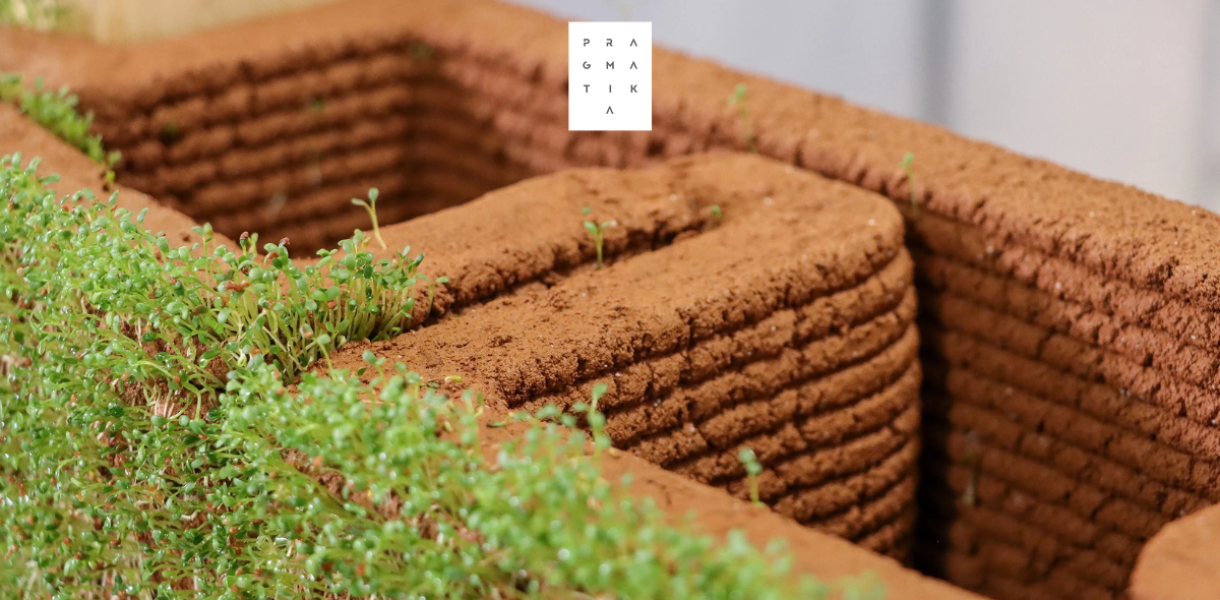
At first, the printed prototypes look like ordinary buildings from the ground, but after a few days they are covered with a thick layer of greenery, write Dezeen.
The inventors claim that the "living walls" created in this way have a number of advantages, including natural insulation, flood prevention and green areas that serve as a source of pollination for insects.

"Green facades" printed on a 3D printer. Photo: Ehsan Baharlu
Unlike conventional building landscaping, these 3D walls can be built into the very fabric of architectural objects, rather than simply superimposed on top. This would reduce the cost of building materials with a higher emission index and replace them with a circular alternative that the researchers say can be used over and over again.
"If we don't need a printed sample, or if it doesn't meet our quality requirements, we can recycle and reuse the material for the next batch of ink," explains Ehsan Baharlu, associate professor at the University of Virginia's School of Architecture.

Ehsan Baharlu, head of the research group, creates "living walls" using 3D printing. Photo: Tom Daly
Buildings constructed using 3D technology can become carbon neutral or even carbon negative, as their plant coverings will draw carbon dioxide out of the atmosphere.
In order to prove the durability of the printed "green walls", the researchers created a number of independent structures that resemble beehives. In addition, it was necessary to check whether there would be enough moisture and nutrients to support seed germination and seedling growth.

Buildings where the first stage of research and development took place. Photo: Ehsan Baharlu
For the greening of the building, we chose sedum - a succulent plant that can survive with a small amount of water, since the extrusion process makes the soil compact and dry. The result was positive.

In a few days, the printed material was completely covered with whitewash. Photo: Ehsan Baharlu
Since then, researchers have begun to create walls about a meter high. The next stage of the experiment will be the use of several layers of material in the wall panel, which will allow to isolate the dry inner wall from the wet outer wall. If the results are positive, it will make it possible to create a completely "living" architecture.
Read also
Engineers have developed strong concrete that includes recycled tires
Turkish developers are creating roof tiles in which birds can settle