Rejection of visual noise
If a few decades ago, heavy curtains, pelmets, and multi-layered textiles were perceived as a sign of a status interior, today architecture is increasingly gravitating toward pure geometry, openness, and working with natural light.

Photo provided by the company "Jalyuzi-Service"
Window design no longer exists separately from architecture. Sun protection systems are integrated into ceilings, niches or the window structure itself, remaining almost invisible when open. Thanks to this, the interior retains its integrity, and the space - lightness and visual calm.

Photo: Steve A Johnson / Unsplash
This trend is particularly evident in modern architecture with panoramic glazing. Offices and private residences are increasingly replacing traditional blinds with automated roller systems that allow for the adjustment of lighting levels without losing the clean geometry of the space.
"Automated systems allow you to adapt lighting to the movement of the sun and maintain the architectural purity of the interior throughout the day," they say. in the installation solutions department of the company "Jalyuzi-Service".
Light as part of architecture
Morning diffused light can make a minimalist space soft and warm, while harsh daytime light can emphasize the graphic nature of architecture. This is why modern window design systems are subject to the logic of light, how it enters the space, how it changes throughout the day, and how it interacts with the textures of the interior. Designers strive to direct it so that the space is alive and natural at any time of the day.

Photo: Steve A Johnson / Unsplash
Full blackout systems provide absolute privacy and comfort in bedrooms, home theaters or recreation areas. Semi-blackout fabrics gently diffuse daylight while maintaining a sense of space, while sun-blocking screen materials are the ideal solution for panoramic glazing: they eliminate glare on monitors and leave the city outside the window visible.
"Modern sun protection allows you to work with light almost like a material - to gently adjust the atmosphere depending on the time of day and the nature of the space," — added the team "Jalyuzi-Service".

Photo provided by the company "Jalyuzi-Service"
Roman blinds: a return to the classics through minimalism
The return to classic solutions today occurs through the filter of minimalism. An example is Roman curtains. Once a historical decorative element today successfully fits into Scandinavian and contemporary interiors thanks to its architectural graphicness.
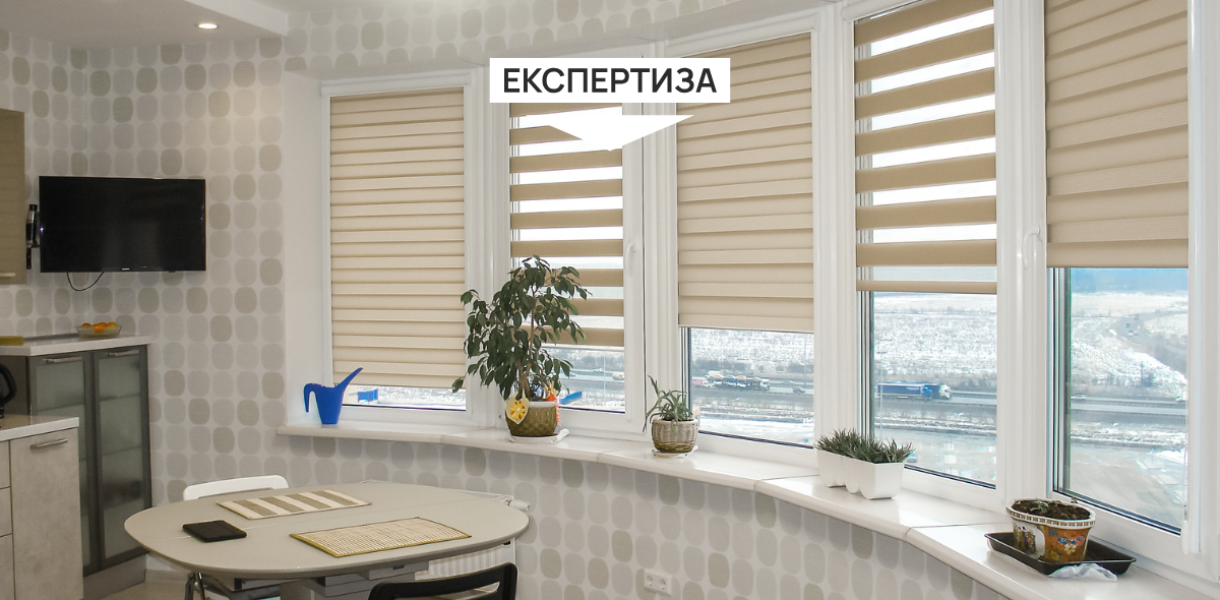
The Roman blind combines the tactility of fabric with the discipline of geometry. Its clear horizontal folds work almost like a rhythmic element of the facade - discreetly, but expressively. That is why designers are increasingly using such systems in spaces where a balance between the softness of the living environment and the purity of modern architecture is important.

Photo provided by the company "Jalyuzi-Service"
The method of integration remains an important component: installation in the window opening creates a sense of monolithicity, while mounting directly into the frame allows for maximum lightness of the structure. It is in such details that a modern approach to design is formed, where aesthetics is born not from decor, but from precision.

Photo provided by the company "Jalyuzi-Service"
When it comes to invoice, experts advise choosing a manufacturer, which uses architectural fabrics with a high level of resistance to ultraviolet rays. Roman blinds fit snugly against the window, taking on the direct impact of sunlight.
Ordinary fabrics quickly lose pigment, and after a season, light streaks may appear on the folds of curtains, making the product look dirty or old. In contrast, architectural fabrics are dyed using a special technology (often the thread is dyed at the solution stage), which makes them immune to color degradation. In addition, ultraviolet light destroys the polymer bonds in the fabric. Cheap fabrics become brittle under the influence of the sun, and over time they literally begin to crumble in your hands or tear at the points where the cords are attached.

Photo provided by the company "Jalyuzi-Service"
Integration into Smart Living
The next stage in the evolution of window space is the full integration of sun protection into the Smart Living system. Today, technologies work almost imperceptibly: they automatically adjust the level of lighting, respond to the intensity of the sun, help reduce the load on air conditioning, and adapt the interior atmosphere to the time of day.
Control via Apple HomeKit, Google Home or Amazon Alexa is gradually becoming as natural a function as climate control or acoustics.
At the same time, a smart home is less and less associated with a demonstration of technology. On the contrary, the main value is becoming unobtrusive comfort, when the space itself maintains the right balance of light, temperature, and privacy.

Photo provided by the company "Jalyuzi-Service"
The company "Jalyuzi-Service" summarizes: integrating sun protection into smart systems allows the house to independently adapt to the owner's life scenarios and operate much more energy efficiently.
See also:
Marriott interiors can be purchased for your home, but some items cost over €6500
The Kitchen as a Showroom: Why Appliances Have Become an Architectural Statement
Ukrainian designer Viktoriya Yakusha seeks softness through memory and material recovery