World specialists from various fields, including ecologists, urban planners, anthropologists, physicists, urban planners and architects, are currently engaged in the search for quick and long-term ways to reduce the negative impact of climate change on the Earth. Numerous studies show that natural disasters—floods, storms, abnormal heat, and rising sea levels as a result of global warming—may affect 800 million people, which will ultimately result in losses of $1 trillion (!) per hour by the middle of our century

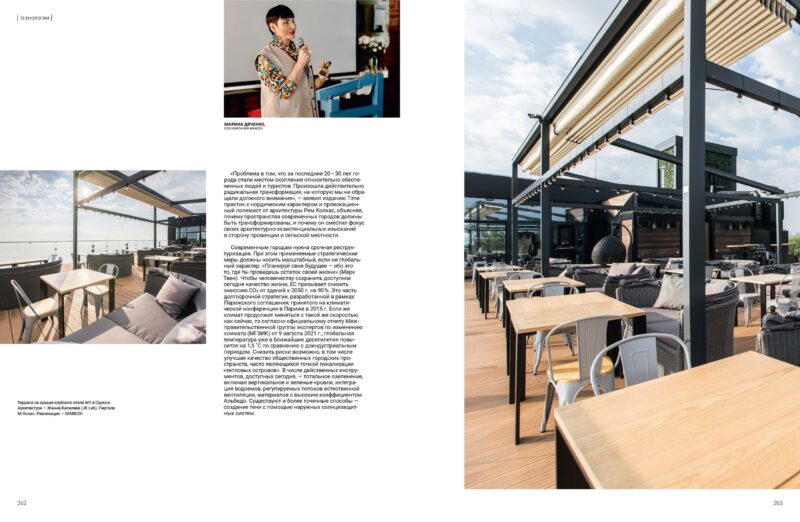
Maryna Dyachenko, CEO of the MANEZH company
In megacities, this problem is aggravated by the "urban heat island effect", when the air in the districts is heated on average by 1-6 °C higher than in the suburbs. For example, American cities are 0,5–4 °C warmer during the day, and 1–2,5 °C warmer at night, than in the surrounding countryside. The source of the effect is an insufficient amount of green cover, urban morphology (building density and its proximity to roadways), widespread use of asphalt, concrete, and materials with a low Albedo value (the coefficient of reflection of the light flux from the surface). But the main reason is anthropogenic. It is estimated that in conditions of intensive urban growth (according to the UN, by 2030, 60% of the world's population will live in cities), they account for 60-80% of the world's energy consumption. The housing and tourism sector is in fourth place in terms of emissions of carbon dioxide into the atmosphere (from 17 to 21%).
"The problem is that over the past 20-30 years, cities have become a place of concentration of relatively well-off people and tourists. A truly radical transformation has taken place, to which we have not paid due attention," said Rem Koolhaas, a practitioner with a Nordic character and a provocative polemicist on architecture, to Time, explaining why the spaces of modern cities must be transformed, and why he shifted the focus of his architectural and existential refined towards the province and the countryside.

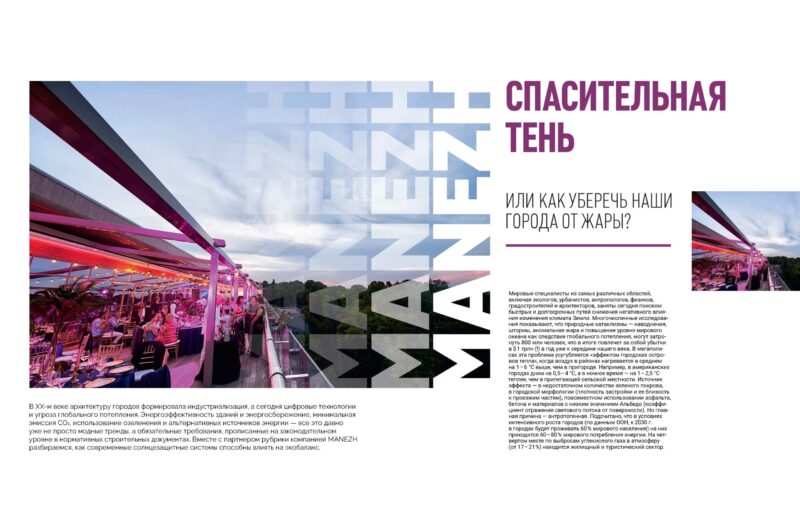
The terrace on the roof of the club hotel M1 in Odessa. Architecture — Zhanna Kiseleva (JK Lab). Pergola M-Ocean. Implementation — MANEZH
Modern cities need urgent restructuring. At the same time, the applied strategic measures must be large-scale, if not global in nature. "Plan your future, because that's where you'll spend the rest of your life" (Mark Twain). In order for humanity to preserve the quality of life available today, the EU calls for reducing CO2 emissions by 2050% by 90. This is part of the long-term strategy developed as part of the Paris Agreement adopted at the climate conference in Paris in 2015. If the climate continues to change at the same rate as now, then according to the official report of the Intergovernmental Panel on Climate Change (IPCC) dated August 9, 2021 g., the global temperature will increase by 1,5 ˚С in the coming decades compared to the pre-industrial period.
It is possible to reduce risks, including by improving the quality of public urban spaces, which are often the point of localization of "heat islands". Effective tools available today include total greening, including vertical and green roofs, integration of reservoirs, regulated natural ventilation flows, materials with a high Albedo coefficient. There are more point ways — creating a shadow with the help of outdoor sun protection systems.

Armed with nature
"Instead of a park in a city, we need a garden in a park," says Canadian designer, innovator and teacher Bruce Mau. And here point-based, or rather, local solutions turn out to be the most effective. In Paris, for example, "islands of heat" are successfully contrasted with "islands of coolness" — special cooled outdoor areas: their concrete surface and installed benches for rest are refreshed with water directly from the Seine (about the importance of green projects in the fight against the level of CO2 and "heat islands" PRAGMATIKA.MEDIA wrote in the 17th volume).

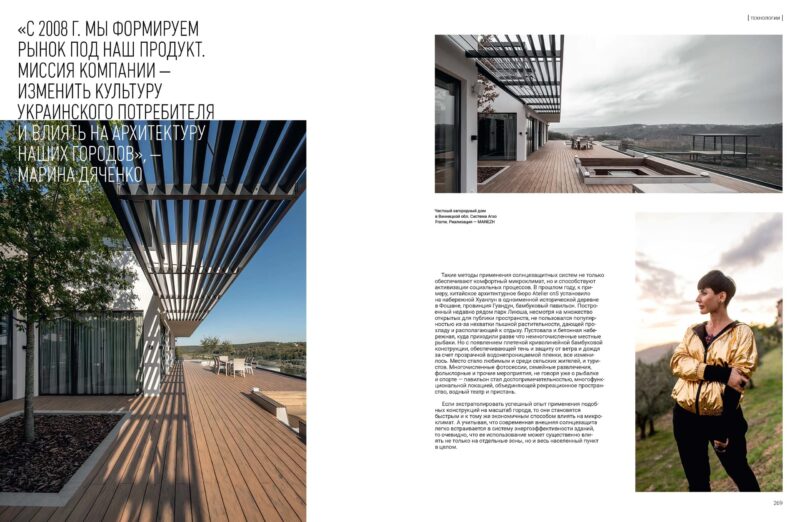
Private country house in Vinnytsia region. Arso Frame system. Implementation — MANEZH
The authorities of the Colombian city of Medellin turned the roadsides of 18 roads and 12 waterways into a real paradise thanks to the "Green Corridors" project: they planted trees along transport highways to reduce the impact of heat islands made of concrete and asphalt. Thus, one of the busiest streets of the city, Oriental Avenue, was reconstructed, more than 2 km of pedestrian paths were paved, and the sidewalks were turned into gardens, 600 trees were planted and more than 1 trees were planted. other plants: wild fauna, birds and butterflies have even returned here. In Singapore, in Bishan-Ang Mo Kio Park, a 2,7 km long concrete drainage channel was demolished, which for decades separated the green part from the adjacent residential area, and restored the natural winding channel of the Kallang River, the longest on the island. By the way, naturalization cost almost twice as much as repairing the canal, and there is no longer any need to maintain it. In Brazil, in particular in Rio de Janeiro, so-called rain gardens are used to reduce the flow rate, quantity, and pollution of stormwater runoff. By combining trees, plants, stones and other natural or artificial elements, they are formed near sidewalks, roads, flower beds or even inside plots. In the linear park in Mexico City, both of the above methods were used, which helped to increase the relative humidity of the air by 16% and reduce the temperature by 5%. The park is located above the historic structure of the Grand Canal - the most important part of the drainage (read: sewage) system of the capital of Mexico.

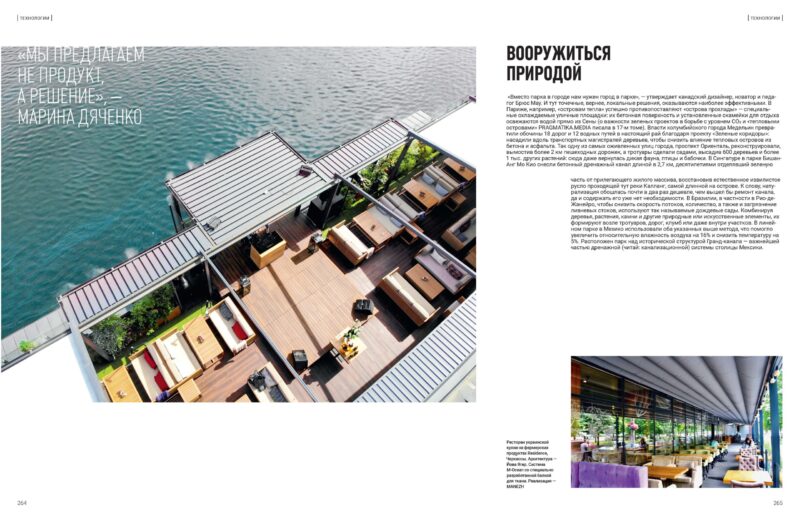
Restaurant of Ukrainian cuisine based on farm products Residence, Cherkassy. Architecture - Yova Yager. The M-Ocean system with a specially designed fabric beam. Implementation — MANEZH
External sun protection or something that should not be neglected by the architect
New Zealand has the highest incidence of skin cancer in the world. It is believed that strong exposure to solar radiation provokes it. Local authorities of all levels have decided to reduce the influence factor of UV radiation in order to protect citizens. First of all, they tried to provide public spaces in cities with shading. For this purpose, 5-7 years ago, they started implementing projects that include outdoor sun protection structures. Thus, in the city of Rotorua, one of the country's popular tourist destinations, where one can get to know the culture and lifestyle of the native inhabitants of the country, the Maori people, as part of the revitalization of the center, the most important street, It Street, was covered with a canopy made of Y-shaped wooden posts. They retain a polycarbonate roof that transmits light, heat, but not UV radiation (SPF 15+). The owners of cafes and establishments equipped sidewalks with pergolas with sliding roofs — this is a kind of alfresco experiment. At the Lido Aquatic Center in Palmerston North, a well-known center for aquatic entertainment, the terrace of the 50-meter outdoor pool was shaded with the help of sail systems that protect against direct and scattered UV rays throughout the day.

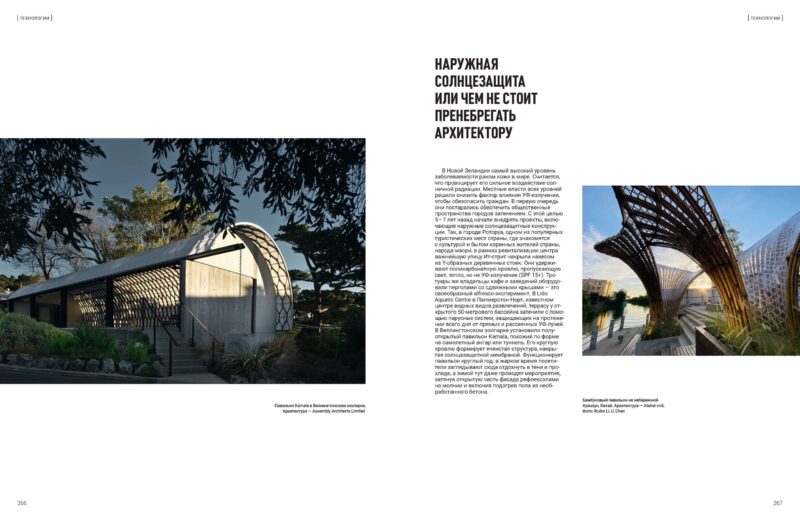
Kamala Pavilion at Wellington Zoo. Architecture — Assembly Architects Limited
In the Wellington Zoo, a semi-open Kamala pavilion, similar in shape to an airplane hangar or tunnel, was installed. Its round roof is formed by a cellular structure covered with a sun protection membrane. The pavilion functions around the clock: in hot weather, visitors come here to rest in the shade and coolness, and in winter they even hold events here, the open part of the facade is covered with reflective strips on the zipper and the floor heating made of raw concrete is turned on.

Bamboo pavilion on Huanglong embankment, China. Architecture — Atelier cnS. Photo: Ruibo Li, Li Chen
Such methods of applying sun protection systems not only provide a comfortable microclimate, but also contribute to the activation of social processes. Last year, for example, the Chinese architectural bureau Atelier cnS installed a bamboo pavilion on the Huanglong embankment in the historic village of the same name in Foshan, Guangdong province. The recently built Liyusha Park, despite the many spaces open to the public, was not popular due to the lack of lush vegetation that provides coolness and rest. The concrete embankment, where only a few local fishermen came, was also empty. But with the appearance of a woven curvilinear bamboo structure, which provides shade and protection from wind and rain due to a transparent waterproof film, everything changed. The place has become a favorite among both villagers and tourists. Numerous photo sessions, family entertainment, folklore and other events, not to mention fishing and sports - the pavilion has become a landmark, a multifunctional location that combines a recreational space, a water theater and a marina.
"Since 2008, we have been forming a market for our product. The company's mission is to change the culture of the Ukrainian consumer and influence the architecture of our cities", - Maryna Dyachenko
If you extrapolate the successful experience of using similar structures to the scale of the city, then they become fast and, moreover, they will affect the microclimate in an economical way. And considering that modern external solar protection is easily integrated into the energy efficiency system of a building, it is obvious that its use can significantly affect not only individual zones, but also the entire settlement as a whole.

Private country house in Vinnytsia region. Arso Frame system. Implementation — MANEZH
Pergola systems as a universal mechanism of protection from the sun and bad weather
"MANEZH systems are unique," emphasizes Maryna Dyachenko, CEO of the company MANEZH, the leader of the Ukrainian market in the field of design and production of outdoor sun protection systems. — We did not copy, but created our own solutions, improving Western analogues taking into account the climatic zone of Ukraine: volume of precipitation, frequency and density of their fallout.
When asked how the company's products differ from other domestic manufacturers, Marina answered: "We do not offer a product, but a solution. We study the client's needs, fix a clear specification and the tasks that the customer sets before us. And only then do we begin the design, determining in the process which model is best to choose, how to realize the abutment, water drainage, docking of modules or different systems in the case of their application, plus we coordinate the result with the designers of the object's facades. In other words, we take on everything from ideas to implementation, including installation, service, maintenance twice an hour, extending the service life of any of our systems."

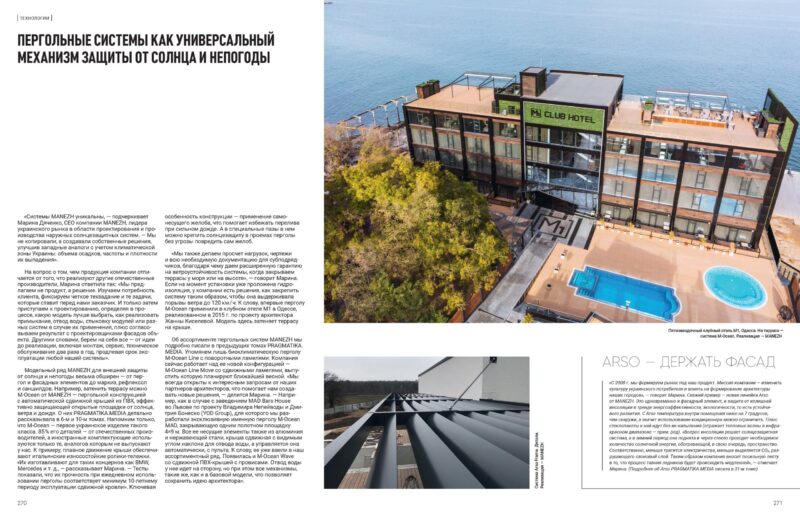
Five-star club hotel M1, Odessa. On the terrace is the M-Ocean system. Implementation — MANEZH
The MANEZH model range for external protection from the sun and bad weather is very extensive — from pergolas and facade elements to awnings, reflectors and sunshields. For example, you can shade the terrace with M-Ocean from MANEZH - a pergola structure with an automatic sliding PVC roof that effectively protects outdoor areas from the sun, wind and rain. PRAGMATIKA.MEDIA talked about them in detail in 6-m и 10 volumes. Let us remind you that M-Ocean is the first Ukrainian product of this class. 85% of its parts are from domestic manufacturers, and foreign components are used only those whose analogues are not produced in our country. For example, the smooth movement of the roof is provided by Italian wear-resistant trolley rollers. "They are made for such concerns as BMW, Mercedes, etc.," says Marina. — Tests showed that their strength during daily use of the pergola corresponds to at least a 10-year period of operation of the sliding roof." The key feature of the design is the use of a self-supporting gutter, which helps to avoid overflow during heavy rain. And in special grooves in it, you can fasten the sun protection in the openings of the pergola without the risk of damaging the gutter itself.
"We offer not a product, but a solution," - Maryna Dyachenko
"We also make load calculations, drawings and all the necessary documentation for subcontractors, thanks to which we provide an extended guarantee for the wind resistance of the system when we close the terraces near the sea or at a height," says Marina. If waterproofing has already been installed at the time of installation, the company has solutions for fixing the system in such a way that it can withstand wind gusts of up to 120 km/h. By the way, the M-Ocean pergola was first used in the M1 club hotel in Odessa, implemented in 2015 according to the project of architect Zhanna Kiseleva. The model here shades the terrace on the roof.

Arso Frame system. Details. Implementation — MANEZH
We wrote in detail about the range of MANEZH pergola systems in previous volumes of PRAGMATIKA.MEDIA. Let's mention only the M-Ocean Line bioclimatic pergola with rotating slats. The company is currently working on its new configuration — M-Ocean Line Move with sliding slats, which is planned to be released in the coming spring. "We are always open to interesting requests from our architect partners, which helps us create new solutions," says Marina. — For example, as in the case of the MAD Bars House in Lviv, designed by Vladimir Nepeyvoda and Dmytro Bonesco (YOD Group), for which we developed an exclusive M-Ocean MAD named pergola, covering a 4×9 m area with one sheet. All its supporting elements also made of aluminum and stainless steel, the roof is sliding with a visible angle of inclination for water drainage, and it is controlled automatically from the remote control. By the way, it has already been introduced into our assortment. M-Ocean Wave with a sliding PVC roof with sags also appeared. It drains water to the side, but at the same time all the mechanisms are the same as in the basic model, which allows you to preserve the architect's idea."
Arso - keep up the facade
"Since 2008, we have been forming a market for our product. The company's mission is to change the culture of the Ukrainian consumer and influence the formation of the architecture of our cities," says Marina. A recent example is the new Arso line from MANEZH. It is both a facade element and protection from excessive insolation in the trend of energy efficiency, environmental friendliness, that is, sustainable development. With Arso, the temperature inside the room is 7 degrees lower than outside, which means that the use of the air conditioner can be limited. Plus double-glazed windows go to it without infrared spraying (reflects thermal waves in the infrared range - approx. ed.). "The issue of insolation is solved by the solar protection system, and in the winter period it is raised and the necessary amount of solar energy passes through the glass, which, in turn, heats the space. Accordingly, less electricity is consumed, less CO2 is released, which destroys the ozone layer. In this way, the company makes a significant contribution to the fact that the process of melting glaciers will occur more slowly," says Marina. (More about Arso PRAGMATIKA.MEDIA wrote in the 31st volume).

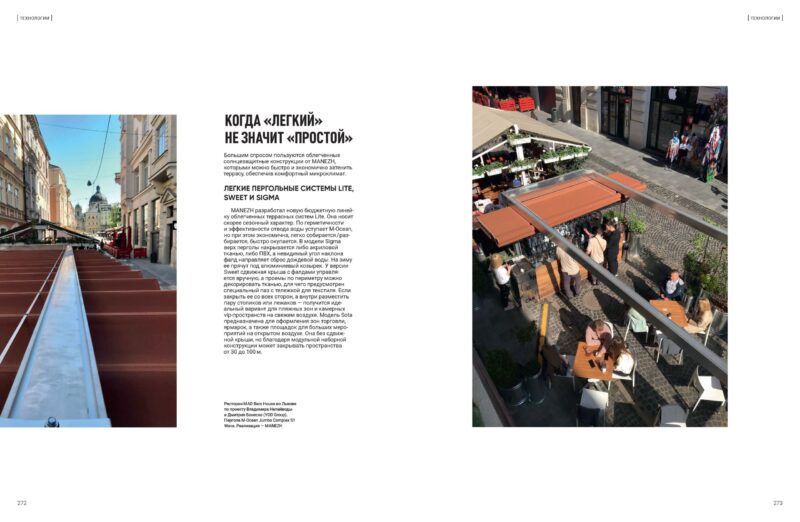
MAD Bars House restaurant in Lviv designed by Vladimir Nepeyvoda and Dmytro Bonesco (YOD Group). Pergola M-Ocean Jumbo Complex S1 Wave. Implementation — MANEZH
When "easy" does not mean "simple"
Lightweight sun protection structures from MANEZH are in great demand, with which you can quickly and economically shade the terrace, providing a comfortable microclimate.
Light pergola systems Lite, Sweet and Sigma
MANEZH has developed a new budget line of lightweight Lite terrace systems. It is rather seasonal in nature. M-Ocean is inferior in terms of tightness and efficiency of water drainage, but at the same time it is economical, easy to assemble / disassemble, and quickly pays off. In the Sigma model, the top of the pergola is covered with either acrylic fabric or PVC, and the invisible fold angle directs the discharge of rainwater. For the winter, it is hidden under an aluminum visor. In the Sweet version, the sliding roof with folds is controlled manually, and the openings around the perimeter can be decorated with fabric, for which a special slot with a trolley for textiles is provided. If you close it from all sides, and place a couple of tables or deckchairs inside, it will be an ideal option for beach areas and private VIP spaces in the fresh air. The Sota model is intended for the decoration of trade areas, fairs, as well as platforms for large outdoor events. It does not have a sliding roof, but thanks to the modular construction, it can cover spaces from 30 to 100 m.

MAD Bars House restaurant in Lviv designed by Vladimir Nepeyvoda and Dmytro Bonesco (YOD Group). Pergola M-Ocean Jumbo Complex S1 Wave. Implementation — MANEZH
Awning and umbrella structures from MANEZH
The Parus system also belongs to lightweight constructions from MANEZH. Thanks to the special Tentmesh fabric, it reflects 98% of ultraviolet rays, and it also has good ventilation, and at a certain angle of inclination, you can even be on the terrace in the rain. There are four grooves on the aluminum stand, where four sails are attached, but one end of the canvas can be left movable to change its position, protecting itself from the sun or precipitation. The option is especially in demand for open school and children's playgrounds, sandpits, swimming pools, outdoor play areas, public areas near trees in parks and squares, plus it solves the problem not only of protection from ultraviolet light, but also of design.
The second "light" solution can be called street umbrellas from MANEZH with 2,50x2,50 m domes of different configurations. One to four such caps are attached to the aluminum stand. You can use the backlight and fabric, in case of damage, everything is easily changed.

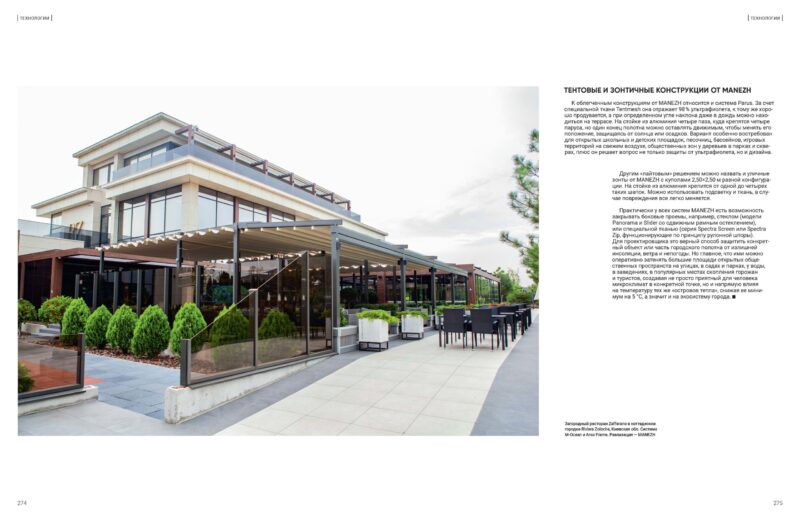
Country restaurant Zafferano in the cottage town of Riviera Zoloche, Kyiv region. M-Ocean and Arso Frame system. Implementation — MANEZH
Practically all MANEZH systems have the option of closing the side openings, for example, with glass (Panorama and Slider models with sliding frame glazing) or special fabric (Spectra Screen or Spectra Zip series, which function according to the principle of a roller blind). For a designer, this is a sure way to protect a specific object or part of the urban fabric from excessive insolation, wind and bad weather. But the main thing is that they can quickly shade large areas of open public spaces on the streets, in gardens and parks, by the water, in institutions, in popular places where citizens and tourists gather, creating not only a pleasant microclimate for a person at a specific point, but also directly influencing on the temperature of the same "heat islands", reducing it by at least 5 °C, and therefore on the ecosystem of the city.
/The material is published on the pages #33 of volume PRAGMATIKA.MEDIA/