

Lidia Chizhevska, urban planner at Integrated Urban Solutions; Haris Pieplas, PhD ETH/SIA, Co-Head of Urban Design, Planning and Development at Integrated Urban Solutions Drees & Sommer
Prerequisites for the recovery of Ukraine
A year has already passed since the outbreak of a full-scale war. In the first months after the initial shock of the onset of these terrible events wore off, Ukrainian architects, urban planners and international colleagues began to collaborate and develop approaches and concepts for the recovery of Ukraine.
During this time, the Ukrainian government proposed a new tool called the "Program of comprehensive recovery of the oblast (region) and the territory of the territorial community (its parts)", aimed at ensuring the need for rapid recovery and adaptation to the complexity of the situation.

The legal basis for the recovery of Ukraine is the comprehensive recovery program
The study of world cases of post-war reconstruction, the solidarity of international organizations, numerous discussions and conferences last year did not give all participants a clear understanding: is it appropriate to think about plans for reconstruction and development before the end of the war? Some cities, such as Kharkiv, Mykolaiv, and communities (municipalities), such as Makariv, Irpin, Gostomel, and Rohan, have already begun their path to recovery. But the main question remains how to achieve the sustainable, comprehensive recovery that the winners deserve?
When and how should the process of restoring the territory begin?
Rescue should begin immediately, not wait for the "perfect moment" that will never come. In particular, the preparatory work should not be underestimated: a large number of activities are aimed at defining the framework and concept, for example, defining the vision, creating a local team, developing a communication strategy and determining the participation of all stakeholders, including the public, before the implementation begins.
In order to have a holistic view of the status quo and the architectural as well as socio-economic damages and losses, it is necessary to carry out a broad analysis and diagnosis that includes data collection on all available resources, field and satellite surveys, review of the legislative framework, interviews, etc.
What are the main disadvantages that can be avoided when restoring territories?
Approach the process comprehensively!
Accurate coordination of actions and management of processes, determination of goals based on a systematic sectoral analysis of resources and events that took place, as well as determination of priorities of goals and measures to such a complex multi-component process as the restoration of the territory, it is important to approach it comprehensively. As a result, it provides complete understanding, saves time, effort and money, and avoids duplication of similar or identical work.

The approach and stages of development of the integrated restoration program
Using this approach, the process of developing a city and community recovery program can be divided into three stages.
1) The first stage of preparatory and research work includes the creation of a local group, the development of a communication strategy: determining the participation of all interested parties, including public, process launch, data collection and analysis.
Possible directions of work for the actual general recovery can be determined on the basis of an integrated synthesis of various thematic layers of collected data (such as social infrastructure, commercial and economic, critical infrastructure, etc.), without which it is impossible to formulate specific goals and objectives of holistic reconstruction and sustainable territorial development.
As a result, the community, the city will get a general and specific understanding of what happened on their territory, what potential opportunities exist and what risks can still be prevented.
2) We cannot determine when the war will end. However, we can predict possible scenarios on the basis of the conducted analysis, which gives a holistic vision of the picture of the future.
The next stage is the construction of scenarios and planning of actions, when strategic tasks are formed to achieve the set goals and action plans for their implementation, and public discussion and engagement activities are carried out.

Drees & Sommer: processes of integrated urban solutions
One of the most important steps and, at the same time, challenges is the involvement of different types of public. Multi-stakeholder participation in scenario development and testing aims to improve communication and link between local government and the public sector. Citizens should be able to make decisions about their future. The ability to implement these decisions, find resources and partners, and ultimately succeed depends on the quality of decision-making processes.
The use of engagement tools such as urban labs, seminars, workshops and other engagement activities also aims to avoid a piecemeal approach to recovery that only benefits individual stakeholders.
3) The implementation stage is the first step to a detailed description of ways of implementing planned actions. It begins with consideration of the financial levers for achieving the result and ends with the implementation of the action plan (projects).
Determining the priority of implementation of these projects with technical and economic justification is crucial. Implementation (target goal) is based on the development of an action plan with a detailed description of the required resources and funding.
An important part of the implementation stage is the holding of architectural competitions to select the best quality proposal - in a transparent way to find the most qualified team to work on the project.
These contests should not be competitive in the traditional sense. Such competitions should involve cooperation between design and planning teams, as well as the involvement of a wide range of stakeholders: the public, business, academic circles, international experts, public authorities, etc. These "marathon competitions" can be held in City Action Labs and facilitate collaborative creative efforts in the recovery process with less controversy and greater accountability among different interest groups.
Project management mechanisms are fundamental at every stage of a restoration project. In general, only a high-quality and holistic approach to defining the financial, management, coordination and consultation mechanisms of the work plan and the reporting system, including monitoring and evaluation of the achievement of the territory's development indicators, leads to successful recovery.
Should local authorities wait for the Recovery Plan of Ukraine as a general vision of recovery from the state?
The current trend shows that many local and international respectable organizations have already started to move the recovery process forward. But this contribution should be more cohesive and coordinated.
Most representatives of local authorities live with the main question, isn't it time to plan your future? And he is waiting for a decision - specific prescriptions from the national authorities where to start and what to do.

Program of comprehensive restoration of the Makariv community
Despite the uncertainty and risks of a protracted conflict, some communities, such as Makariv, in cooperation with the international architectural planning and consulting company Drees & Sommer – Integrated Urban Solutions and the Union of Architects of Ukraine and the Architectural Chamber of NSAU, are already taking active measures to restore the life of the community and revival of the economy and development of the territory.
After the large-scale Russian invasion of Ukraine on February 24, 2022, Makariv and the villages of the Makariv community became the center of hostilities and bloodshed. Residents lived under Russian occupation for a month and a half. The occupiers killed more than 200 civilians.
As a result of daily massive shelling by the Russians, 3332 objects of social, residential and critical infrastructure were destroyed and damaged. The accessibility of the population to communal services and the labor market has worsened.

Comprehensive analysis of events in the Makariv community
But community authorities work and do not sit idly by. In particular, they prepared proposals for finding funding for the development of a recovery program. Because it's not enough to repair the windows in the school when you don't understand how to restore the heating and bring back the residents.
Relativecleaning up destroyed objects or building new ones?
Having tested the approach and methodology of the Makariv community restoration project, we divide the problems faced by local self-government bodies as a result of the war into two groups. The first group of issues that require an immediate and urgent solution. Restoration of electricity supply, water supply and other life support systems of the population, for example, installation of broken windows in the school. The first and most difficult question that communities have to answer is whether there is a need to restore destroyed objects.
How to return the population? Do we need to rebuild all the destroyed objects, or maybe some villages will never be rebuilt?
Of course, this is a difficult issue for the residents of these villages. But this question arose even before the war. Every year in Ukraine, 19 villages are depopulated due to urbanization and population migration. After the war, this figure may increase significantly. The issue of legal regulation and the further fate of objects, such as houses, in such settlements remains open due to the complex mechanisms prescribed in the legislation. One thing is clear: without clear planning, based on an in-depth analysis of the situation, it is impossible to make balanced and rational decisions.
The second group of questions is a question of a strategic nature, when the objects are destroyed and are subject to long-term capital reconstruction. In this case, it is necessary to assess the situation and plan the restoration of such objects step by step. In these cases, it is advisable to implement pilot projects for testing new approaches to recovery. There are quite a lot of innovative technologies in the world that do not reduce, but on the contrary, even increase comfort and quality of life, while building a house can be quick, simple and made of recycled materials.

Drees & Sommer: From cradle to cradle – principles of circular construction
Since 2019, Drees & Sommer and EPEA Internationale Umweltforschung GmbH have been working together to create cradle-to-cradle principles for the circular economy in all sectors. EPEA's materials expertise is the basis for product optimization from the molecular to the modular level. This approach is attractive not only from an ecological point of view, but also from an economic point of view, which is extremely necessary for the restoration and improvement of the sustainability of Ukrainian cities and communities.
Does the document development time affect the quality of recovery planning? How to do it quickly and efficiently?
A community recovery program should be a dynamic document. It shows and predicts actions at the time of its creation. The calculation period of the action plan can consist of three stages. The first stage lasting 2-3 years is the restoration and implementation of emergency response measures. The second stage consists in the implementation of measures to restore the territory for an average of 5-7 years. The third stage of 10+ years is aimed at the implementation of development measures. Such gradual and purposeful actions make it possible to adapt to changes and evaluate the progress and expediency of the decisions made.

The versatility of ALHO modular construction methods
The implementation of the action plan is decisive in the process of sustainable recovery. Long does not always mean high-quality, especially when we are talking about significant destruction of the housing stock. Housing must be built "yesterday". And the first thing that comes to mind when we put "fast" and "housing" in the same sentence are modular containers. Such a combination of words immediately sets us up for aggression both from the side of fellow architects and from the population, which usually does not believe in the temporary nature of such housing. But successful European practices show otherwise.
For example, ALHO is a market leader in modular construction and implements best practices in modular building construction. With 50 years of experience in the implementation of this technology and continuous improvement, the company creates an individual approach to each type of building for fast and sustainable economic construction. ALHO pays particular attention to the use and life cycle of materials. The term "life cycle costs" refers to the sum of all costs generated by a product (building) during the entire life cycle, i.e. the life of the product. Buildings that have been designed and built with environmental and sustainability considerations in mind are often the most cost-effective option, even with higher construction costs.
This approach clearly shows that even rapid construction of modules with correct calculations and the application of more environmentally friendly innovative methods will provide economic benefits and a better quality of life in the future.
When recovery community can the city be considered successful? What are the recovery criteria?
The success of recovery depends on improving and creating a new quality of life, increasing the capacity of local authorities, establishing connections, ensuring better quality of services. The main priorities, the achievement of which is a criterion for the success of the restoration, were formed by international and Ukrainian experts (Anna Bondar Verkhovna Rada of Ukraine, Kees Christiaanse KCAP, Lydia Chizhevska National Union of Architects of Ukraine, Gyler Mydyti KCAP, Peter Navrat ONplan Lab, Otar Nemsadze GIZ Georgia & Tbilisi Architecture Biennale , Haris Piplas Drees & Sommer, Robert Youssef ONplan Lab) during the conference in Prague.

Conference on architecture and construction. Cultural policy - ECAP 2022 11-12.10.2022
It is important to combine local, national and international efforts by creating a legislative and policy framework to coordinate action, including all possible stakeholders. Of course, the needs of the community must be at the center of recovery. People-centeredness and the creation of favorable conditions for life are one of the main goals of improving the living environment. Everything we do is aimed at improving the quality of everyday life.
Architecture, urban planning and strategic planning are the main tools for achieving sustainability and capacity of cities and communities, adaptation to the consequences of tragic events. The traditional sectoral approach to planning in Ukraine should change to a comprehensive one, which, in turn, makes it possible to work and plan activities in an integrated manner.
Funds for reconstruction and restoration are quite limited. It is unlikely to be possible to mobilize the entire amount at once. Therefore, it is extremely important to understand the measures and determine their priority
In conclusion, there are 10 recommendations that provide new quality and outline the framework conditions that can help to achieve a comprehensive, step-by-step, socio-economically fair and rethought reconstruction of every city and community of Ukraine. A crystallization of this could be the idea of coordinating forces under an umbrella organization such as the German IBA (International Building Exhibition)*.
* International construction exhibition (IBA) is an urban planning and urban development tool originally used only in Germany to provide new ideas and projects in the social, cultural and environmental fields for urban or landscape changes deemed necessary in the respective circumstances.
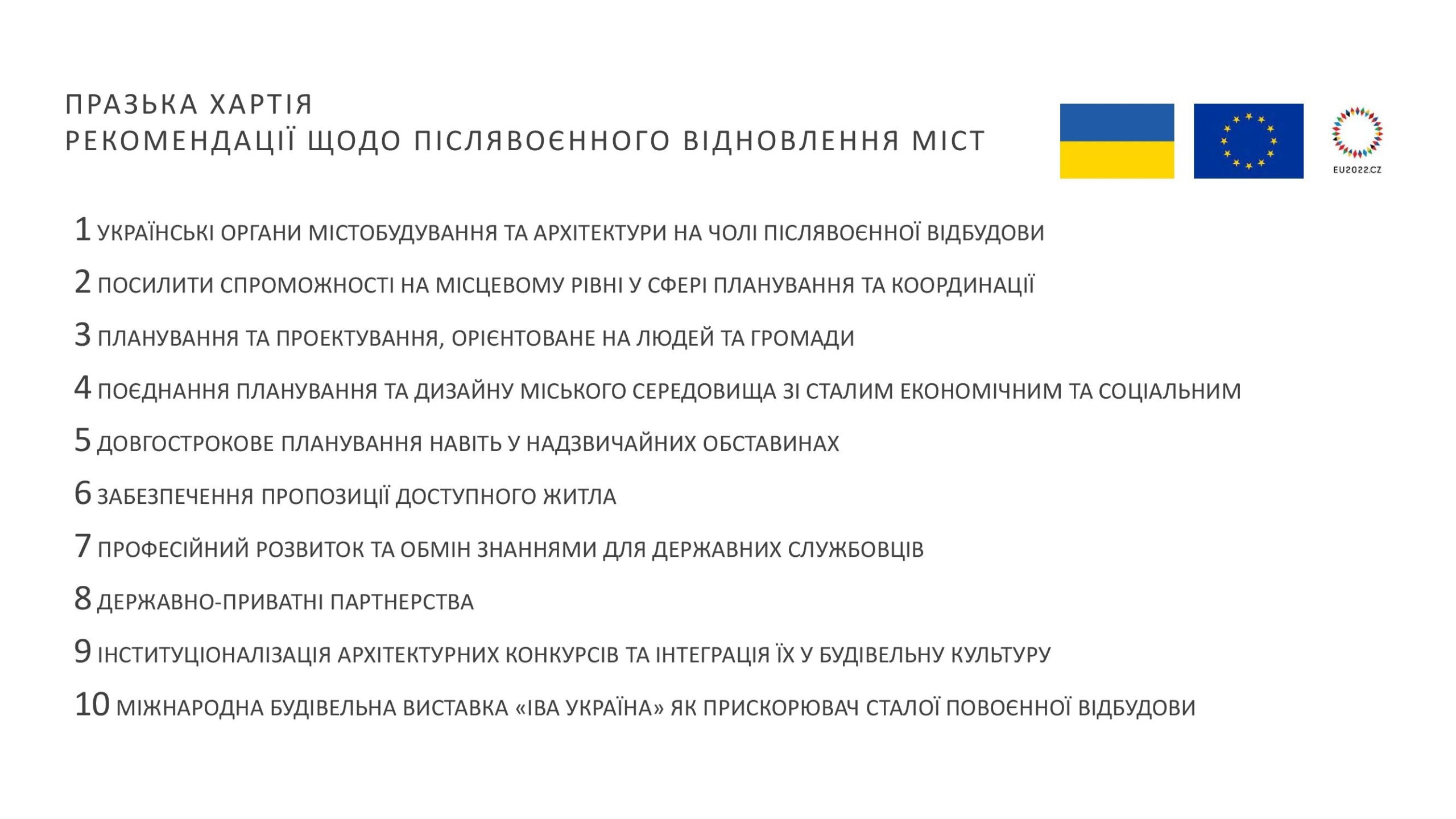
10 recommendations for post-war urban reconstruction
SUMMARY: We need to start the rebuild process now. To plan recovery according to the principle "as it was" is a road to nowhere. Only a comprehensive analysis and rethinking of the existing will help not to fail the reconstruction. A comprehensive recovery program is a document that allows you to create a holistic picture and define specific steps and stages. Since the document is complex and covers all spheres of life, it is worth involving professionals and various groups of stakeholders in its development. In close cooperation of Ukrainian and international colleagues, it is possible to achieve truly progressive, innovative and sustainable solutions.
Read also
Conflict of interest: how to motivate the developer to reduce the height and most importantly - why?


