



Mykola Kotsyruba's comment to the material "On the cutting edge of the trend. How cities and people turn global problems for good".
PRAGMATIKA.MEDIA: How much demand is there for real estate in peripheral areas of the capital and suburbs today? In the first months of the pandemic, there were many predictions that people would seek to leave the city center and high-density areas. Do these predictions come true?
Mykola Kotsirub: It can be stated that the demand between the center and the peripheral areas did not change much. According to the data we collect and process at M4U, before the pandemic in the primary residential real estate market, the ratio of central business prices to peripheral areas and suburbs was 2.41 (December 2019), a year later the ratio was 2.5, and as of December 2021 — 2.49.

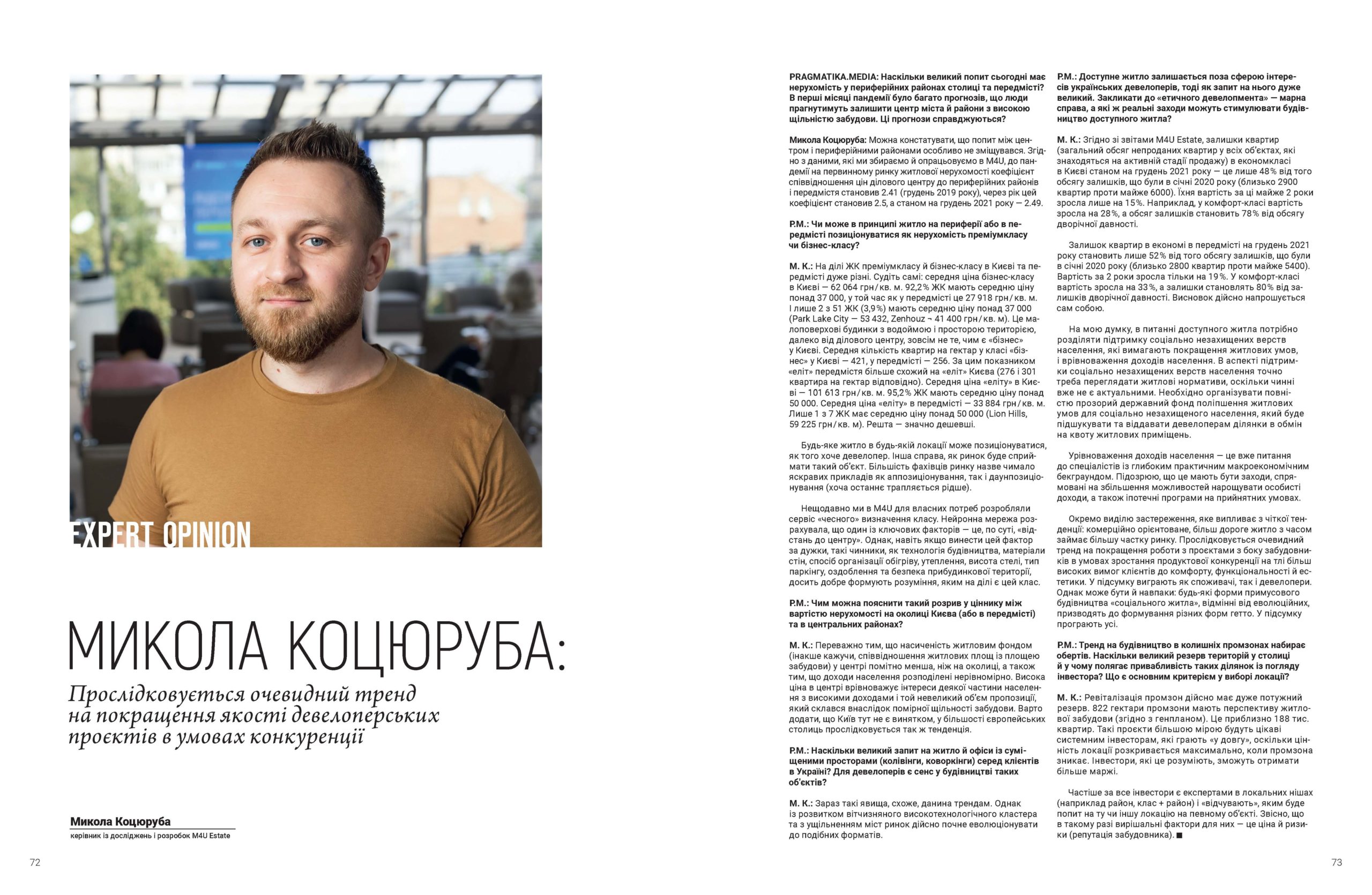
Mykola Kotsyruba, head of research and development at M4U Estate
PM: In principle, can housing on the periphery or in the suburbs be positioned as premium or business class real estate?
M.K.: In fact, premium-class and business-class residential complexes in Kyiv and the suburbs are very different. Judge for yourself: the average price of a business class in Kyiv is UAH 62 per square meter. m. 064% of housing units have an average price of more than UAH 92,2, while in the suburbs it is UAH 37/sq.m. m. And only 000 out of 27 housing complexes (918%) have an average price of more than 2 UAH (Park Lake City — 51 UAH, Zenhouz ¬ 3,9 UAH / sq. m).
These are low-rise buildings with a pond and a spacious area, far from the business center, not at all what "business" is in Kyiv. The average number of apartments per hectare in the "business" class in Kyiv is 421, in the suburbs - 256. According to this indicator, the "elite" of the suburbs are more similar to the "elite" of Kyiv (276 and 301 apartments per hectare, respectively).
The average price of the "elite" in Kyiv is UAH 101 per square meter. m. 613% of housing units have an average price of over 95,2. The average price of the "elite" in the suburbs is UAH 50/sq.m. m. Only 000 out of 33 housing units has an average price of over 884 (Lion Hills, 1 UAH / sq. m). The rest are much cheaper.
Any housing in any location can be positioned as the developer wants. Another matter is how the market will perceive such an object. Most market experts will name many vivid examples of both apposition and downpositioning (although the latter occurs less often).
Recently, we at M4U have been developing a "fair" class definition service for our own needs. The neural network calculated that one of the key factors was essentially "distance to center". However, even if this factor is taken out of parentheses, such factors as construction technology, wall materials, the method of organizing heating, insulation, ceiling height, type of parking, decoration and security of the surrounding area, quite well form an understanding of what this class actually is.
PM: How can you explain such a gap in the price tag between the value of real estate on the outskirts of Kyiv (or in the suburbs) and in the central areas?
M.K.: Mainly due to the fact that the density of the housing stock (in other words, the ratio of residential areas to the built-up area) is significantly lower in the center than in the outskirts, as well as the fact that the incomes of the population are unevenly distributed. The high price in the center balances the interests of some part of the population with high incomes and the small volume of supply, which has developed due to the moderate density of buildings. It should be added that Kyiv is not an exception, most European capitals follow the same trend.
PM: How big is the demand for housing and offices with combined spaces (colivings, coworking spaces) among clients in Ukraine? Does it make sense for developers to build such facilities?
M.K.: Now such phenomena seem to be a tribute to trends. However, with the development of the domestic high-tech cluster and the densification of cities, the market will really begin to evolve into similar formats.
PM: Affordable housing remains outside the sphere of interests of Ukrainian developers, while the demand for it is very high. Calling for "ethical development" is futile, but what real measures can stimulate the construction of affordable housing?
M.K.: According to the reports of M4U Estate, the balance of apartments (the total volume of unsold apartments in all objects that are in the active stage of sale) in the economy class in Kyiv as of December 2021 is only 48% of the volume of balances that were in January 2020 year (about 2900 apartments against almost 6000).
Their value has increased by only 2% in these almost 15 years. For example, in the comfort class, the price has increased by 28%, and the volume of the balance is 78% of the volume two years ago.
The balance of apartments in the economy in the suburbs as of December 2021 is only 52% of the amount of balances that were in January 2020 (about 2800 apartments against almost 5400). The cost increased by only 2% in 19 years. In the comfort class, the cost has increased by 33%, and the balance is 80% of the balance two years ago. The conclusion really suggests itself.
In my opinion, in the issue of affordable housing, it is necessary to divide the support of socially vulnerable sections of the population, who demand the improvement of housing conditions, and the equalization of the incomes of the population. In terms of support for socially vulnerable sections of the population, it is definitely necessary to revise the housing regulations, since the current ones are no longer relevant.
It is necessary to organize a fully transparent state fund for the improvement of housing conditions for the socially vulnerable population, which will find and give plots to developers in exchange for a quota of residential premises.
Balancing the incomes of the population is already a matter for specialists with a deep practical macroeconomic background. I suspect that these should be measures aimed at increasing opportunities to increase personal income, as well as mortgage programs on acceptable terms.
Separately, I will single out a caveat that follows from a clear trend: commercially oriented, more expensive housing over time occupies a larger share of the market. There is an obvious trend to improve work with projects on the part of developers in the conditions of growing product competition against the background of higher customer requirements for comfort, functionality and aesthetics. In the end, both consumers and developers will win.
However, the opposite can also be the case: any forms of forced construction of "social housing", other than evolutionary ones, lead to the formation of various forms of ghettos. In the end, everyone loses.
PM: The trend for construction in former industrial zones is gaining momentum. How large is the reserve of territories in the capital and what is the attractiveness of such plots from the point of view of an investor? What is the main criterion in choosing a location?
M.K.: The revitalization of industrial zones really has a very powerful reserve. 822 hectares of the industrial zone have the prospect of residential development (according to the master plan). This is approximately 188 apartments. Such projects will be more interesting to systemic investors who play "long", as the value of the location is revealed to the maximum when the industrial zone disappears. Investors who understand this will be able to get more margin.
Most often, investors are experts in local niches (for example, district, class + district) and "feel" what the demand will be for this or that location on a certain object. Of course, in this case, the decisive factors for them are the price and risks (reputation of the developer).
Main photo: Unsplash.com/Alice Butenko
Read also
Kyrylo Stepanets: The urban exploration trend will not save old houses
Oleksandr Stolovy: Architecture is also about experiment
Mykola Chepelev: All we have left is copypaste and cargo cult


