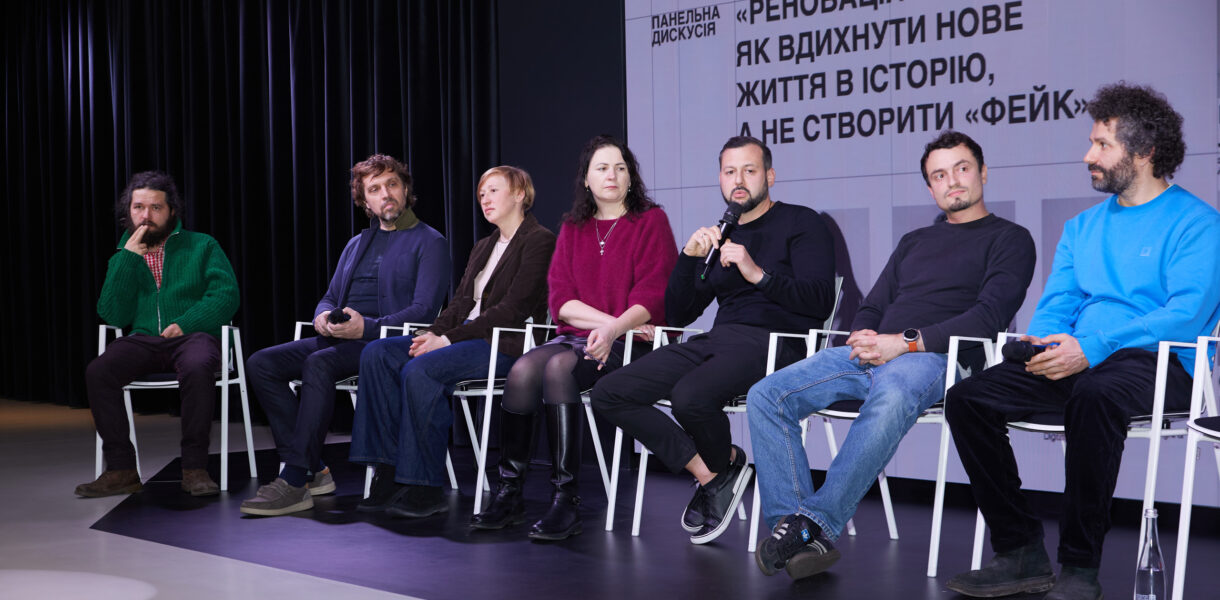
Kyryll Stepants' comment on the material "On the cutting edge of the trend. How cities and people turn global problems for good".
PRAGMATIKA.MEDIA: Can we say that there is a subculture of urban exploration in Ukraine — urban explorers — and a corresponding trend has already formed?
Kyrylo Stepanets: Yes, of course, this community — part of the global trend — exists in Ukraine as well. In our country, it is not so numerous, but more diverse. For example, we call people who go underground diggers, but nobody in the West uses this term, and when you say I am a digger, people look at you with surprise. There is no such thing as a "roofer".
All this is called urban exploration. In the West, this subculture is very developed and includes people of all ages, so it is not the prerogative of teenagers looking for extremes. There are a lot of urban explorers all over the world, they write books and make movies. Blogs are self-evident, this is already a trivial phenomenon.

Kyrylo Stepanets, city researcher, tour guide
PM: If I understand correctly, an integral element of attracting people is a certain intrigue: you do not conduct tours of obvious locations, you show a hidden part of the city. How many leaders like you are there in Ukraine?
K. S.: Quite a lot, even more than I would like. Popularization has both positive and negative sides. What is urban exploration? First of all, this is penetration into places inaccessible to the general public. For example, on the territory of some factory, and although it is closed and no longer works, it is still guarded. And so one person climbed in, posted a photo, and everyone rushed over the fence to this closed area. And the place lost its charm.
There is also an ethical problem: many people start doing research for interest and emotional sustenance, and then it occurs to them that there is money to be made from it. In the days of my youth, when I thought of nothing else but getting somewhere, we could pull out and sell a pair of rotten gas masks. And now our followers are hunting for metal, building materials, they can destroy the structure of buildings - in short, they are trying to make money.
PM: How big is the fund of abandoned buildings and structures and can it be considered a kind of reserve for the development of cities?
K. S.: It can be perceived rather as a property and cultural reserve or as a reserve place. Demolished - built a new one. It is clear that all dilapidated houses can be restored, but we have a tradition of demolishing them.
PM: Why do you think our society has not developed an understanding of the value of authentic buildings and artifacts?
K. S.: Demand creates supply. Society does not need this cluster. The population of Kyiv is very heterogeneous. In order for a certain urban culture to be formed, a high percentage of the urbanized population is required, when several generations have lived in one city in a row.
And in our country, the population of large cities is growing due to internal migration from small villages, these people are not spoiled and are not very demanding in terms of aesthetics. They are unlikely to be pleased with the ruins, they are much more to their liking some bright advertising. We have not yet matured to understand the situation, but I do not rule out that ten years will pass and something will change.
PM: Do you often have ideas that this or that building or object could be perfectly adapted for a coffee shop, community center, housing, etc.?
K. S.: No, absolutely. Once upon a time, there was a practice of squatting in Kyiv - unauthorized settlement. But this is not close to me. I like our dilapidated facilities as they are now. And the idea of giving the ruins a second life is not close to me.
PM: But is it obvious that time and indifference can destroy the strongest stones, and sooner or later ancient walls will fall?
K. S.: I often read comments under my photos on the blog from people who are saddened by the deplorable state of this or that building. They complain: "They ruined the beauty!". But wait, aren't there a few beautiful houses around that are whole and intact? It is necessary that they were also destroyed.
PM: Which of the Ukrainian cities is the most saturated with abandoned architecture and artifacts?
K. S.: There are only five large cities in our country, the rest are rather small towns. Therefore, of course, the capital is the most interesting in this respect. And it is a mistake to think that only in Ukraine there are many destroyed buildings. There are also many abandoned buildings in Europe. Recently I was traveling in Italy, and near Milan I discovered an abandoned hospital complex of incredible proportions, where among the buildings stands a church with painted walls and broken stained glass windows. Everything is neglected, littered.
Or the town of Liège near Brussels: there I saw a huge church, which is larger than our Mykolaiv church. It stands with the window openings blocked up, and inside there is bird droppings on the ancient organ. Therefore, the death and destruction of architecture is a global trend, and it is naive to believe that the trend of urban exploration will change something.
Of course, there is another reason, perhaps the main one: commercial. Restoration and renovation of old buildings does not allow to multiply the number of square meters that can be profitably sold. It is one thing to have a low-rise old building, and another to have a 20-story business center that can be built in its place. Of course there is a difference!
PM: Do you think this kind of shifting of architectural layers is a natural cycle?
K. S.: Yes, like life and death. Perhaps I was too inspired by Tarkovsky's film and the image of the abandoned mysterious Zone as a child.
PM: Meanwhile, in Tallinn, on the site of the abandoned industrial areas where "Stalker" was filmed, the fashionable district Rotermann City appeared, whose architects were able to find a balance between preserving the old and new architecture.
K. S.: Interesting, I haven't been there yet.
PM: Are people on your tours actually interested in architecture?
K. S.: I do not overload people with stories about architectural details, but try to show them the city in all its manifestations: not only deserted ruins, but also lively colorful places in the center. A good tour is a compilation. In order to please a wide audience, it is necessary to have knowledge about the place and area, about little-known facts. You also need a story from yourself and stories about people. In Kyiv alone, I have more than a hundred routes developed personally, but I would not say that my tours can be called "architectural".
PM: Is it fair to call Kyiv's development chaotic?
K. S.: Yes, it is a complete eclecticism, a vinaigrette of styles. I didn't like it before, but then I came to terms with it and even started to find a positive in it. When I travel in Europe, I notice that I am more "hooked" not by ancient buildings, but by modern architecture, in particular skyscrapers. Perhaps this is some kind of provincial syndrome, since the Kyiv of my childhood, in the late 80s and early 90s, was quite a provincial city.
But recently I have rethought my perception of new architecture. Despite the fact that I still love old things, I believe that my sympathies should be correlated with the interests of society, and there is a demand in society for the construction of high-rise buildings and active business. It's an indicator that people have money, and that's a good thing.

Read also
Oleksandr Stolovy: Architecture is also about experiment
Mykola Chepelev: All we have left is copypaste and cargo cult