

Dutch Design Week is a "Don Quixote exhibition" against the backdrop of Milan's iSaloni, Paris' Maison&Objet or Cologne's Imm Cologne. The vast majority of exhibits at these exhibitions are finished products: furniture, lighting, decor and interior solutions. They are already in mass production or are being prepared for launch. The stands there are decorated so carefully and exquisitely that the art of presentation sometimes overshadows the objects themselves. Everything must be flawless, seduce the consumer and work for marketing.
Dutch Design Week is a fundamentally different story and different ambitions. An exhibition devoid of gloss. When you first get there, your brain just breaks. Minimalist stands, which present incomprehensible innovations on the border of science, design and modern art, make you ask every time: so what, it was possible?

Dutch Design Week branded taxis take guests between locations on a volunteer basis. Photo: Cleo Goossens
At DDW, there is an atmosphere of exploration and discovery. A significant part of the exhibits illustrate the path, not the result. Presumably, the reason is that the exhibition grew out of the student environment. In 1998, students of the Design Academy of Eindhoven decided to present their diploma works to the general public. They held a small one-day exhibition, another one the following year, and then the project began to grow. Design at the level of hypotheses, research and the search for answers turned out to be interesting not only to a narrow professional circle.
The event is actively attended by people who have nothing to do with the industry. They come from neighboring cities just to expand their worldview, as they are used to going to museums or theaters
Dutch Design Week takes place in many locations of the city. One of the must-sees is the exhibition of student works by graduates of the Academy of Design. However, the free student spirit is not only evident at the Graduation Show. Some of the projects presented in other "adult" locations are also more about finding one's own voice and experiments than about solutions or a finished product. Even if there is a chair on the stand, don't believe your eyes, read the project description. It is probably made of an innovative material, or has a secret mechanism for healing the back, or carries deep symbolism. Simply, a chair without history, innovation or mission in the paradigm of Dutch Design Week cannot exist.

One of the Graduation Show projects. Photo: Max Kneefel
Make the World a Better Place
If the Dutch Design Week exhibition was to be described in one word, it would be the word "future". In Eindhoven, design is not just about form or emotion. It is primarily about innovation. People who strive to change the world for the better and solve some of the current problems offer their projects and ideas. Here you will find a dozen varieties of bioplastics, recycling of worn fishing nets, and the use of industrial waste.

The U're In Skimcare project is a urine-based skin moisturizing essence
Designer chemists suggest moisturizing your skin with a serum based on your own urine. Cultural designers create jewelry by exploring smiling as a learned reaction of women who have been oppressed by patriarchal society for generations. At the nearby stand there is a new material made from ground shells. In another location, there is a textile decorated with algae growing in it. Another has pencils made entirely of wood and vegetable wax. The project that caused perhaps the most uproar is Shit Show by the Dutch designer Fides Lapider (Fides Lapidaire).
The bottom line is that designer-researchers propose to centrally remove excrement from city sewage systems, treat it with the help of certain microorganisms that remove toxicity, and enrich cultivated areas with this substance
Guests of the project were offered burgers with vegetables grown on such soils. Dezeen even made a separate video report about this "revolutionary" find.

Clothing made of bioplastics based on vegetable starch
It is difficult to predict which exhibits will remain exhibits, and which will survive the test of time, reality, and a system that resists change. Looking at the translucent scraps of bioplastics in one of the exhibition pavilions, you remember that a few years ago I saw slightly different bioplastics created by another designer at the same place. And even a year before that, there were other colored scraps from the same segment.
And it is not known for certain whether any of them were realized as a product. However, perhaps everyone has become an intermediate link, a new rung on the innovation ladder. And the amount of knowledge and experience accumulated by designers will at a certain moment become critical and give an invention that will start a new social trend and affect the lives of each of us. Or not.

The Best Jewelery project A Woman Can Wear Is Her Smile by Alma Teer
Get Set
Designers who present their work in Eindhoven ask the question: why am I doing this? There is a suspicion that the answer "to make money" does not suit them. The creative activity of the people whose work is exhibited at Dutch Design Week suggests deeper motives: environmental, social, cultural, or a mix of several. This approach has always been impressive. However, this year, given the military background of Ukraine, Dutch Design Week was perceived somewhat differently.
The theme of this year's DDW is Get Set. It sounds surprisingly appropriate
It seems that all this time the designers carefully worked out the basis for something bigger, did their "squats and pull-ups" so that at some point they could push off the starting blocks and rapidly set off into a new world of the future. The only question is, did they prepare for such a future? Perhaps to the future from Yuval Harari's Sapiens: A Brief History of Humanity? In it ten years ago, the researcher pondered how we will live in a world that has overcome epidemics, wars and famine. In a world that will pose many new questions to humanity. For example, what should be the professional and career path of a person whose life expectancy is 300 years?

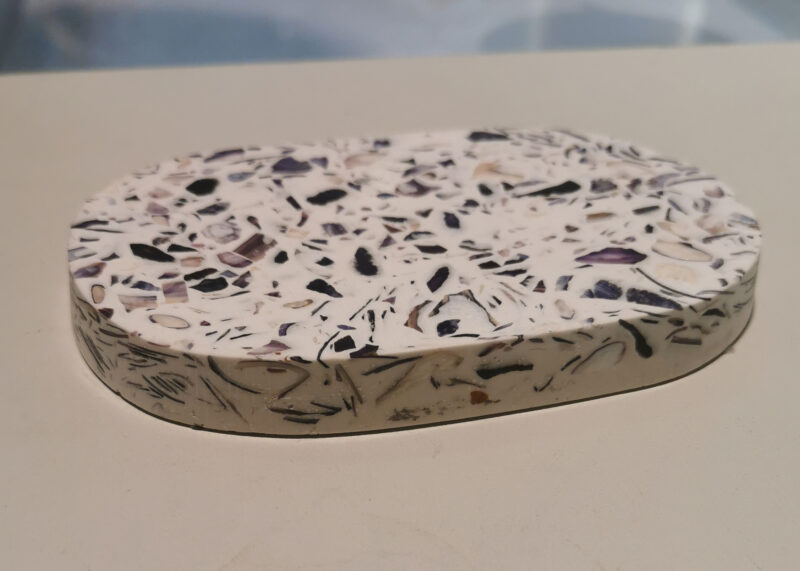
Innovative material based on crushed Malakio shells
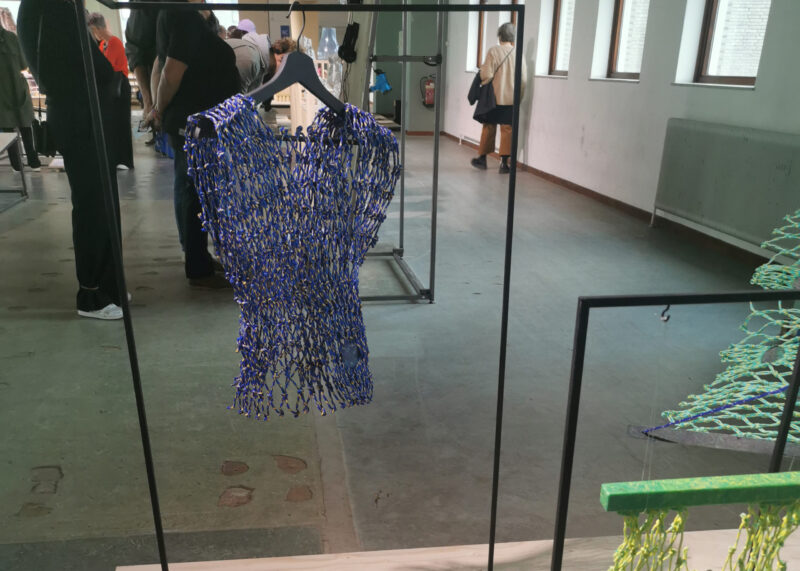
Clothes made from old fishing nets at the Graduation Show
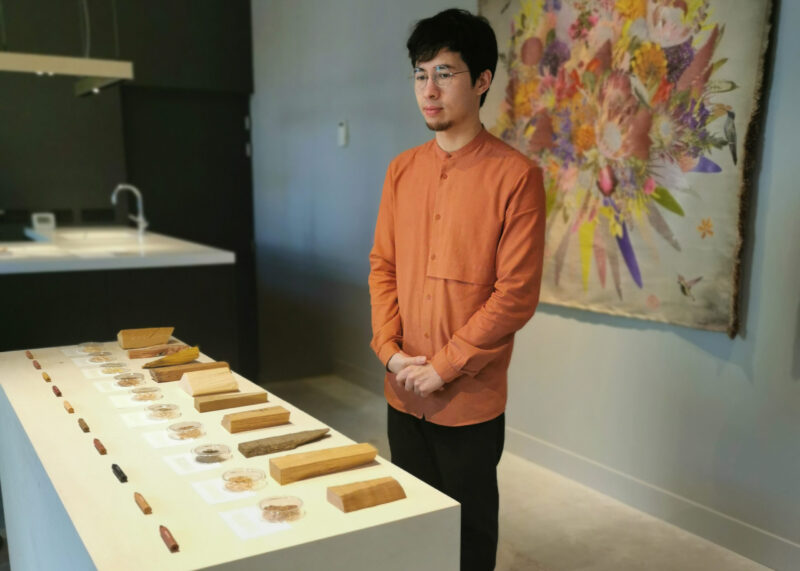
Organic pencils made of wood and vegetable wax in the Kazerne gallery
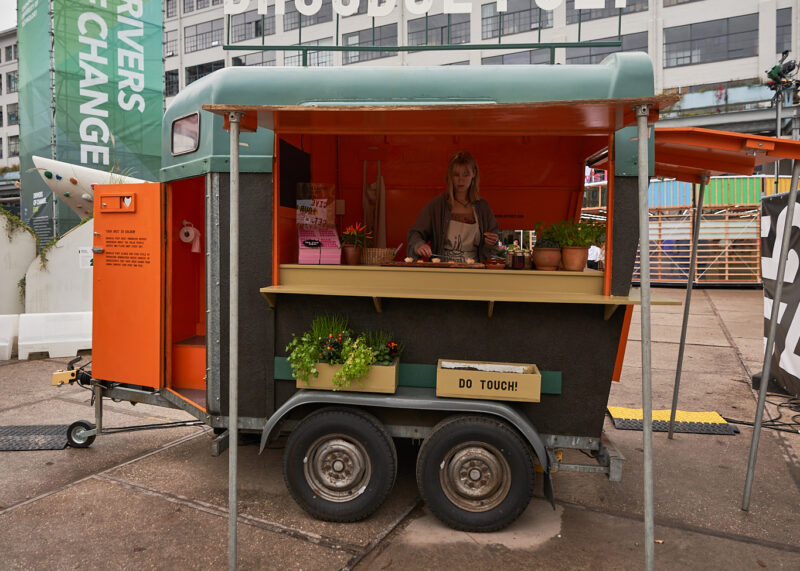
The Broodjepoep project on the use of human feces in agriculture. Photo: about.today
But the future surprised us, it threw out its dirty little balls in front of us and instead of the problem of colonization of Mars, it posed somewhat different questions from which there is nowhere to escape. However, the two thousand kilometers that separate Eindhoven from the war leave many designers with the illusion that this cultural retreat is something distant and localized. There is a prevailing vision that their domino in this row will endure in some incomprehensible way.

The Ukrainian-Dutch Home(Land) project in The New Block is one of the StrijpS locations
Home
Ukraine presented its own exhibition at Dutch Design Week for the fourth time. This time, the project was the largest not only in terms of area and number of exhibits, but also in terms of the depth and complexity of the topic. All exhibits and scenography were created specifically for the exhibition. Home(Land) curators Dasha Tsapenko and Nazar Gresko enlisted support Stichting Art East + Discover African West and Narada Foundation and involved an interdisciplinary creative group from Ukraine and the Netherlands. For the most part, designers from two countries worked on creating objects in pairs.
Home(Land) is an exploration of home and its sudden loss
About the longing for one's own space and the opportunity to find it in a new place. The impetus for these reflections was the war with millions of refugees, for whom the home was transformed from a household category into a sacred one.

The process of dyeing wool with borscht ingredients - preparation for Home(Land)
The project contained so many ideas that there would be enough for several separate exhibitions. It's a complex and meaningful story that can be appreciated in terms of aesthetics, and can be immersed in context to leave The New Block showroom a little different than when you entered.
Guns (traditional clothing of Ukrainian shepherds) and dishes became the main lines of the story.

The process of guna creation
Gunia
Gunya is a metaphor for a home that can be taken with you. For a shepherd in the wilderness, this is protection from bad weather and a charm against all evil. Like a superman suit, gunya gives its wearer extra powers.
Gunis are woven by hand on an old-fashioned two-stage loom. It all starts with sheep shearing, wool preparation, thread making and weaving. Next, the gunya is washed in a "valila" in river water, dried and scraped. All the guns at the exhibition were created by craftswoman or rather artist Ruslana Honcharuk from the village of Yavoriv in Prykarpattia. During the preparation of the exhibition, she came to Eindhoven to participate in experiments with materials.
In addition to wool, the gunny can be woven from a "vegan" version of the yarn - hemp fiber Hamp Fur, created by Oksana Devo and her brand DevoHome. This product was already presented in Eindhoven, it was an exhibit of the Affair With Earth project in 2019.

Gunya dyed with mushroom pigment extracted by Ilse Kremer. Model Farid Bekirov. Photo: Alex Blanco
Specially for Home(Land), guni made of hemp fiber was dyed with natural dyes. One is a pink pigment extracted from mushrooms by the Dutch researcher Ilse Kremer. Its purpose is to offer a worthy alternative to chemical fabric dyes, the use of which pollutes the environment. Currently, Ilse has learned how to extract red, yellow and orange pigments from mushrooms and is working to ensure that the coloring result is stable and predictable.
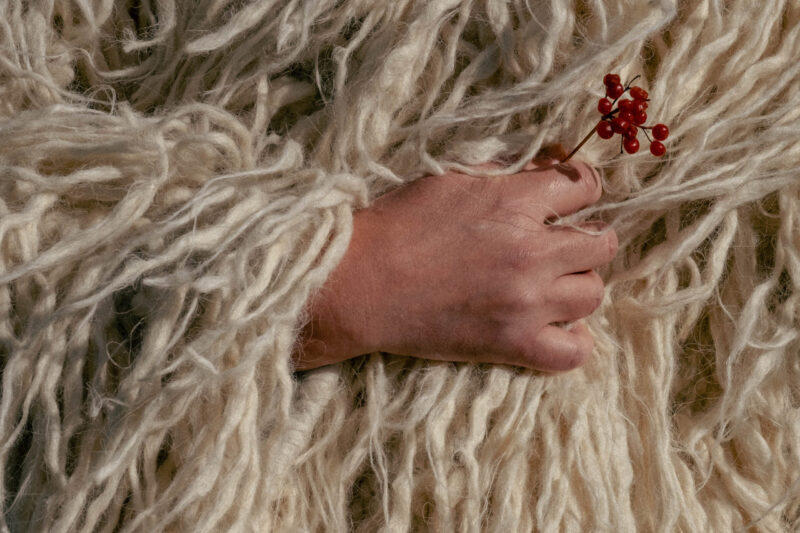
Traditional Gunya. Model Yuriy Pozayak. Photo: Alex Blanco
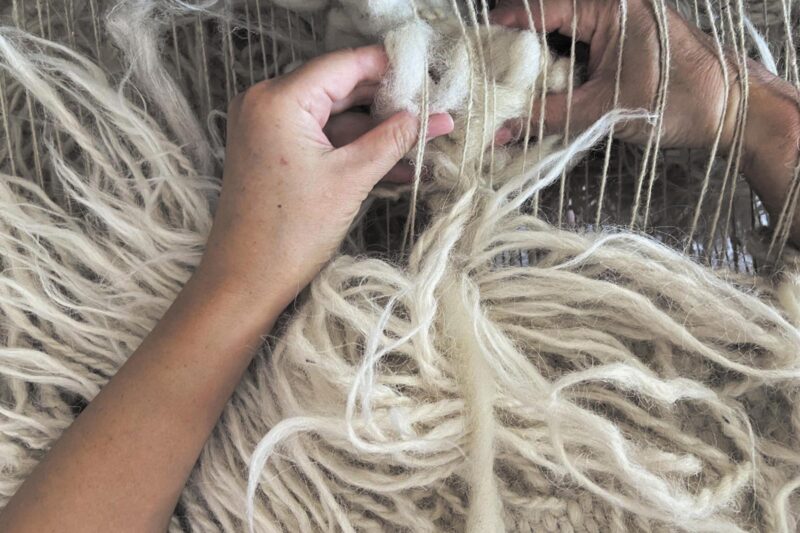
Guni weaving process
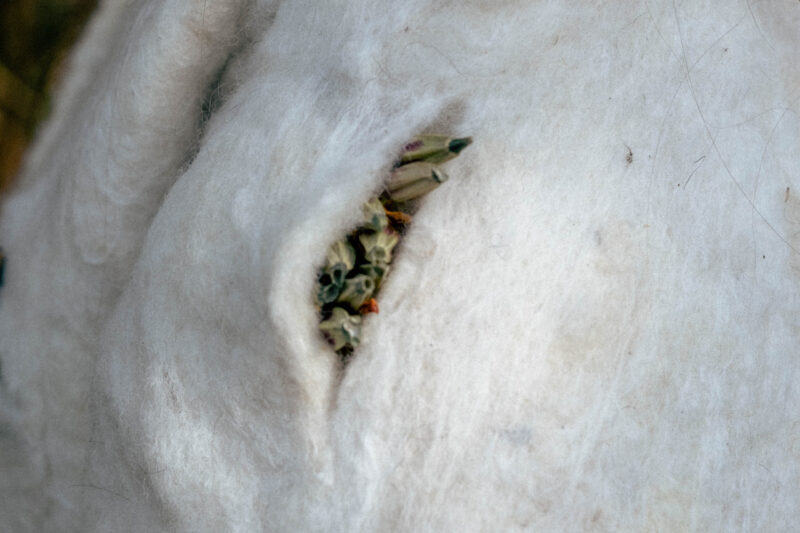
Gunya with slots for storing seeds. Model Oksana Savchuk. Photo: Alex Blanco
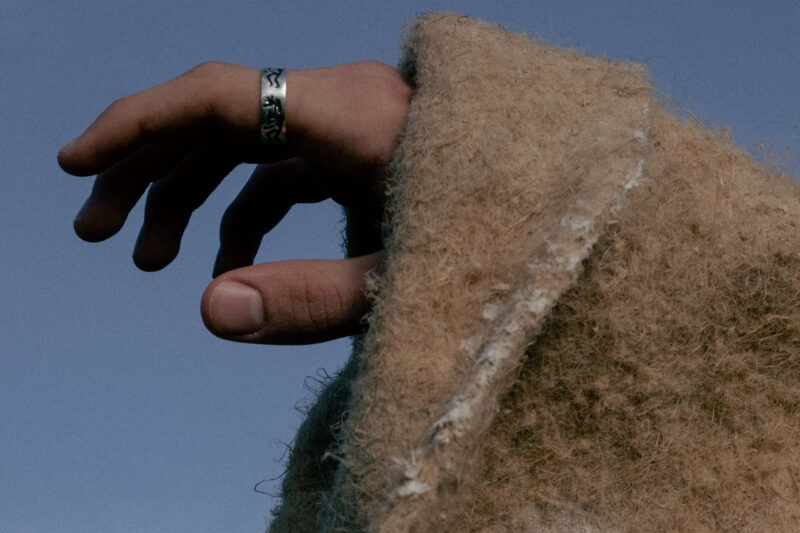
Gunya made of biomaterial based on hemp fiber and mycelium. Model Danylo Gresko. Photo: Alex Blanco
Another dyeing experiment was "Borschova gunya". Dasha Tsapenko, together with the Dutch designer Marjo van Schaik, dyed her fibers with ingredients used to prepare borscht: beets, carrots, onions. It turned out juicy, but it is difficult to predict how stable the color will be, because it is known that beet pigment quickly loses its brightness.
The most innovative exhibit of Home(Land) was gunya made of mushroom mycelium
Based on hemp fiber and mycelium, Dasha Tsapenko has grown textiles that can be used for clothing and decor. The task of inventing a new biomaterial that can be produced not only in the laboratory is complex and ambitious. To do this, you need to defeat the bacteria aggressive to the fungus, as well as make the material elastic. Dasha is working on solving these problems in the laboratory of Utrecht University together with Professor Han Vosten (Han Wösten).

Gunya, dyed with borscht ingredients. Model: Fulco Treffers. Photo: Alex Blanco
The third line of guns is felt models. This is the refined essence of guni, a "skeleton" without the usual shaggy hair. The most dramatic exhibit is a gunya with seed pockets scattered over its entire surface. Maryo van Schaik dedicated this model to the largest seed bank in Ukraine, which was destroyed by rocket attacks in Kharkiv. This is a metaphor for the most valuable thing that a person can take with him when fleeing from war.

Service from CHY Pottery, glazed using salt. Photo: Alex Blanco
Shared meal
The second story line of Home(Land) is the dishes. A reminder of the table around which close people gather. And also the tactile sensations of your favorite mug in your hand, which can emotionally transport you to the atmosphere of home, no matter how far away it is.
Each of the tableware sets revealed the theme of the exhibition through a separate story. The service, made according to the traditional technology of baking in salt, reminded of a basic product that suddenly became scarce in Ukraine. We all felt the value of salt after the occupation of Crimea and the destruction of the "Artemsil" enterprise in Donetsk region. Mines in Drohobych have become more active, but they are not enough to meet the needs of the entire country. Dutch ceramist Charlotte Visser used salt from three regions for glazing: Crimea, Donbas, and western Ukraine.

Salt-glazed tableware by CHY Pottery. Photo: Alex Blanco

Salt-glazed tableware by CHY Pottery. Photo: Alex Blanco
Jugs from the Ukrainian-Dutch duo Sasha Popruha and Stijn van Aardenne were 3D printed from a biomaterial based on miscant (a silvery grass that grows along rivers), starch and vegetable wax. In terms of shape and decoration, they repeat traditional Ukrainian ceramics, at the same time they have a peculiar "printed" texture and a deep natural aroma.
Another innovative material is the result of a combination of lignin (natural wood polymer) and buckwheat husk. In this way, the experimenter Basse Stittgen (Basse Stittgen) depicted the natural wealth of Ukraine - grain and forest. The result of the research was dishes and a fancy audio system that reproduces sound through membranes made of lignin and cellulose.
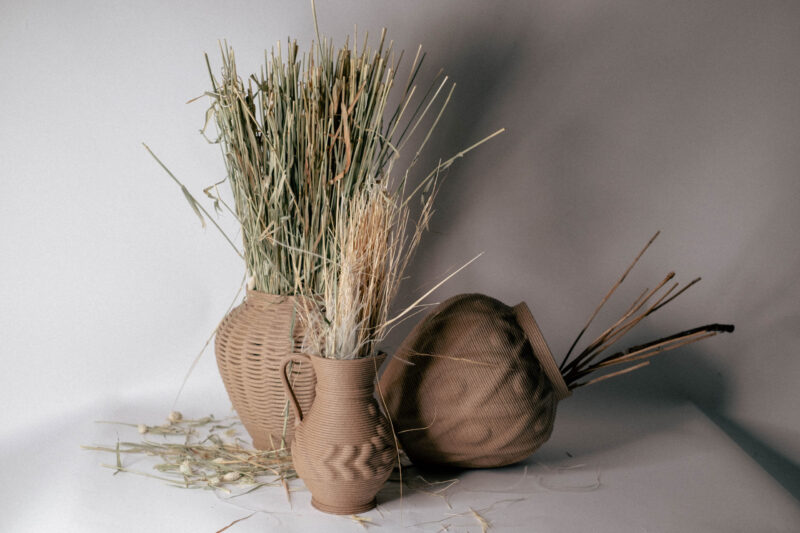
Anumo tableware by Sasha Popruga & Stijn Van Aardenne. Photo: Alex Blanco
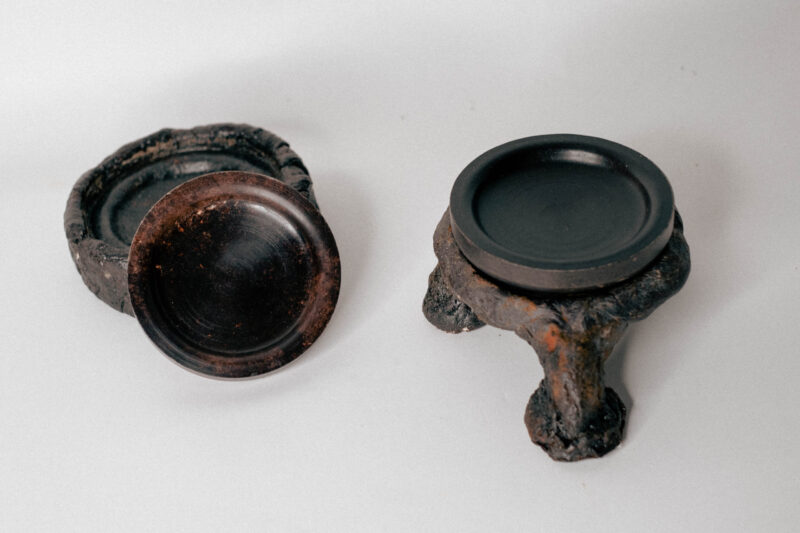
Tree of Culture tableware by Basse Stittgen. Photo: Alex Blanco
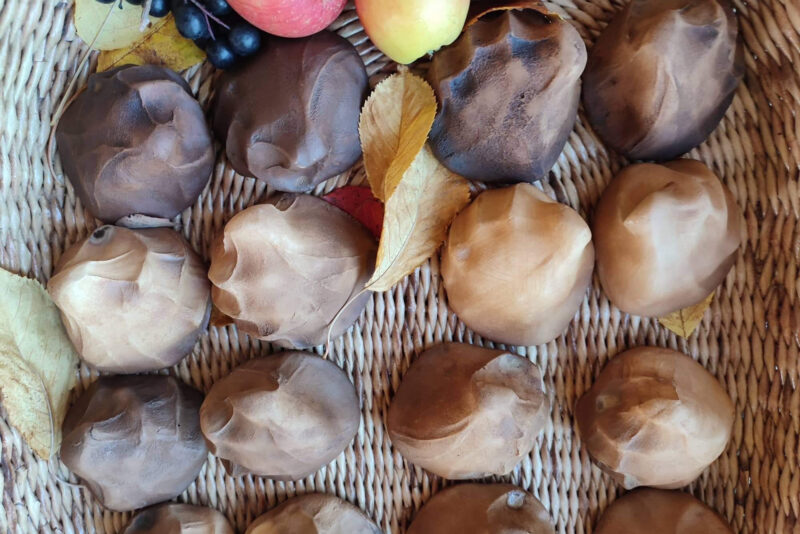
Dish Diversity in Milk(ing) by Sietske Klooster in collaboration with Oksana Denysevych. Photo: Alex Blanco
A return to the traditional technique of "milking" ceramics was demonstrated by the collaboration of the Dutch ceramist Sietske Klooster and the Ukrainian artist Oksana Denysevych from Khotov. They worked together on the mug collection. Sitske made the molds using the imprint of her own bent elbow, and Oksana glazed them with milk from farmers from different regions of Ukraine.

Dish Diversity in Milk(ing) by Oksana Denisyevich. Photo: Alex Blanco
Another dramatic image of the exhibition was the vases of Anna Ryabova, made from the ruins of buildings that were bombed during the war
The exhibition Home(Land) does not claim to solve global problems and does not have any final recipe. Instead, it offers several complex stories. You can delve into them to find your own sense of the geographical point, the square meters and the emotional image that arises with the word "home". And you can simply learn something about the traditions of Ukraine and the Netherlands. Home(Land) suggests looking back and synthesizing the experiences of generations to create innovations that can influence your future.

Kazern Gallery
Ukrainian design shows the way
In addition to the Home(Land) exhibition, another confident Ukrainian voice was heard at Dutch Design Week. In the Kazerne gallery and iconic showroom Piet Hein Eek featured decorative masks and a carpet from the OLK Manufactory. Curators of galleries of this level have a keen eye for valuable things, they do not choose mediocre works. The traditional technique and conceptual images created by Oksana Levchenya perfectly fit into the context of the avant-garde and multi-layered Dutch gallery history, once again confirming that Ukraine clearly sounds not only in the context of war news.
Our design is interesting, clear and relevant. In recent years, it can be seen at all the key exhibitions — from Milan to Copenhagen. The presence of Ukrainian projects and individual works in Eindhoven demonstrates competitiveness at the level of intellectual searches, innovations and ideas. Design works as a language of cultural diplomacy. It forms the image of a modern and bold country with a cultural base, respect for its own traditions and a desire to develop and actualize them, adding new emotional meanings and telling about a complex and at the same time unique experience.

Masks from OLK Manufactory in the Kazerne gallery

Carpet from OLK Manufactory in gallery OLK Manufactory in gallery Piet Hein Eek
Today, Ukrainian designers do not need to go somewhere or grow to the international level, they are already there and already in the vanguard. This opinion is by no means the result of an influx of patriotism and self-pity. Disappointed in Dutch Design Week? Ukrainian design will show the way" - a large article by the influential Dutch design columnist Jeroen Junte was published under this title. In it, the journalist contrasts the complex, deep and emotional exhibition Home(Land) with infantile concepts of saving the world, where the description is usually much bigger than the exhibit.
Read also
Homesickness. Exhibition of Ukrainian and Dutch design Home(Land)


