

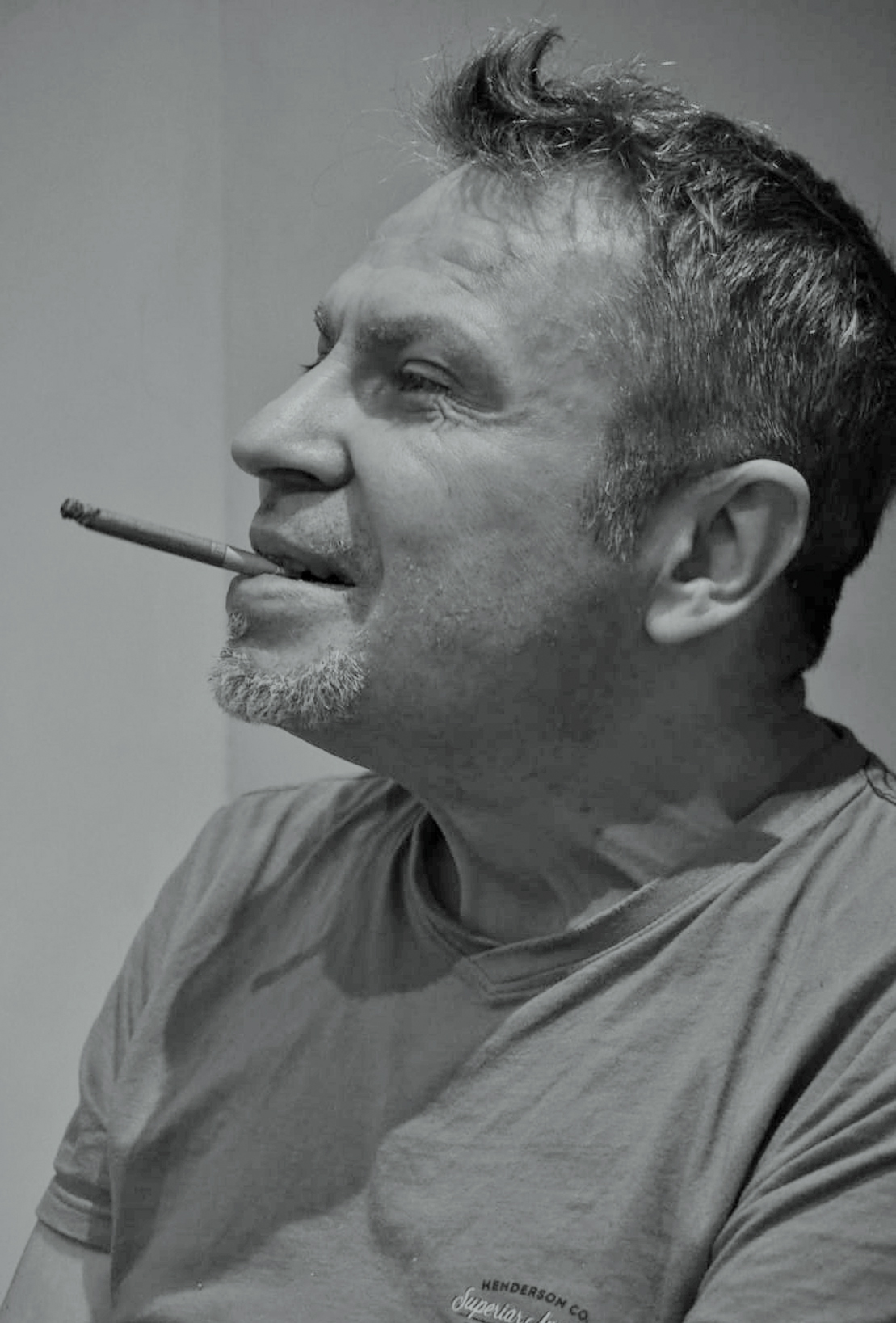
Volodymyr Hnatienko
Volodymyr Hnatyenko passed away in 2023. He left behind hundreds of sketches — residential complexes, business centers, public spaces, creative clusters, facades, landscape solutions for Kyiv, Odessa, Rivne, Zhytomyr, Bukovel, Tbilisi, and other cities in Europe and Asia. Many of his works have been implemented. But the album is valuable not only for what has been implemented. It allows you to see the built and the unimplemented side by side — and understand that for Hnatyenko there was no fundamental difference between them. The sketch was not a preparatory stage for him. It was architecture — in its purest, boldest form.
His sketches are physical objects in which thought is not yet separated from gesture.
It is important to understand what the word "sketch" means in the context of Hnatyenko. This is not digital visualization, not rendering, not work in a program. This is paper, tracing paper, impeccably sharpened pencils and a carefully selected line of felt-tip pens. Hnatyenko worked with his hands - at a time when architectural design had almost completely moved to the screen. His sketches are physical objects in which thought is not yet separated from gesture. This was his principled position: an architectural image is born in the contact of pencil with paper, in movement that seeks form before consciousness has time to edit it.

The album is not just a collection of graphics. It includes texts from colleagues, friends, and loved ones.
The album is not just a collection of graphics. It includes texts from colleagues, friends, and loved ones: his wife Olena Zbaratskaya; CEO of Archimatika Dmitry Vasiliev and chief architect Mykola Morozov; his teacher, Professor Valery Tovbych; friends and colleagues, architects Yuri and Marina Garbarov, as well as architect and founder of SuperSpaceStudio Oleksandr Popov. Together, these voices form a portrait of a person who perceived architecture not as a set of square meters, but as a way of seeing and transforming the world.
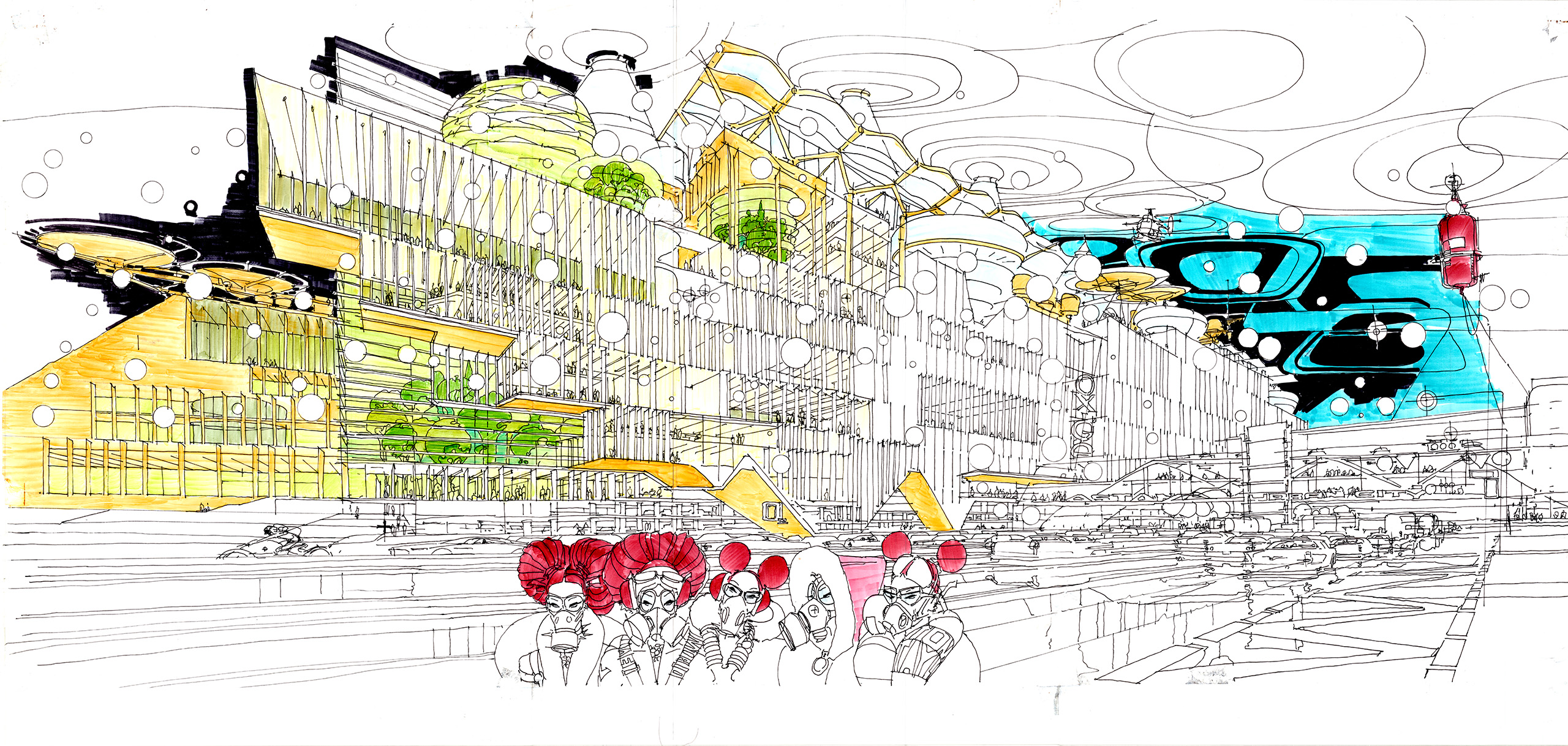
One of Volodymyr Hnatyenko's sketches
Olena Zbaratskaya, Volodymyr’s wife, writes about how he saw — literally. “This person perceives the world as if it were speaking to her in a completely different language — the language of images, and for Vova they were clear and obvious,” she recalls the moment they met. When Hnatyenko made sketches, his task was not to create beauty or harmony as such — the task was closer to creating a cover for a music album: the sketch had to “speak” the main idea and convey the character of the music with which it was filled. There was a lot of music in his life. Sometimes, instead of explanations, he gave a “task” — to listen to the music he had chosen. Hnatyenko sought answers to questions that went far beyond the boundaries of architectural practice: what should a modern “Mona Lisa” be like? How to write “The Creation of Adam” today? Why is Matisse’s “Dance” a work that needs to be rewritten anew? To the last question, Zbaratskaya answers: “I think because when you watch “Dance,” you hear music.”
"Facade composer" - that's what Hnatyenko was called back at university. His teacher Valeriy Tovbych, who has been working in architectural education for over forty years, admits that in all this time he has never met such a talent for creating facades. Five versions of one facade in different styles - from constructivism to modernism - and each of them is not a stylization, but a modern interpretation. "A significant part of architects do everything utilitarianly," writes Tovbych, "and in each of Volodya's sketches there was always an idea."
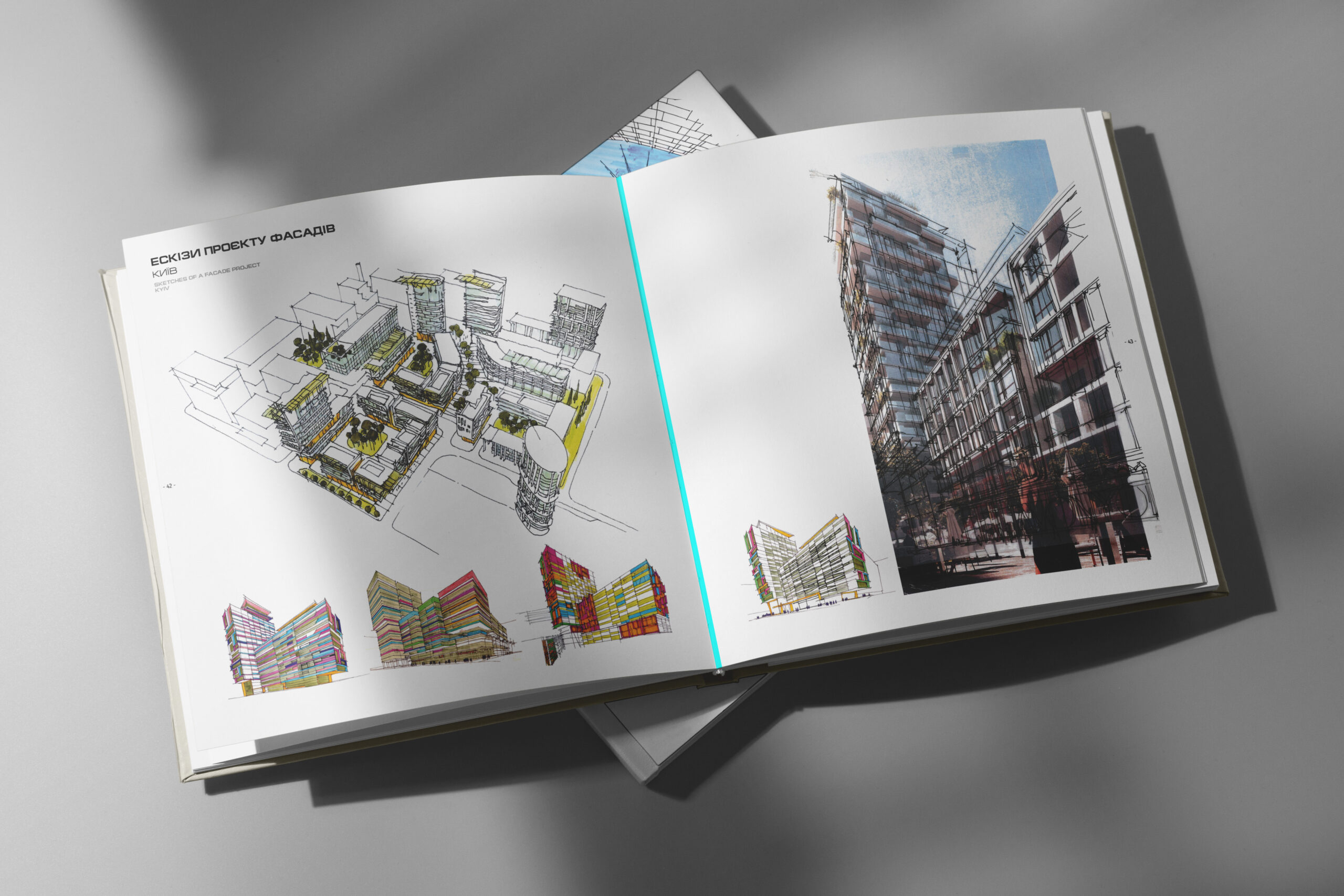
The album allows us to see Ukrainian architecture as Hnatyenko saw it: "sexual", outrageous, revolutionary - and free from conventions.
At Archimatika, Hnatyenko occupied a position that cannot be described by any standard position. He did not manage projects from start to finish, did not calculate budgets, did not adhere to schedules. He drew. And this was not a whim or a privilege - the company consciously protected him from everything that interfered with the main thing: the birth of a truly bold, free architectural image. Dmitry Vasiliev recalls: "It was impossible to let him do a comprehensive project from A to Z, because he was too romantically transforming reality. All these economic indicators, budgets, marketing, cost, construction technologies - to be honest, he was of little interest. He created his own reality as much as possible. But precisely because he did not bind himself to conventions, his decisions were the most daring." Colleagues jokingly called him “Vova the Printer”: when visualizations were needed, the quickest way was to print out the renderings and give them to him — and he would transform the technical picture into an author’s expression. He was not limited by schedules and deadlines. “We were trying to structure it all the time,” says Vasiliev, “but then we decided: let’s not touch it. If there is inspiration, that’s great. If there isn’t, that’s fine. It was unrealistic and counterproductive to force it into the framework of an architectural discipline.”
Dmytro Vasyliev: "He saw that the world should be exactly like this — with its own values, visual and ideological guidelines"
Behind Hnatyenko, there was a sense of sadness—the sadness of a person whose ideas did not fit into reality. “Vova had a holistic picture of the transformation of reality,” explains Dmitry Vasilyev. “He saw that the world should be exactly like this—with his own values, priorities, visual and ideological guidelines. The world in his vision had to contain certain moods, certain women, certain cars, certain buildings and signs.” His favorite expression was “architecture should be sexy.” A residential area where every house resembles a nail in shape. Complexes of round houses with atriums inside. White horizontals, which he called in one word: “Miami!” And every time—a gap between what he saw and what was being built. “His work was not always adapted to our economic reality,” Vasilyev admits. “In the Emirates, it would probably be wildly popular—that’s where they need such shockingness and creative self-expression the most. "They're building projects by Zaha Hadid and Frank Gehry there. That's where his talent would be best perceived."
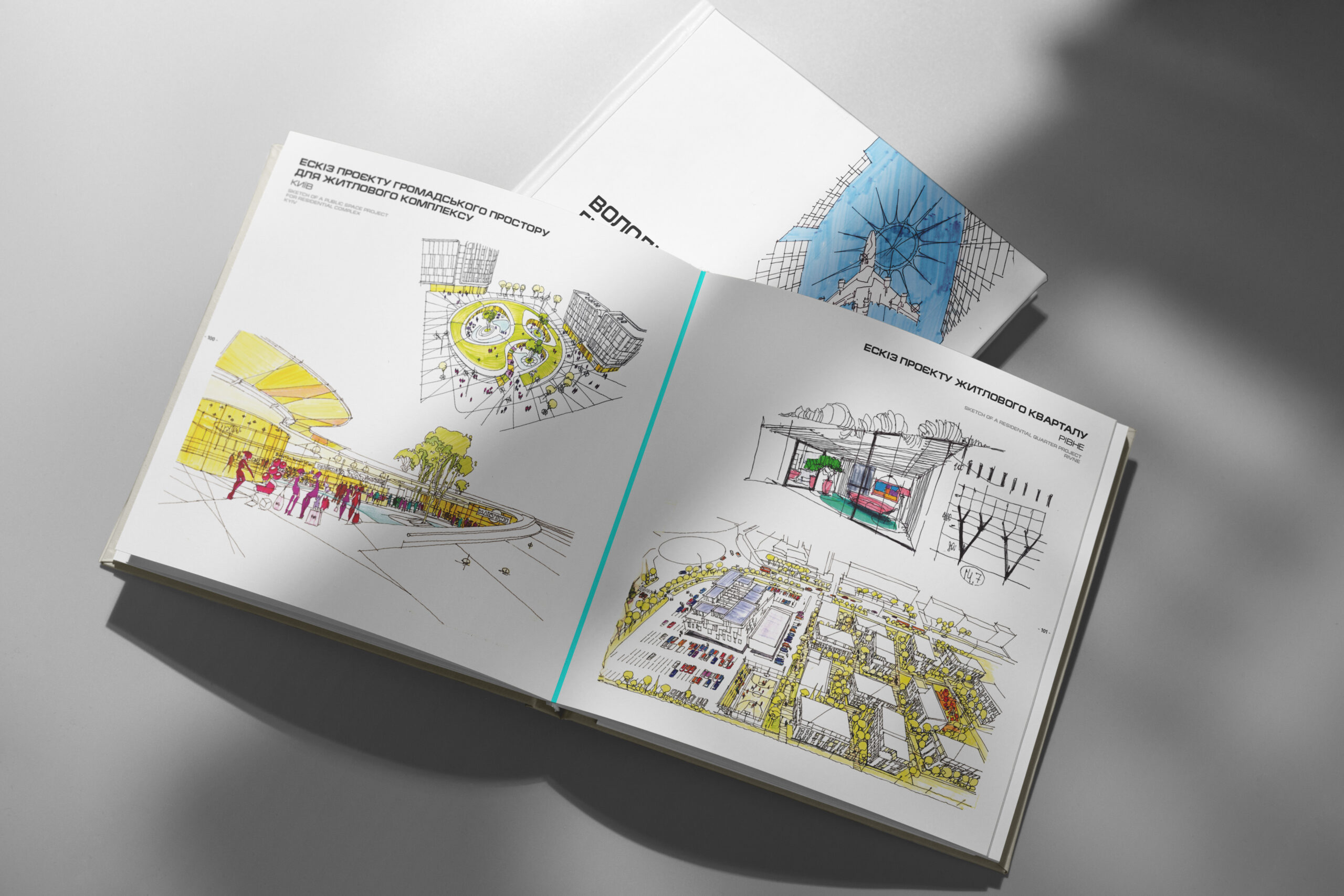
The album is evidence of a type of architectural thinking that had almost no chance of being realized in Ukraine, but it did exist.
Hnatyenko was consistent in his aesthetics not only in architecture. His friends Yuriy and Maryna Garbary recall: "Vova was unique in life as well. He was quite laconic in his clothes, but everyone he knew knew his signature shoes. He drew sketches himself, and his childhood friend, the shoemaker Mykola, made them to order: various shades of gray, blue, green, but not black. There should always be color."
In this sense, Gnatyenko stands alongside architects for whom design did not end with the facade: Zaha Hadid and Rem Koolhaas once reimagined the shape of shoes for leading global brands – but they did it as a commercial collaboration. Gnatyenko did it for himself, based on his own sketches, simply because he could not do otherwise.
Oleksandr Popov, who was the initial initiator, organizer, and investor of the book’s creation, takes the topic to another level in his final essay for the album. He calls it “the path of the albatross”: when an architect does not land in the routine of the design process, but remains at the level of a pure idea, only occasionally plunging into the “samsara of architectural development.” What Hnatyenko did, Popov puts on a par with the visionary graphics of Bulle, Piranesi, and Chernykhov — architects whose sketches became manifestos, not drawings. In his last conversation with Popov in February 2023, Hnatyenko spoke about the concept of a new Ukrainian Renaissance — that Ukrainian architecture needs its own revival, not borrowed, but grown from within. “Our problem is that we did not have a Renaissance,” he said. He did not have time to fully formulate this concept.

One of Volodymyr Hnatyenko's "selfie girls" - signature characters that he placed in a pattern on his sketches. New Year's card for Archimatika, 2018
Popov calls Hnatyenko “the main creative architect of pre-war Ukraine” and concludes the essay with the words: “It is not known how the war will end. It is not known whether the fragile sprouts of new architecture that have emerged over thirty years of independence will give rise to an independent Ukrainian architectural movement, or whether they will remain the forerunner of an unrealized dream. But, undoubtedly, they already have an originality and independent creative quality worthy of world recognition.”
The album "Volodymyr Hnatienko: Architectural Sketches" is not a memorial or an obituary. It is a testament to a type of architectural thinking that had almost no chance of being realized in Ukraine, but it did exist — brightly, uncompromisingly, with humor, and with a pencil in hand. Hundreds of sheets on which one person, over decades, drew a world worthy of being built.