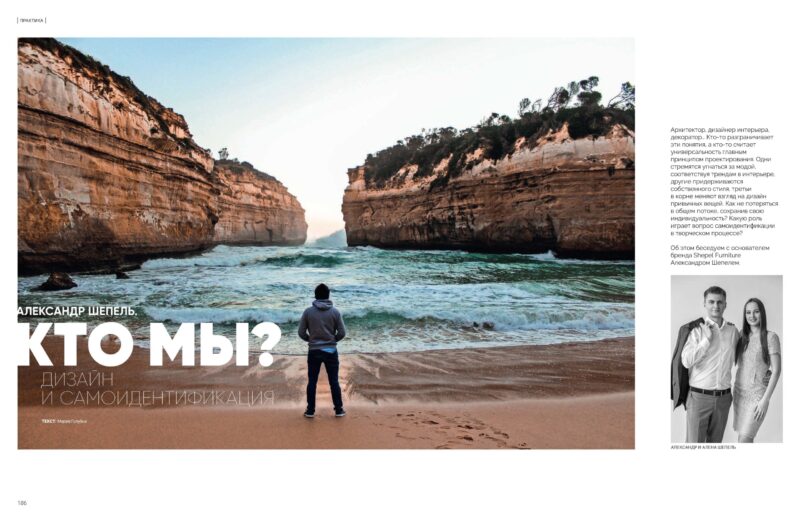
Alexander and Alena Shepel
A journey without a compass
At the end of the 1794th century, when great navigators were discovering new continents and making accurate maps, the twenty-seven-year-old Frenchman Xavier de Maistre, living on the top floor of an apartment building in Turin, who had failed in his hobby of aeronautics, became famous for traveling in his own room. And if Magellan, Drake and Cook needed spyglasses, compasses, chronometers, barometers and a lot of other devices to achieve their goals, then the only artifact of de Maestra was black and pink pajamas. The strength of the work "Journey around my room", written by Xavier in XNUMX, is that the author offers the reader a completely different philosophy of movement. De Mestre believes that the pleasure a person experiences while traveling depends only on the mood. This ironic book is a unique manifesto that opens a new perspective on the perception of familiar objects and spaces. With what delight the author describes the sophistication of the bed legs, imbued with respect for this difficult piece of furniture, expresses gratitude for the time spent with it! In his "Night Expedition to the Bedroom", Xavier de Maistre admires the beauty of the starry sky, which is observed daily from the window, as a navigator or astronaut would admire a guiding star. De Mestre convinces the reader that if he could pay attention to simple things and learn the true art of travel, open the door to another reality only through his own mind, then he would certainly get rid of apathy and make his life much more interesting. Xavier de Mestre is right in that, getting used to the objects around us, we gradually become blind, lose our sense of sharpness and taste for life.

Photo: Stephen Leonardi/Unsplash
If this crazy Frenchman had not been engrossed in flights and literary fantasies, but had lived in our days, he would surely have been an architect or an interior designer. Why? The goals of design are largely to bring new colors to familiar spaces, to revive boring objects, creating a completely different reality. But how is this possible today, when all continents in the field of design seem to have been open for a long time, when the Vitruvian triad remains unchanged, and technologies are developing so rapidly that today's know-how will be obsolete tomorrow? What can be considered an innovation in design in our "post-post-postmodern" era, when it is difficult to be unique, unique, original? "Everything was invented for us. There's no need to reinvent the wheel," the skeptical architect will say. "Let's take a trip through our own bedroom and thank each object for its mission," the romantic architect will say. Flexibility of the mind, audacity, an artist's intuition, a non-standard vision — all these qualities help to move away from patterns and stereotypes, constantly looking ahead and anticipating one's time. It is not surprising that the very word "project" comes from the Latin projectus and means "thrown forward". To create architecture, interior, furniture, decor, "threw forward", made the result of his creativity visionary, is the goal pursued by modern architectural bureaus and design studios.
Skeptic or romantic?
We have already discussed this topic with Alexander Shepel, the founder of the Ukrainian brand Shepel Furniture, who emphasized that any design is the creation of a different reality, a dream, a way of life, where each object does not appear by chance, but has a perfectly precise purpose and mission. This philosophy is the basis of the company and determines absolutely all processes related to project activities.

Photo: Gatis Marcinkevics/Unsplash
Our previous interview with Alexander began with the phrase: "I do not call myself an architect, nor a designer, in any case not a furniture maker..." Who is he? Inventor, researcher, philosopher, romantic architect or universal architect? Continuing the conversation with Alexander this time, we again turn to such an important concept as self-identification in the creative process. "First of all, we want to answer the question 'who are we?'" says Alexander Shepel, "since this is the basis for all subsequent work."
The Shepel brand is not a project workshop, not a company, not a production. This is first of all a family business, which has become a way of life for its founders, a part of the daily route, communications and thinking. Work that intersects art and refined algorithms, craft and technical skills, theoretical research and practice, reflection and constant development. Work that is a reflection of one's own view of the world and personal qualities. Shepel Furniture is part of these processes.
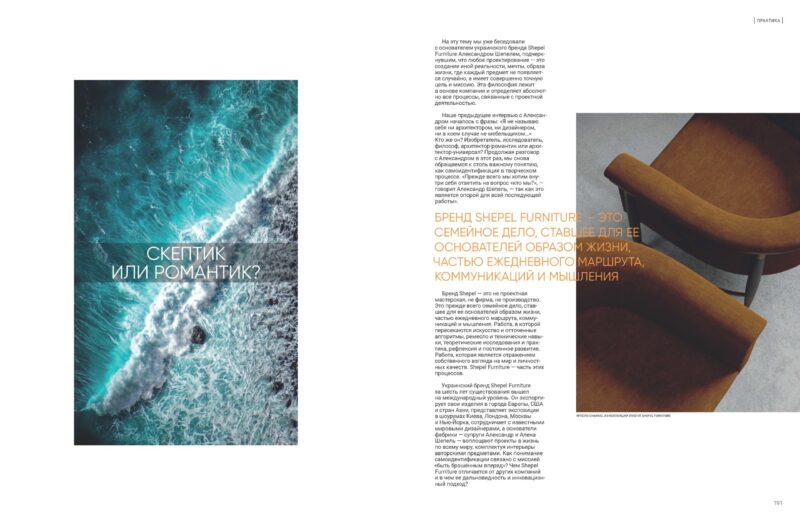
The Shepel Furniture brand is a family business that has become a way of life for its founders, a part of the daily route, communications and thinking

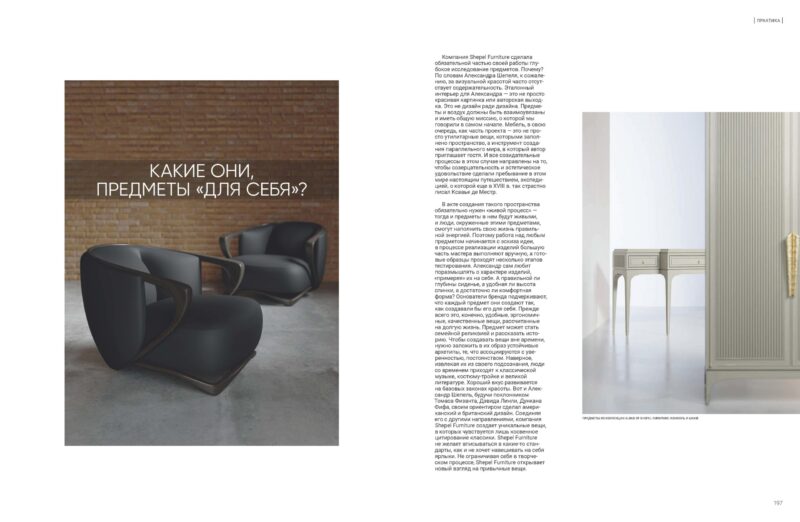
Channel chair from the Vivid collection by Shepel Furniture
The Ukrainian brand Shepel Furniture reached the international level in six years of existence. He exports his products to the cities of Europe, the USA and Asian countries, presents expositions in showrooms in Kyiv, London, Moscow and New York, collaborates with famous world designers, and the founders of the factory - the spouses Alexander and Alena Shepel - bring projects to life around the world , completing the interiors with original items. How is the understanding of self-identification related to the mission "to be thrown forward"? How does Shepel Furniture differ from other companies and what is its vision and innovative approach?
Contextual approach and universality
In the space of the Ukrainian market, the field of design is divided into many components. We speak: architect, urban planner, landscape designer, interior designer, object designer, decorator, visualizer. In the Western tradition, the division into these professions is more conditional. The word "design" in English corresponds to design — a comprehensive concept that includes all the above categories. Among our Western colleagues, the profession of an architect presupposes universality based on a contextual approach. Piero Lissona and Cino Dzucca, Hiroka Matsuura and Jean-Marie Massot postulate unity of approaches for any professional task when working on different scales. In the philosophy of these and many other modern world architects, the design of a city or a faucet for a bathroom is essentially no different, and any product is considered an integral part of the environment in which it exists. Gradually, this understanding becomes more relevant for approaches in Ukrainian design.

Photo: Dominik Jirovsky/Unsplash
The key principles that Alexander Shepel focuses on in his work are universality and the environmental approach. Having worked as an architect since the age of 15, he always dreamed of creating objects or spaces that would embody his own ideas about the dream - perfection, beauty, meaningfulness. Aleksandr always strives to build his work in such a way that his concepts of the right way of life, family values, quality living environment attract the same people, be it partners or clients. And today, thanks to such principles and previous experience, Alena and Alexander Shepel manage to combine design, realization of objects, assembly and management. Large-scale constructions with the author's support, furniture production, participation in exhibitions, master classes, workshops - all this has become part of the personal life of the company's leaders, and the degree of involvement in all processes reflects a true passion for their profession. "I like to make drawings myself when I have time," says Alexander, "I relax like that." Over the past few years, Alex (as his foreign colleagues and clients call him) has learned to live between Ukraine, Europe and America, switching between languages, time zones and types of activities.

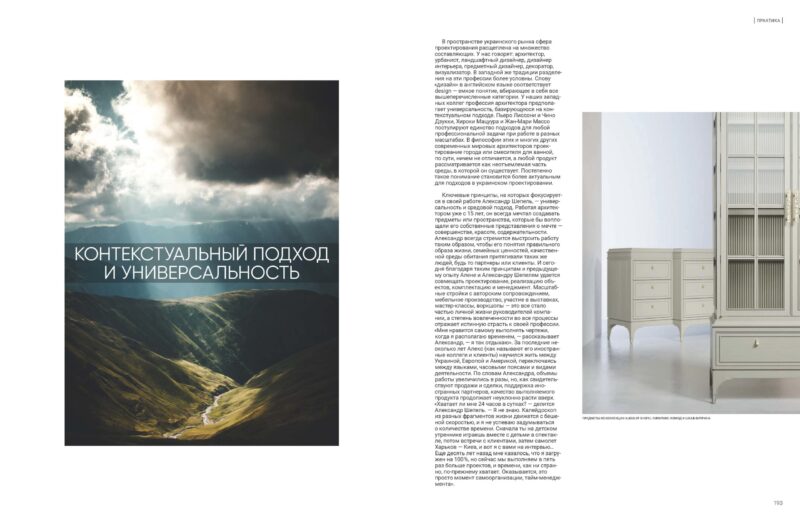
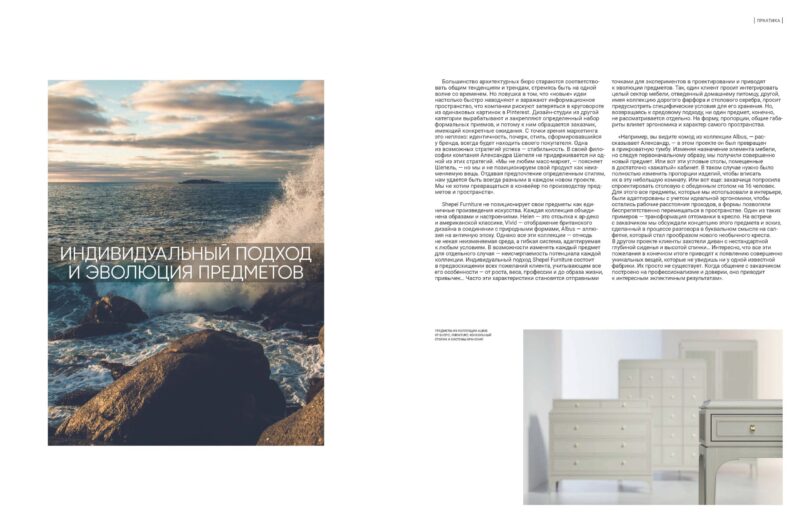
Items from the Albus collection by Shepel Furniture: a chest of drawers and a display cabinet
According to Alexander, the volume of work has increased several times, but as evidenced by sales and deals, the support of foreign partners, the quality of the finished product continues to grow steadily. "Are 24 hours a day enough for me? — shares Alexander Shepel. - I do not know. A kaleidoscope of different fragments of life moves at breakneck speed, and I don't have time to think about the amount of time. First, at the children's matinee, you play together with the children in a play, then meetings with clients, then the plane from Kharkiv to Kyiv, and here I am with you for an interview... Ten years ago, it seemed to me that I was 100% loaded, but now we are performing in five times more projects, and strangely enough, there is still enough time. It turns out that this is simply a moment of self-organization, time management."
How did it all begin?
The birth of furniture production for the spouses Alena and Alexander was not some spontaneous decision. The Shepel Furniture brand did not arise by itself. The "law" that exists for all architects and voiced by our guest speaks of its appearance: "It is impossible to escape from architecture." Designing interior items has always been part of the professional process for Shepel, and over the past 10 years, a huge amount of work has been done in this direction. The ideas seemed interesting, and the fact that many professionals of a different level and scale responded positively to them guided the founders of the company. Alexander recalls one of the inspiring cases: "Once, a few years ago, I had the chance to meet Jean-Louis Deniot. I remember we talked for about ten minutes. But on the other hand, ten minutes! This is an incredible amount actually. I shared my sketches and works with him, he appreciated them very highly and even joked: "Where are my 30 years?"

Photo: Kevin Ianeselli/Unsplash
At some point, a real breakthrough just happened, and skills, knowledge, experience simply needed a physical outlet. At a certain stage, Alexander and Alena began to pay more and more attention to the furniture sector, which is how the need arose to open their own production. "At first, we thought that as soon as we focused on furniture production, construction would take a back seat and perhaps we would abandon architectural and interior design, but it turned out to be exactly the opposite," says Alexander Shepel, "and this played into our hands. Previously, we lacked individuality in the finished products of even well-known factories, and trust in the transfer of our own developments to contractors. It is impossible to carry out quality control and intervene in all processes when you do not understand, in general, who is involved in them. Now, when we carefully approach the selection of employees, form a real team of professionals, it has become easier. After all, we want to be sure of the result, because we are ultimately responsible."
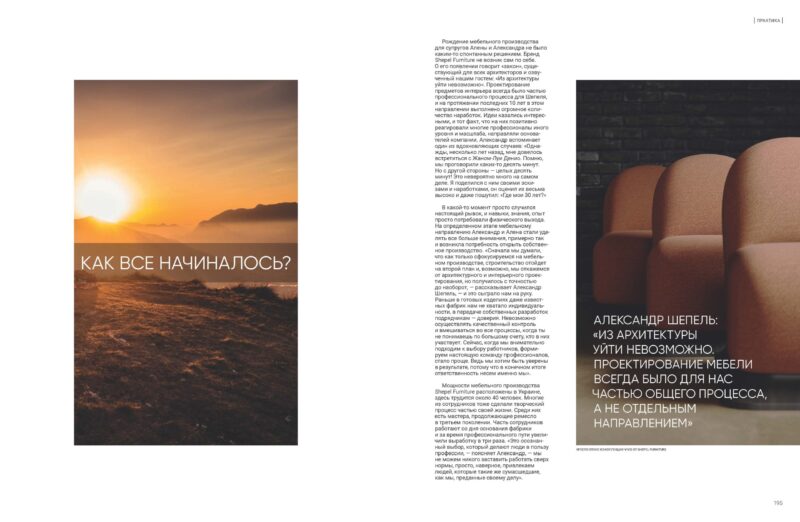
"It is impossible to escape from architecture. For us, furniture design has always been a part of the overall process, not a separate direction."

Stone armchair from the Vivid collection by Shepel Furniture
Shepel Furniture's furniture production facilities are located in Ukraine, about 40 people work here. Many of the employees also made the creative process a part of their lives. Among them there are masters who continue the craft in the third generation. Some of the employees have been working since the day the factory was founded, and during their professional career they have increased production three times. "This is a conscious choice that people make in favor of the profession," explains Alexander, "we can't force anyone to work beyond the norm, we just probably attract people who are as crazy as we are, dedicated to our work."
What are they, items "for yourself"?
The Shepel Furniture company has made in-depth research of objects a mandatory part of its work. Why? According to Alexander Shepel, unfortunately, visual beauty often lacks content. A reference interior for Alexander is not just a beautiful picture or an author's trick. This is not design for design's sake. Objects and air must be interconnected and have a common mission, which we talked about at the very beginning. Furniture, in turn, as a part of the project, is not just utilitarian things that fill the space, but a tool for creating a parallel world into which the author invites the guest. And all creative processes in this case are aimed at making contemplation and aesthetic pleasure a real journey in this world, an expedition, which was already mentioned in the XNUMXth century. so passionately wrote Xavier de Mestre.

Armchair from the Vivid collection by Shepel Furniture
In the act of creating such a space, a "living process" is necessarily necessary - then the objects in it will be alive, and people surrounded by these objects will be able to fill their lives with the right energy. Therefore, work on any subject begins with a sketch of the idea, in the process of implementing the products, most of the work is done by hand, and the finished samples go through several stages of testing. Alexander himself likes to think about the nature of the products, "trying" them on himself. Is the depth of the seat correct, and is the height of the back comfortable, and is the shape comfortable enough? The founders of the brand emphasize that they create each item as they would create it for themselves. First of all, these are, of course, comfortable, ergonomic, high-quality things designed for a long life. The item can become a family heirloom and tell a story.

Items from the Albus collection by Shepel Furniture: a console and a cabinet
In order to create things out of time, it is necessary to put stable archetypes in their image, things that are associated with confidence and constancy. Probably, by extracting them from their subconscious, people eventually come to classical music, three-piece suit and great literature. Good taste develops on the basic laws of beauty. Alexander Shepel, being a fan of Thomas Pheasant, David Lynla, and Duncan Fife, made American and British design his guide. By combining it with other directions, the Shepel Furniture company creates unique things in which one feels only an indirect citation of the classics. Shepel Furniture does not want to fit into any standards, just as it does not want to label itself. Without limiting itself in the creative process, Shepel Furniture opens a new look at familiar things.
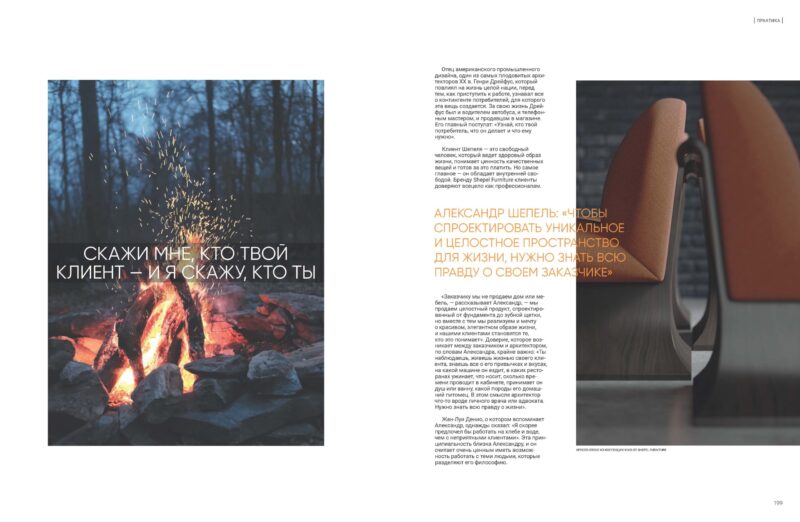
Tell me who your client is, and I'll tell you who you are
The father of American industrial design, one of the most prolific architects of the XNUMXth century. Henry Dreyfus, who influenced the life of the whole nation, before starting work, learned everything about the contingent of consumers for whom this thing is created. During his life, Dreyfus was a bus driver, a telephone operator, and a salesman in a store. His main postulate: "Find out who your customer is, what he does and what he needs."

Photo: Timothy Meinberg/Unsplash
Shepel's client is a free man who leads a healthy lifestyle, understands the value of quality things and is ready to pay for it. But the most important thing is that he has inner freedom. The Shepel Furniture brand is completely trusted by clients as professionals.
"We do not sell the customer a house or furniture," says Alexander, "we sell a complete product, designed from the foundation to the toothbrush, but at the same time we realize the dream of a beautiful, elegant way of life, and those who understand this become our customers ". According to Alexander, the trust that arises between the customer and the architect is extremely important: "You observe, you live the life of your client, you know everything about his habits and tastes, what car he drives, what restaurants he eats at, what he wears, how much time he spends in the office, he takes a shower or a bath, what breed is his pet. In this sense, an architect is something like a personal doctor or lawyer. You need to know the whole truth about life."
"To design a unique and integral space for life, you need to know the whole truth about your customer"

Stone armchair from the Vivid collection by Shepel Furniture
Jean-Louis Deniot, whom Alexander recalls, once said: "I would rather work on bread and water than with unpleasant customers." This principle is close to Alexander, and he considers it very valuable to have the opportunity to work with people who share his philosophy.
Individual approach and evolution of subjects
Most architectural bureaus try to comply with general tendencies and trends, striving to be on the same wave with the times. But the trap is that "new" ideas so quickly flood and infect the information space that companies risk getting lost in the circle of identical images on Pinterest. Design studios from the second category develop and establish a certain set of formal techniques, and therefore a customer with specific expectations turns to them. From the point of view of marketing, this is not bad: the identity, handwriting, style formed by the brand will always find its buyer. One of the possible strategies for success is stability. In its philosophy, Alexander Shepel's company does not adhere to any of these strategies. "We don't like the mass market," explains Shepel, "but we don't position our product as an unchangeable thing." Giving preference to certain styles, we manage to be always different in each new project. We don't want to turn into a conveyor belt for the production of objects and spaces."

Photo: Dan Stark/Unsplash
Shepel Furniture does not position its items as individual works of art. Each collection is united by images and moods. Helen is a reference to art deco and American classics, Vivid is a reflection of British design combined with natural forms, Albus is an allusion to the ancient era. However, all these collections are by no means an unchanging environment, but a flexible system that can be adapted to any conditions. It is possible to change each item for a separate occasion — the inexhaustibility of the potential of each collection. The individual approach of Shepel Furniture consists in anticipating all the wishes of the client, taking into account all his features - from height, weight, profession to lifestyle, habits... Often these characteristics become the starting point for experiments in design and lead to the evolution of objects. So, one client asks to integrate a whole sector of furniture dedicated to a pet, the other, having a collection of expensive porcelain and table silver, asks to provide specific conditions for its storage. But, returning to the middle approach, not a single subject, of course, is considered separately. The shape, proportions, and overall dimensions are influenced by ergonomics and the nature of the space itself.

Items from the Albus collection from Shepel Furniture: console table and storage systems
"For example, you see a chest of drawers from the Albus collection," says Alexander, "in this project, it was turned into a bedside table. Changing the purpose of the furniture element, but following the original image, we got a completely new item. Or here are these corner tables, placed in a rather "crammed" office. In this case, it was necessary to completely change the proportions of the products in order to fit them into this small room. Or here's another: the customer asked to design a dining room with a dining table for 16 people. For this purpose, all items that we used in the interior were adapted taking into account ideal ergonomics, so that the working distances of the aisles remained, and the forms allowed to move freely in space. One such example is the transformation of an ottoman into an armchair. At the meeting with the customer, we discussed the concept of this item and a sketch made during the conversation literally on a napkin, which became the prototype of a new unusual chair. In the second project, the clients wanted a sofa with a non-standard seat depth and back height... It is interesting that all these wishes ultimately lead to the appearance of completely unique things that you will not see in any well-known factory. They simply do not exist. When communication with the customer is built on professionalism and trust, it leads to interesting eclectic results."
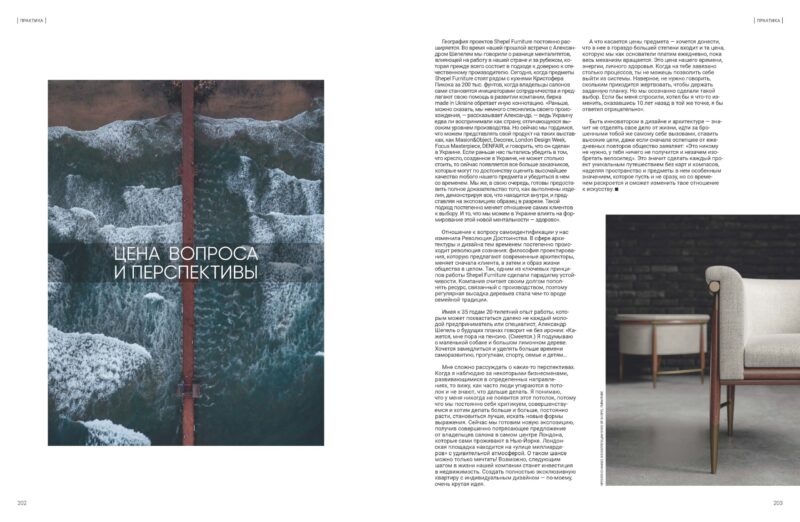
The price of the question and prospects
The geography of Shepel Furniture projects is constantly expanding. During our last meeting with Alexander Shepel, we talked about the difference in mentalities affecting the work in our country and abroad, which primarily consists in the approach to trusting the domestic manufacturer. Today, when Shepel Furniture items stand next to Christopher Peacock's kitchens for 200 pounds, when salon owners themselves become the initiators of cooperation and offer their help in the development of the company, the tag made in Ukraine acquires a different connotation. "Earlier, you can say, we were a little shy about our origin," says Alexander, "because Ukraine was hardly perceived as a country with a high level of production. But now we are proud that we can present our product at such exhibitions as Masion&Object, Decorex, London Design Week, Focus Masterpiece, DENFAIR, and say that it is made in Ukraine. If earlier we were asked to convince that an armchair made in Ukraine cannot cost so much, now more and more customers are appearing who can appreciate the highest quality of any of our items and be convinced of it over time. We, in turn, are ready to provide full proof of how the products are made, demonstrating everything that is inside, and presenting a sample in section at exhibitions. Such an approach gradually changes the attitude of the clients themselves towards the choice. And the fact that we can influence the formation of this new mentality in Ukraine is great."

Photo: Matt Howard/Unsplash
The Revolution of Dignity has changed our attitude to the issue of self-identification. In the field of architecture and design, meanwhile, a revolution of consciousness is gradually taking place: the design philosophy offered by modern architects changes first the client, and then the way of life of society as a whole. Thus, one of the key principles of Shepel Furniture's work was the paradigm of sustainability. The company considers it its duty to replenish the resources associated with production, so regular tree planting has become something like a family tradition.
Having 35 years of work experience by the age of 20, which not every young entrepreneur or specialist can boast about, Alexander Shepel speaks ironically about his future plans: "It seems like it's time for me to retire. (Laughs.) I'm thinking about a small dog and a big lemon tree. I would like to slow down and devote more time to self-development, walks, sports, family and children...
It is difficult for me to discuss any prospects. When I watch some businessmen developing in certain directions, I see how often people lean against the ceiling and don't know what to do next. I understand that I will never have this ceiling, because we constantly criticize ourselves, improve and want to do more and more, constantly grow, become better, look for new forms of expression. Now we are preparing a new exhibition, we received an absolutely amazing offer from the owners of the salon in the very center of London, who themselves live in New York. London Square is located on the "Street of Billionaires" with an amazing atmosphere. One can only dream of such a chance! Perhaps the next step in the life of our company will be investment in real estate. To create a completely exclusive apartment with an individual design is, in my opinion, a very cool idea.

Channel chair from the Vivid collection by Shepel Furniture
And as for the price of the object, I would like to convey that it includes to a much greater extent the price that we, as founders, pay daily while the whole mechanism rotates. This is the price of our time, energy, and personal health. When you have so many processes tied to you, you can't afford to log out. Probably, there is no need to say how much one has to sacrifice in order to maintain a given bar. But we consciously made such a choice. If I were asked if I would like to change something, being at the same point 10 years ago, I would answer negatively."
To be an innovator in design and architecture means not to separate your work from life, to follow the challenges you have thrown yourself, to set high goals, even if at first the society, blinded by daily repetitions, declares: "No one needs this, you will not succeed and there is no need to invent the bicycle." This means making each project a unique journey without maps and compasses, giving the space and objects in it a special meaning, which, even if not immediately, will unfold over time and can change your attitude to art.
/The material is published on the pages #30 of volume PRAGMATIKA.MEDIA/